• Please note that there are a few updates and clarifications made in the Audiokarma Rules, mostly relating to advertising and the addition of the new "Paying it Forward" & "Giving back" forums in the AudioKarma Audio Marketplace section.

Pre-Outs, Main In uses... or the Tape Out

Indeed, but the critical distinction is that's all about "real" biamping. You may know that but not all do. Essentially nothing described there applies to passive biamp.
If, by passive biamping, you mean that each amp channel of the biamp installation is receiving the full bandwidth signal as an input and depending upon the speakers crossover to shape the signal fed to the driver (i.e. woofer vs tweeter), then I would respond that that arrangement gains the listener absolutely nothing in the way of increased output, or cleaner sound, or lower distortion.

If you go through Elliot's explanation of biamping, and why it is sometimes helpful, you will come across the section where he shows a graphic of a high frequency wave form riding on top of a low frequency one, thereby boosting the total voltage of the signal. It is that elevated voltage that will drive the amp into clipping and distortion. Doing "passive biamping" keeps that situation intact, with the potential to drive both amps into clipping. Without the active crossover in place between the preamp and the 2 power amps, biamping just gets more heat into the room, higher electric bills, and possibly more heat dissipated in the speaker's crossover (I need to analyze some more to be sure of that statement).

I would recommend that anyone considering biamping without a crossover between the preamp and the power amps, to just drop that arrangement from their consideration, unless they are willing to add such a crossover at a later date

Shelly_D
 
If, by passive biamping, you mean that each amp channel of the biamp installation is receiving the full bandwidth signal as an input and depending upon the speakers crossover to shape the signal fed to the driver (i.e. woofer vs tweeter), then I would respond that that arrangement gains the listener absolutely nothing in the way of increased output, or cleaner sound, or lower distortion.
Yes, that's what I meant since there isn't really a good way to describe it otherwise, without using a very dismissive term for it.

(And agree the info about biamping on ESP site does not apply.)
 
Last edited:
If, by passive biamping, you mean that each amp channel of the biamp installation is receiving the full bandwidth signal as an input and depending upon the speakers crossover to shape the signal fed to the driver (i.e. woofer vs tweeter), then I would respond that that arrangement gains the listener absolutely nothing in the way of increased output, or cleaner sound, or lower distortion.

If you go through Elliot's explanation of biamping, and why it is sometimes helpful, you will come across the section where he shows a graphic of a high frequency wave form riding on top of a low frequency one, thereby boosting the total voltage of the signal. It is that elevated voltage that will drive the amp into clipping and distortion. Doing "passive biamping" keeps that situation intact, with the potential to drive both amps into clipping. Without the active crossover in place between the preamp and the 2 power amps, biamping just gets more heat into the room, higher electric bills, and possibly more heat dissipated in the speaker's crossover (I need to analyze some more to be sure of that statement).

I would recommend that anyone considering biamping without a crossover between the preamp and the power amps, to just drop that arrangement from their consideration, unless they are willing to add such a crossover at a later date

Shelly_D

In addition to reading the Elliot articles posted, I read a little more about biwiring and one YouTuber states it does nothing because the signal still reaches the crossover in the speaker. I have to admit only a loose understanding of the articles and now I'm still more confused about the biwiring since watching the video.

I decided to try the Sony with the Pre-out, but the video made me hold off. I was going to go from the Pre-Out on the Sony to a little Tube03 preamp, then to the monoblocks and then to speakers. I was going to bi-wire from the monoblocks to the speaker. But I think now I might just standard wire the speakers. I'll swap out my present speakers with the ones that can be bi-wired some time down the road.

 
Lets see if I can help you understand bi-wireing a bit more. To understand this what you need to understand first is the nature of the crossover. I'm going to restrict this to a simple 2 way speaker, a woofer and a tweeter.

In this example, the crossover has 2 parts. One part (network) attaches to the woofer and the other to the tweeter. Each of these parts is called a filter. The job is to let some frequencies get through to the speaker and to attenuate (or filter) the rest. The job of the tweeters filter is to let highs get through and keep out the lows. We call that a high pass filter, because it lets the highs pass through but keeps out the lows. The job of the filter for the woofer is pass through the lows but keep the highs out. That is called a low pass filter.

On the back of the speaker, when it is configured for just one set of leads, the w wires attach to the terminals on the outside of the box. Once inside the box, the music must eventually reach both speakers. Since the crossover is needed, the music first goes from the inside of the terminals to the 2 filters, then on to the speakers. In order to do that there needs to be wire running from the inside terminal of the speaker to each of the network (filters) of the crossover. Hence there are 4 wires coming off the inside of the terminal, 2 to the woofers filter and another 2 to the tweeters filter.

In standard mode, there are 2 wires from the amp to the speaker terminals and then behind the terminal it splits out in 2 directions, one to the woofer network and one to tweeter network. All that bi-wireing does is move the point where that split happens from behind the speaker terminals back to the amp terminals.

By the way, I am not impressed with that video's explanation of bi-wireing as he does not explain the internals of the speaker in a clear enough manner to allow a begineer to properly understand the finer points of what is happening.

Shelly_D
 
Thanks @shelly_d !

So the thing that got me thinking about this is my simple understanding, or maybe misunderstanding, of power. My fleawatt Fisher 170 sounds great with my Polk speakers from the late 90's. I usually listen to either vinyl or music from my PC. I've always interpreted the way others talk about power as more is better. That may or may not be true, I don't know. But as part of this hobby of ours and wanting to become more informed about power and other dark arts like biamping, I started thinking what I might be able to experiment with on a limited budget to test some of those things using receivers I've collected over the years.

I first wanted to see if there was a way to use the Fisher 170 along with monoblocks to increase the power, but it seems that the tape out is the only way to go with that receiver. In that situation I'd need to put a preamp with volume control after the tape out and before the monoblocks. I think. The Polks only have two poles so I'd merely be boosting the power within the system as it now stands. That was the first baby step, I thought, yet maybe not as simple as I expected.

The second step after seeing if there was an improvement in sound would be remove the two pole Polks, replace them with a four pole set of Polks I have, and to bi-wire them from the two monos. Same situation as above - out from the tape outs in the Fisher, to a preamp, monos, and then bi-wired to the newer Polks. Evaluate again...

Improvement would lead me to take out the Fisher and replace it with the Sony with the PreOuts and Main ins. This seems to be the more preferred method given the limitations of the tape outs. Here, the only change would be the receiver. Evaluate again.

I don't think bi-amping is in my budget, but when I initially read about bi-wiring it seemed an interesting idea to try as an alternative. Does the above seem to be a reasonable course of investigation?
 
@shelly_d , you said -

"I would recommend that anyone considering biamping without a crossover between the preamp and the power amps, to just drop that arrangement from their consideration, unless they are willing to add such a crossover at a later date."

Is this the kind of thing you're talking about? I watched this video some time ago and follow him occasionally.
 
I first wanted to see if there was a way to use the Fisher 170 along with monoblocks to increase the power, but it seems that the tape out is the only way to go with that receiver.

Tape out is not the only way it can be done.

You could, and some people have/do use the headphone output to get a lower level volume controlled signal.

Or, you could use a speaker level to line level converter to get a volume conrolled lower level output. Such as this one from SVS: speaker to line converter That's a "premium" version, there are lower cost ones that do effectually the same thing.
 
@shelly_d , you said -

"I would recommend that anyone considering biamping without a crossover between the preamp and the power amps, to just drop that arrangement from their consideration, unless they are willing to add such a crossover at a later date."

Is this the kind of thing you're talking about? I watched this video some time ago and follow him occasionally.
I have seen quite a few of this guys videos and I have some doubts about some of the things he talks about but there are other things that he is dead on about. When he is talking about music spectrum, as he is doing here, he is absolutely correct. The reason that video is basically true, and that Bi-Amping is a thing and is worth doing, stems from the same reason. We get into a bit of music and sound science here so please tighten your seat belt and hang on.

Much of what we know about how we hear comes from the work that Alexander Graham Bell did working with deaf children. It was later expanded upon by lots of other researchers whos names I ether forgot or never know. The body of research has learned that the total amount of energy in spread of the frequency spectrum in a non-linear manner. There is more power contained in the low frequencies and more intelligence, more clarity and understandability (remember that Bell also invented the telephone where being able to understand the person on the other end of the line was kind of important) in the high frequencies. This is the fundamental reason that biamping does some good (when it is done with an active crossover between pre and power amps) and why that video is talking about screening out the very lowest octave of music when running speakers with small woofers. The diagram from the articles I linked to earlier may help here.
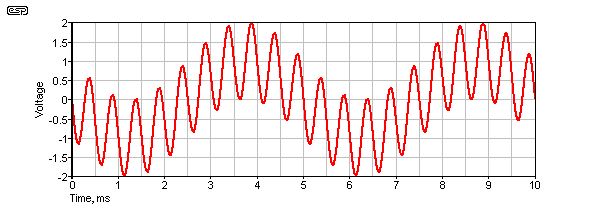
biamp-f3a.gif

What this is showing is a high frequency signal being lifted and sunk by being superimposed on a low frequency one. The red shows the high frequency signal very rapidity transitioning between peak and valley, however as you trace from 0 to 10 on the graph, you can see the entire wave first depressed, then lifted, then that cycle repeats. The depression and lifting is the low frequency signal at work. What this looks like to me (it has been a very long time since I read the article) is 2 signals, both signals the low and the high have the same peak voltages, that is they are 2 volts peak to peak. That is they both oscillate between plus 1 volt and minus 1 volt. However they are combining into one complex signal. So even though neither is getting higher then plus 1 or lower then minus 1 you get a combined peaks of plus and minus 2 volts. This is kind of mid blowing the first time you are introduced to it so please take some time to understand what is going on in this graph.

Now that I have completely confused the issue, here is how it relates to amplifier power and frequency spectrum. Lets pretend that the signal in the graph is your music coming into your system off the record. With a simple system, an amp and 2 speakers, the one amp must act upon the entire spectrum and will see that combined signal that peaks at plus and minus 2 volts and tries to amplify that. If the volume is not too loud, it will do it just fine. Turn it up and the amp will reach it's limits and start to distort, because that plus and minus 2 volt signal, driven by the dumb electronics in the amp wants to be output to the speakers at say plus and minus 16 volts. If your amp is is only capable of say 12 volts, it sill simply peg at 12 volts until the input signal drops from the 2 volt maximum back down to (in this case) 1.5 volts. Then the distortion stops and the output again follows the input.

Music is of course much more complex then this but using this can illustrate the technics that the video is talking about and what active biamping can do that biwireing and passive biamping cannot. Remember that more energy (you can think power her as well) resides in the low frequencies. What the video is talking about is removing the very lowest frequencies from the signal before it go to the amp. When he says the lowest octave he means the frequencies from 20 Hz to 40 Hz. By removing them before they get into the amp, some of that slow rise and fall that you see in the graph is eliminated. This eases the burden on the amp and also reduces how far the woofer speaker must move to reproduce the signal. Reducing that large movement at the woofer, allows for some of the higher frequency signal in say the 2nd or 3rd octave to be reproduced by the speaker. Now we come to why active biamping works to improve things. With active biamping, after going through the preamp the signal gets divided into highs and lows. In the case of our graph signal that slow plus and minus 1 volt signal is sent to the low frequency amp, and the plus and minus high frequency signal is sent to the high frequency amp. So now each amp is seeing only plus and minus 1 volt instead of 2 volts. At the same volume level, instead of wanting to put out 16 volts, the demand is now only 8 volts from each amp, well within the capability of the 12 volts the amp is capable of. Therefore, no distortion since the output is not pegging as it did before (btw that is called clipping).

Man this is getting long winded. I can go on and on, can't I. Sorry about that.

Now, why I think bi-wiring and passive bi-amping do not give the benefits we are talking about here.

Bi-wiring: If you were able to understand my explanation of bi-wiring above, then it is obvious that there is no signal separation on the wires and all of the signal is delivered to the speaker terminals. The filter networks in the crossover in the speaker screen out the frequencies each speaker needs to have removed (lows removed from the tweeter and highs removed from the woofer) and what is left is sent the speaker. On the music's path through the amplifier, the amp is seeing all of the music, from lowest to highest frequency, and therefore it is carrying the full burden of the music. I see no benefit here from either the point of view of the amp, nor of the speaker.

Passive Bi-amping: When doing this, without separating the lows and highs out between the 2 amps, each amp is getting that full signal. In the case of our example both amps are seeing the plus and minus 2 volt signal, not the plus and minus 1 volt signal that the active bi-amping arrangement produced. If you want to drive you output up to the same level we were talking about (wanting 16 volt output) then both amps will want to output 16 volts. If both are only capable of 12 volts, then both will peg (clip) at 12 volts output until the input drops far enough to bring down the demand. I do not see the benefit of driving either one or both amps into clipping in such a setup.

I went through this very long winded lecture (sorry about that) so that if you understand wat is going on here you can make a few decisions on what you want to do for yourself.

As far as using tape in and out for something like this, the only benefit you can get from that amp would be the use of the Phono Preamp. Since you do use a phonograph (yes I am THAT old) that is something to take into consideration. What that arrangement gives you is input switching and the phone preamp, but no other functionality.

I hope this is 1, not to hard to understand, and 2, not insulting you by assuming lack of knowledge that do have.

Good Luck

Shelly_D
 
Passive bi-amping can sound great. You don’t need Monoblocks (they are nice for good stereo separation, but a dual mono amp is more or less the same there).

You need a power amp of similar or higher power, an inexpensive passive preamp or tube buffer (these are optional or necessary depending on how well matched the new power amp is with your Sony receiver) and a pair of splitter cables

You put the single end of each splitter cable into the Sony’s Preamp Out, and one of the other ends goes back into the Sony’s Main In (keep track of what is R and L!), and the other goes to the new power amp’s Line In.

I would use the new amp for the bass input of your bi-amped speakers, and the Sony for the high input. If the bass is too loud in the mix you need a passive preamp or tube buffer to balance the sound.

Many people say it is a waste of time, but if you have the itch and want to hear if a new power amp sounds better than your Sony, go for it!

If you don’t like the passive bi-amp setup, then you can figure out if you like the power amp better, to power your speakers, instead of the Sony amp stage, and just power the speakers in a normal stereo setup.
 
Back
Top Bottom
