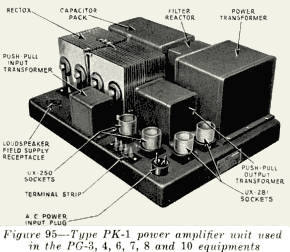
Yes that amp is for driving a stage speaker. The large dry rectifiers (like selinium rectifiers, although I think they are copper oxide) are for powering the field-coil magnet on the speaker. The amp is just one stage of push-pull using 2 type 50 tubes, which were almost obsolete by 1929. Transformer input, transformer output, no other parts in the signal path. You would need a preamp to feed a signal to this, and I would be very sceptical of it making hifi sound. It is a no feedback design, and I would suspect distortion in the range of 2% to 5%..which would be considered good at that time. The early motion picture soundtracks were fairly limited in frequency range. Very little filtration in the B+ supply because big electrolytic capacitors did not exist then. The design relied on the poor bass frequency response of the speaker for minimizing hum. There is at least one choke. Tube filaments are AC. The 50 is a directly heated triode, very hard to drive..but was one of the most powerful audio triodes available at that time, before the 300b. The only way to get more power then was to use transmitting triodes, which Western Electric did in some commercial amps. I am estimating your amp puts out about 10 Watts. It is a giant chassis.
We need photos please.
RCA came out with a competing theatre sound system to the Western Electric system, and they both existed side-by-side for several decades. RCA developed the variable-area sound recording system for movies, and Western Electric used the variable density system. Of course your amp is for playback..but just a little history on the systems.