

-
Feeling lucky? Check out the AK 24th Anniversary Giveaway thread and join in the fun!
You are using an out of date browser. It may not display this or other websites correctly.
You should upgrade or use an alternative browser.
You should upgrade or use an alternative browser.
Receivers or Tuners with Separate Tuning Dials for AM and FM
- Thread starter GyroTuner
- Start date


Register to hide this ad

A relic from the early days of stereo broadcasting whereby one channel (L or R) was broadcast over an AM station and the other channel on FM. Each station would need to be tuned independently thus the need for separate dials for each band and the selector would be set to "FM-AM STEREO".
Since there would be listeners who would only be listening on either AM or FM-only equipment, stereo separation was intentionally limited or they would lose "half" of the material. This is on top of the disparity of SQ between AM and FM transmissions between the two channels. For these reasons this scheme was very short lived, therefore there are very few tuners/receivers with independent tuning provisions for each band.
It should be pointed out however that only the FIsher and Scott units have the "FM-AM STEREO" circuitry enabling both bands to be played through the left & right sections of the tuner output. The Heathkit unit doesn't have this circuitry and simply permits either all-AM or all-FM (or FM stereo) listening. That's a major distinction between these models.
Since there would be listeners who would only be listening on either AM or FM-only equipment, stereo separation was intentionally limited or they would lose "half" of the material. This is on top of the disparity of SQ between AM and FM transmissions between the two channels. For these reasons this scheme was very short lived, therefore there are very few tuners/receivers with independent tuning provisions for each band.
It should be pointed out however that only the FIsher and Scott units have the "FM-AM STEREO" circuitry enabling both bands to be played through the left & right sections of the tuner output. The Heathkit unit doesn't have this circuitry and simply permits either all-AM or all-FM (or FM stereo) listening. That's a major distinction between these models.
Last edited:
yes. Lasted for a year or two centered around 1961.
My Pilot 654 (7591 outputs) has the same setup as do the same year 402 (similar, but EL84 outputs and ceramic phono) and 602 (EL84 and magnetic phono).
I would imagine pretty much any AM/FM tuner or receiver for the 1961 model year will have a similar setup, along with a lack of a FM MPX built in, but jacks provided for same.
My Pilot 654 (7591 outputs) has the same setup as do the same year 402 (similar, but EL84 outputs and ceramic phono) and 602 (EL84 and magnetic phono).
I would imagine pretty much any AM/FM tuner or receiver for the 1961 model year will have a similar setup, along with a lack of a FM MPX built in, but jacks provided for same.
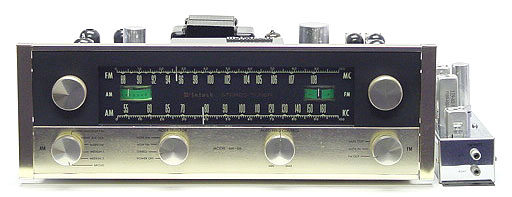

A relic from the early days of stereo broadcasting whereby one channel (L or R) was broadcast over an AM station and the other channel on FM. Each station would need to be tuned independently thus the need for separate dials for each band and the selector would be set to "FM-AM STEREO".
Since there would be listeners who would only be listening on either AM or FM equipment, stereo separation was intentionally limited or they would lose "half" of the material. This is on top of the disparity of SQ between AM and FM transmissions between the two channels. For these reasons this scheme was very short lived, therefore there are very few tuners/receivers with independent tuning provisions for each band.
It should be pointed out however that only the FIsher and Scott units have the "FM-AM STEREO" circuitry enabling both bands to be played through the left & right sections of the tuner output. The Heathkit unit doesn't have this circuitry and simply permits either all-AM or all-FM (or FM stereo) listening. That's a major difference between these models.
yes. Lasted for a year or two centered around 1961.
My Pilot 654 (7591 outputs) has the same setup as do the same year 402 (similar, but EL84 outputs and ceramic phono) and 602 (EL84 and magnetic phono).
I would imagine pretty much any AM/FM tuner or receiver for the 1961 model year will have a similar setup, along with a lack of a FM MPX built in, but jacks provided for same.
Great information, thank you both. Any pictures of the the Pilot models?

radioactive
tube gear fanatic
heres a rca
 has am,fm, am-fm, and multiplex
has am,fm, am-fm, and multiplex
mhardy6647
Lunatic Member
Separate AM and FM sections were needed in the pre-multiplex days of "AM-FM simulcast stereo". Probably more common in standalone tuners than in receivers per se -- but not an unusual thing to find albeit for only a few years. (late 1950s to very early 1960s).
The nice thing about such radios -- very good, wideband AM radio sections.
I don't have too many such tuners, but I do have a couple of Heathkits. One is a basket case. This one is interesting, in that it is new enough to have the ultimately licensed, mono-compatible MPX stereo as well as the capability to receive AM-FM stereo simulcasts.
 DSC_7320_zps0428d3fa by Mark Hardy, on Flickr
The nice thing about such radios -- very good, wideband AM radio sections.
I don't have too many such tuners, but I do have a couple of Heathkits. One is a basket case. This one is interesting, in that it is new enough to have the ultimately licensed, mono-compatible MPX stereo as well as the capability to receive AM-FM stereo simulcasts.
DSC_7320_zps0428d3fa by Mark Hardy, on FlickrGreat information, thank you both. Any pictures of the the Pilot models?
Have to search, mine is at the spa to try to get the FM tuner working acceptably.


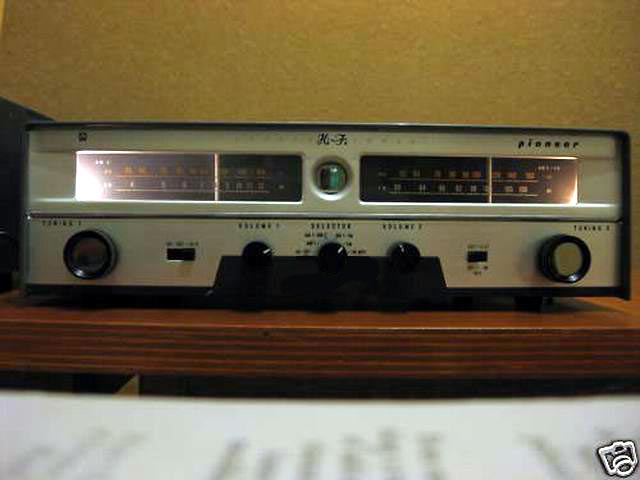
heres a rca
View attachment 1967536has am,fm, am-fm, and multiplex
The RCA Radiola Mark I is gorgeous. Had never heard of or seen one, but according to this thread it may have been just a prototype built on a Pilot 602 chassis. So probably very rare.
https://www.audioasylum.com/forums/vintage/messages/24/242246.html
Here's a picture of the Pilot 602.

I have one of these Nutone 2057 units, which was for an intercom system. Not stereo or high fidelity, but it does have separate AM and FM tuning dials. And they are circular dials (actually half circles), which are also not commonly found.

radioactive
tube gear fanatic
i saw some posts on the rca saying the same time.it looks like the one ivpostedvevolved into the rca mx7The RCA Radiola Mark I is gorgeous. Had never heard of or seen one, but according to this thread it may have been just a prototype built on a Pilot 602 chassis. So probably very rare.
https://www.audioasylum.com/forums/vintage/messages/24/242246.html
Here's a picture of the Pilot 602.
View attachment 1968074
I have one of these Nutone 2057 units, which was for an intercom system. Not stereo or high fidelity, but it does have separate AM and FM tuning dials. And they are circular dials (actually half circles), which are also not commonly found.
View attachment 1968075


Sandy G
Retired Member
Lord-A-Mercy, ain't seen one of those things in AGES..Yeah, methinks they go back to the tail end of the Eisenhower Administration, or the beginning of the JFK era...You find one now,, betcha it'll need a bit of "Going Thru" by a GOOD Toob guy..Still wouldn't mind having one, if only for the uniqueness of it all. An' face it, they are kinda KEWL lookin' w/their "Gee Mr Wizard, its 1961!" vibe.You latter day hipsters won't possibly understand....More's the pity.....
Fisher TA-600 and TA-800
Sherwood S-7000
Stromberg-Carlson SR-445
Pilot TA-590
The Stromberg-Carlson is another beauty. Apparently, according to the ad below, it combined the AM-441 and FM-443 tuners into one box with no duplicate circuitry.


I have one of these Nutone 2057 units, which was for an intercom system. Not stereo or high fidelity, but it does have separate AM and FM tuning dials. And they are circular dials (actually half circles), which are also not commonly found.
Now that you bring it up, HH Scott made quite a few different models with separate, round dials. 330A,B,C,D; 331A,B,C; and 333, 333B.

The Stromberg-Carlson is another beauty. Apparently, according to the ad below, it combined the AM-441 and FM-443 tuners into one box with no duplicate circuitry.
The earlier versions it was pretty obvious. You could see down the center where they just screwed the two chassis together.
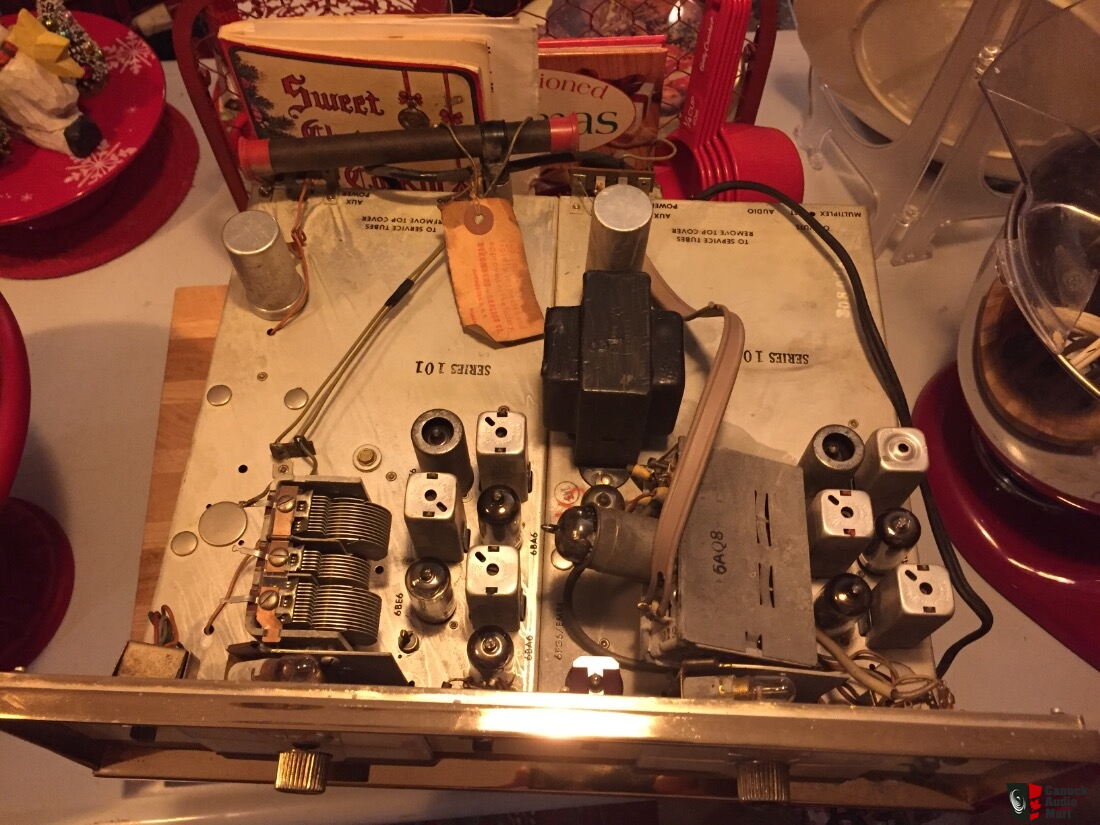
Mine is a slightly later one where it was actually one chassis.


David_NC
Super Member
I have a Pioneer with the dual tuner setup, an SM-B201. Oddly, it has a separate left and right input selectors. Not only can one listen to simulcasts, but it's possible to send the phono input to one channel and FM (or any other input) to the other channel. It's definitely an strange setup. It's got dual magic eyes, too.
