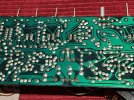
Sansui AU-717 restoration - no sound and it's FILTHY!

Jefft91

Active Member
This is a recent project I started. I've done quite a few AU-717s, but I wanted to take a different approach this time.
  1. Starting with the power supply, I de-soldered all of the wires to allow me to easily remove the board to work on it.
  2. I (almost) completely disassembled the unit in order to clean the chassis.
  3. I removed all of the boards off of the back to allow me to polish the RCA connectors without scratching up the back panel. This also facilitates complete removal of the phono/input selector board, thus avoiding strain on the ribbon connectors.
  4. While I had the back stripped, I was able to straighten out the crease (see before photos) on my woodworking bench.
  5. I decided to reflow all the solder joints on the boards. I'll explain more below, but this totally avoids finding stealth cold/cracked solder that I always have a hard time seeing. I then cleaned all the flux thoroughly when finished. I'll show photos of the defluxed boards.
Here are some before photos. Note the decades of dust and the bent back panel (in the second photo).
IMG_4538.jpgIMG_4539.jpgIMG_4541.jpgIMG_4542.jpgIMG_4543.jpgIMG_4544.jpg
 
Register to hide this ad
Here's the work on F2663 Power Supply and Protect board.

  1. Replaced all electrolytic caps, upsizing where appropriate.
  2. Removed all the glue. See the cotton balls soaked in lacquer thinner. I call this my "spa treatment". It takes years off the age.
  3. Replace D604 (VD1212) with two 1N4148 diodes in series
  4. Replace TR03,04 (2SB526) with KSA940TU as one of them tested bad.
  5. Replace about 14 corroded resistors and a few diodes that were damaged by the glue
  6. Remove and replace the speaker protect relay. I didn't have a brand new one in stock, so I used one I pulled from a system that had minimal wear on the contacts. I will get a replacement ordered as a backup.
IMG_4551.jpg Before
IMG_4552.jpg"Spa treatment
IMG_4553.jpgIMG_4557.jpgAfter repopulating.
 
I forgot to mention in the first post that before I started the restoration, I debugged the cause of no sound from the amplifier. On a dim bulb tester, I isolated the problem to the power amp section by separating the pre-amp with the switch on the back and then feeding a signal into the outputs. Both were dead. I pulled both amp modules and measured the fuse resistors. All four were completely open circuits.

I replaced all four resistors and put the modules back into the amp. Once again on the dim bulb tester I could get signal out of the two amp modules. I then switched the pre/post switch back to te connected position and was able to pass a signal from the aux input to the speakers. I also got signal through the phono inputs. All of the controls were extremely scratchy/noisy and the speaker and input selectors were intermittent. I decided at that point to do a full restoration and not mess with anything further.
 
Last edited:
Looks great! Did the lacquer thinner damage the screen printing on the board at all? Ive heard some say to use acetone too.
 
Looks great! Did the lacquer thinner damage the screen printing on the board at all? Ive heard some say to use acetone too.
The lacquer thinner I use does nothing to the printing on the board. I suggest testing any solvent on an inconspicuous area before applying it to the whole board. This does create a lot of fumes so all the caveats apply regarding ventilation, protecting yourself from inhalation, ...
 
The lacquer thinner I use does nothing to the printing on the board. I suggest testing any solvent on an inconspicuous area before applying it to the whole board. This does create a lot of fumes so all the caveats apply regarding ventilation, protecting yourself from inhalation, ...

Thanks, just wanted to be sure it didnt eat the printing or board, I have used lacquer thinner a lot in the classic automotive restoration field. I have a 719 that I will be doing a recap on... yours looks very good compared to how mine looked cleaning.
 
Moving on to F-2720 Tone control board.
  1. Replaced all electrolytic caps, upsizing where appropriate.
    1. C25 and C26 poly caps and C27-30 polarized caps in series get replaced by 47uF bipolar caps, plsaced in the holes for C25-26.
    2. C31 and C32 poly caps and C33-36 polarized caps get replaced by 2.2uF film caps. These get put into the holes for C31 and C32.
    3. C21, C22 get replaced with 10uF bipolar caps.
    4. C39-42 get replaces with 47uF/50V low ESR caps
    5. C45-46 get replaced with 10uF low leakage caps
  2. D01, D02 (VD1212) get replaced with pairs of 1N4148 diodes in series
  3. R37-40 fusible resistors get replaces with 82 Ohm metal film resistors.
  4. All switches and pots were cleaned with deoxit. They were very noisy in my audio test so I spent extra time on this step.
IMG_4561.jpgIMG_4578.jpgFront and back of board before restoration
IMG_4585.jpgBoard after replacing components

IMG_4573.jpgBack of board after reflowing all solder joints and removing flux.
 
On to F2723 Equalizer/phono board.
  1. Replaced D1-D4 with two 1N4148 in series
  2. C1,C2 replaced with 1uF film caps
  3. C5,C6 replaced with 470uF/10V low-ESR electrolytic caps
  4. C19,C20 replaced wit 10uF film caps
  5. C27-C30 back-bak pairs of electrolytic caps replaced with 4.7uF/50V film caps
  6. C31-C34 replaced with 47uF/50V low ESR electrolytics
  7. R47-R50 fusible resistor replaced with 82 Ohm metal film resistors
I plan to replace C3 and C4 when replacements arrive. As previously done, I reflowed all solder joints and cleaned the flux. I also reflowed the boards with the RCA connectors, the board with the tone pots and the board with the turnover switches.
IMG_4565.jpgBoard before replacing components and cleaning
IMG_4587.jpgBoard after replacing components

I could not find any photos of the back of the board before the reflow.

EDIT: After listening to the phono, I heard noise that needed attention. I replaced the small signal transistors in both channels with KSA992YTA for all the PNPs and KSC1845FTA for all of the NPNs. I had to orient them reversed from the originals (which were BCE, replacements ECB).
 
Last edited:
When cleanin this unit, I noticed something about the transformers didn't look right. Inspecting closely, the metal chassis is bent where the transformers attach. Both are bent, making me suspect this unit got dropped. There is no other damage except a bend in the back panel. Any other opinions? To fix it I unbolted each transformer and farefully bent the metal back into shape. In the end it looks fine, if slightly out off.
IMG_4680.jpgBefore -both transformers tilted toward the back. What happened to cause this?

IMG_4681.jpg Here you can see how the front mounting point is bent upward and the back one is pushed downward.

IMG_4682.jpgAfter straightening. It's not perfect, but much improved.
 
Last edited:
On to F2723 Equalizer/phono board.
  1. Replaced D1-D4 with two 1N4148 in series
  2. C1,C2 replaced with 1uF film caps
  3. C5,C6 replaced with 470uF/10V low-ESR electrolytic caps
  4. C19,C20 replaced wit 10uF film caps
  5. C27-C30 back-bak pairs of electrolytic caps replaced with 4.7uF/50V film caps
  6. C31-C34 replaced with 47uF/50V low ESR electrolytics
  7. R47-R50 fusible resistor replaced with 82 Ohm metal film resistors
I plan to replace C3 and C4 when replacements arrive. As previously done, I reflowed all solder joints and cleaned the flux. I also reflowed the boards with the RCA connectors, the board with the tone pots and the board with the turnover switches.
View attachment 2996428Board before replacing components and cleaning
View attachment 2996430Board after replacing components

I could not find any photos of the back of thhe board before the reflow.
Those 82Ω resistors look very 'leggy' and it doesn't look like it would take much for them to short out on each other or something else. Maybe consider putting some sleeving on the legs, or shortening them so that they are much less likely to short out?
 
en cleanin this unit, I noticed something about the transformers didn't look right. Inspecting closely, the metal chassis is bent where the transformers attach. Both are bent, making me suspect this unit got dropped. There is no other damage except a bend in the back panel. Any other opinions? To fix it I unbolted each transformer and farefully bent the metal back into shape. In the end it looks fine, if slightly out off.
View attachment 3010842Before -both transformers tilted toward the back. What happened to cause this?

View attachment 3010843 Here you can see how the front mounting point is bent upward and the back one is pushed downward.

View attachment 3010844After straightening. It's not perfect, but much improved.

They didn't mount them the best. Same thing in my buddie's AU-717. His had the transformers leaning towards the back of that circuit board to the left which was nearly making contact. Second pic is after putting them back close to the correct position.
I think this happened when it was shipped as they get banged around and dropped, etc. Flimsy transformer mounts.

IMG_20201003_110504714.jpg

IMG_20201003_113251259.jpg
 
Last edited:
Those 82Ω resistors look very 'leggy' and it doesn't look like it would take much for them to short out on each other or something else. Maybe consider putting some sleeving on the legs, or shortening them so that they are much less likely to short out?
@Hyperion - thanks for catching that. Although the closest legs of the two resistors are connected to the same trace on the board, I replaced both resistors with ones that are crimped closer to the resistor body. Here's how it looks now:
IMG_4683.jpg
 
I ran into a component shortage and some circuit challenges that delayed my completion of this restoration. This post covers the restoration of the two amplifier modules. As usual, I replaced the electrolytics and the fuse resistors, all of which were pretty tired. If I recall, both channels sounded poor due, I think, to the fusistors high resistance. The glue was removed using my "spa treatment" with solvent-soaked cotton balls :). I completely disassembled the board and output transistors from the heat sinks, which were washed in dish soap after removal of the crusty silicone thermal grease. I replaced the mica insulators just so I didn't have to clean them. I apply the thinnest coating of new thermal paste using a small flat-tipped artists brush. I still see slight squeeze out when I tighten the screws, so it must be enough.

I just went searching for and could not find any photos of the amplifier modules out of the system, so I'm posting the final pics of everything assembled. Cosmetically, this unit is as nice looking as any that I've worked on, especially the faceplate and back panel. Those looked so nice that I decided to repaint the cover. I used a two-part automotive paint for this one, which after it dries is extremely durable. If you look closely in thhe photo of the underside, I've used the stretchy clear plastic "string" that I posted about last year. I prefer it to wire ties, as it more closely replicates what they did at the factory and it almost disappears. Note that I did not replace the large filter capacitors as these measured well.

IMG_4702.jpgIMG_4703.jpgIMG_4716.jpgIMG_4744.jpgIMG_4752.jpg
 
Final thoughts:

This is the first time I de-soldered the wires to remove the boards for servicing. I wish I had started doing things this way before. It made things so much more relaxing, especially since I was reflowing all the solder joints (and subsequently removing the flux). I will use this approach from now on.

This is the first time I've replaced so many transistors. I was a bit concerned I might mess something up. Well, I did (put a transistor in backwards, and also put a PNP into an NPN slot), but the DBT saved me and a careful visual inspection revealed my mistake. I won't hesitate to dive into this kind of repair next time.

There were numerous problems with one of the amplifier modules. It had bad fusistors, a blown output transistor, and some other transistors upstream. After I was able to pass signal, the bias wouldn't adjust. Replacing the bias transistor (TR06) and the transistor above it (TR05) remedied the problem. This took me some head scratching and a lot of probing to figure out. This was a real learning experience.

This system ended up looking good, sounding good, and provided a great sense of accomplishment since there was so much wrong with it at the start. And under all that filth was a great looking system. I guess the dirt protected it from getting scratched up!
 
Looks great, Jeff! Can post pictures of the automotive paint you used? I have (2) AU-919 in the queue and they both are going to need their covers rehabbed.
 
I got this from a PPG paint shop. The color match isn't perfect. I think the original paint is slightly greener, but it's very close. It works best over a black primer coat. The details of the paint code are in the second photo. I don't think performance coatings is a PPG brand.
 

Attachments

  • IMG_4756.jpg
    IMG_4756.jpg
    82.4 KB · Views: 12
  • IMG_4757.jpg
    IMG_4757.jpg
    62.2 KB · Views: 12
Back
Top Bottom