• The move to the new server is done. There are some software and database maintenance updates in process. This has us passing the hat around to help out. We appreciate any donations. Seriously, even a dollar helps. The payment page may be found here - https://www.audiokarma.org/support.html

Sansui AU-D33 - voltage conversion 240/220v to 120v

P. S.

Active Member
Hi,
I got a British model of this amplifier with 240/220v switch in the back which I am trying to convert to the US voltage. I am trying to follow advice posted on hifiengine:
https://www.hifiengine.com/forum/conversion-120v-to-220v-sansui-au-d33-amplifier.shtml
but it seems my version does not have cables in proper colors that the post mentions ("Brown, Red, Orange Yellow, Blue and Purple").

Instead I just got what's on the attached photo - brown, blue, 2x white, purple.
I suspect I have the version of transformer only for EU market which is capable only for 240/220v? Can anybody confirm?

If yes - I will likely buy a step-up transformer to run it but I would like to explore the conversion option first.

Thanks a lot,
-Peter
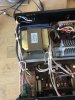
IMG_7891.jpg
 
Register to hide this ad
Only means to convert it would be to find a transformer from a 120V version (or general export type that can do 120/220/240V) and swap it in as this one has no provision for a 120V primary.

Due to safety regulations in Europe and UK at the time, any models built for direct export to those sale areas were generally made as 220/240V only, selectable via a slide switch. General export versions (given the internal designation of "XX", where the code number suffix on your transformer is "EU") from about 1982 onward could be set for 120/220/240V input, while Japanese market versions were 100V input only.

If you can determine the voltage and current specs for each of the secondaries, it may be possible to find an aftermarket transformer to do the job, at the obvious cost of sacrificing some originality. I'd suggest just going with an external step up transformer.
 
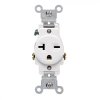
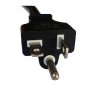
Having just gone through this with my AU-D101, another option is to install a 240 volt 20 amp circuit to power it keeping the factory 240v config, with the proper receptacle and cord end for the voltage and amperage for your local codes.

USA and probably Canada -
38F84C9F-39A7-40C5-B40A-22B40B760CAD.jpeg 6BBB5E7E-BA38-467A-AEBC-3902657A5C57.jpeg
 
^ that is an option, but if retaining the services of an electrician to get it done, will almost certainly cost quite a bit more than buying a step up transformer.

@JimEGR, have you done this yet? I'm curious to hear how it worked out for you, I have a couple of pieces of 220-240V gear here I'd like to test, and if this approach works, I just might wire up a circuit to do so.
 
^ that is an option, but if retaining the services of an electrician to get it done, will almost certainly cost quite a bit more than buying a step up transformer.

@JimEGR, have you done this yet? I'm curious to hear how it worked out for you, I have a couple of pieces of 220-240V gear here I'd like to test, and if this approach works, I just might wire up a circuit to do so.

Not yet. Still remodeling the workshop. Close. I’m confident it will work. Plenty of qualified expertise and testimony contributed to my AU-D101 thread. I’ll follow up there once I’m on line with the 240v.
 
Last edited:
What is a more solid explanation of why it can't be converted, other than "It can't be done"?
What other differences are there besides the power transformer? What parts would be different after the transformer?
 
What is a more solid explanation of why it can't be converted, other than "It can't be done"?
What other differences are there besides the power transformer? What parts would be different after the transformer?
That's it - the transformer, it's primary winding is wound for 240V and tapped at 220V - those are the only choices. Very often there are zero other differences internally.

Multi-voltage equipment may have a Primary winding that is tapped at lower voltages, or more commonly will have two primary windings, of 120V - which can be wired in series for 240V or in parallel for 120V - other more complex transformer tapping arrangements can make other common mains voltages available.

As @Sansuiman has already pointed out - notice the top of the transformer "A1550EU" = Europe (or European Union)
 
Last edited:
Fair to say then, if you did a lot of research into transformer outputs from different 120v units or even bought a new or had a custom wound transformer, it could be converted.
Providing cost was a non-factor.
As @Sansuiman said
 
Last edited:
Fair to say then, if you did a lot of research into transformer outputs from different 120v units
The only things you can be sure of is the mains input voltage and the secondary(-ies) output voltage, and the physical size of the transformer. The current rating of the output windings is often unknown, so calculating what is required for a given transformer core size, in terms of wire gauge and number of turns, is AFAIK an advanced electrical/electronics engineer task. Made more complex if you are starting from scratch, rather than repair/rewinding an existing transformer. ;)
 
Last edited:
Worth noting that in some sales areas - Canada most notably - in order to receive CSA safety certification, additional fusing was required. These additional fuses (on the transformer secondaries) were usually located on the main power supply PCB or on a small additional circuit board made for that purpose. On models where the regulatory agency requirements weren't as stringent, these fuses were usually omitted and a jumper wire placed on the board to bridge the circuit.

There were also instances of the convenience outlets being omitted in the UK , Australian and EU models running at 220-240V. This looks to have been an inconsistent practice, probably due to standards that changed over time. Often models for those markets can be found with metal cover plates installed over the openings in the rear panels where the outlets would have been installed.

But again, as both @Hyperion (and I) had posted upthread, the transformer is usually the only major functional difference. If you look at the inside front cover of most Sansui service manuals from the late 70's onward, there is a table of two letter codes that identify a sales areas for different versions of a unit built to required safety/regulatory standards in different parts of the world. EU, UK, UL (Underwriters Labs for US market) and various others are given in that table. As time went on, additional variants were added; at one point there were specific versions for Austria and South Africa even, probably owing to specific product requirements imposed by those countries.

On most products from roughly 1980 onward, the transformer ID label will include the letter code that corresponds to this table, if a specific localized version was required. XX was the code used for general export versions, meaning convertible for 120, 220 or 240V. Prior to about 1979, XX versions were also convertible for use at 100V, for use in Japan.

For some reason (perhaps a new or changed safety requirement in Japan, I'd guess) about 1979-80, Sansui began making JDM specific versions of their products for use on 100V only, and no longer offered any versions with support for all 4 line voltages (100/120/220/240) after that point in time. There is some overlap as older products still in active distribution could be found with support for all 4 voltages, but there was a clear cutover point in production after which that was no longer the case.
 
Thank you all for the thorough explanation. Pity this one cannot be converted. I did not get to hear this amp yet but based on reviews I think it will be worth $40-$60 investment into a step-up transformer.
I am also planning to get a 250v rated plug for this one as I got the amp without any plug - just bare wires. Hope it will fit the universal receptacle on the step-up transformer (that one I am not sure but I don't dare put a regular 120v plug)

Regards,
-Peter
 
Back
Top Bottom