Sony TAN-8550 Reimagined: What If Sony Made a TAN-8550 Mark II

rottalpha

Yamaholic
Subscriber
Hello Gang,
After a long development and testing process, I wanted to share my work on evolving the Sony TAN-8550 V-FET amplifier — a personal project aimed not at restoring the amp to factory condition, but at carefully reimagining it as a "Mark II" version, guided by 50 additional years of materials science, field data, and circuit evolution.

I hope this write-up is useful or at least thought-provoking for others who care about preserving and honoring these remarkable vintage designs.

This not a restoration.

This project is an evolutionary enhancement of the TAN-8550, and each change undertaken with the utmost respect for the original design.
Rather than restoring the amplifier to its original 1970s configuration, my goal was to thoughtfully reimagine the unit — as if Sony themselves had created a "Mark II" version, equipped with the benefit of 50 years of additional data and materials advancements.
At no point did I seek to "modernize" the TAN-8550 for its own sake. The changes are rooted in preserving its original soul while evolving key areas where reliability, stability, and audio performance could benefit from today's best practices.


1. Power Supply Redesign: Strengthening the Core
In the original design, Sony used dual-can electrolytic capacitors — a relatively common technique of the era — to manage parasitic elements such as series resistance and inductance. However, these capacitors are now largely unavailable, and newer design practices have rendered such compromises unnecessary.

For the redesign, the focus was primarily on current flow, ground stability and signal integrity:

  • Replaced the original filter capacitors with audio-grade Nichicon LKG some of the best caps made for audio
  • Upgraded the bridge rectifiers to soft recovery diodes, significantly reducing high-frequency noise and switching artifacts.
  • Reworked the grounding topology with balanced ground potentials and symmetrical current paths, inspired by later designs from manufacturers such as Luxman and Accuphase.
Old vs new. In order to manage space limitations, a TH and SMD hybrid approach was the best option here.
Note the length of the old wire harness, between the filter cap and power supply, bridge rectifier and all. That is now eliminated :
IMG_6991.jpeg

Side Note: Why the Main Power Supply Matters in a Push-Pull Class AB Amplifier - How this was explained to me by very smart people and how I can best explain it forward:

In a conventional Class AB push-pull amplifier — particularly designs like the Sony TAN-8550 that share a common ground between the power supply and speaker output — the main filter capacitors are not isolated from the audio signal. They are, in fact, an integral part of the signal path.

Here’s why:

  • During normal operation, the upper and lower output devices (in this case, N-channel and P-channel V-FETs) alternately draw current from the positive and negative supply rails.
  • Each half of the waveform (positive and negative) relies on the stability and instantaneous energy availability of its corresponding rail.
  • The ground potential, shared between the amplifier’s internal circuitry and the speaker return path, must remain balanced and undisturbed — even during rapid transients that cause heavy dynamic current flow.
  • Any instability, asymmetry, or voltage ripple on either rail, or imbalance in the ground reference, directly modulates the audio output, adding distortion, smearing dynamics, and collapsing the soundstage.

Thus:
  • The capacitors bridging each rail to ground act almost as extensions of the output stage itself.
  • Their ability to charge and discharge linearly, rapidly, and symmetrically across a wide frequency band is critical to maintaining signal purity.

By using audio-grade capacitors such as the Nichicon LKG, with their low, linear ESR, fast transient response, and high stability across frequencies, the amplifier’s rails remain stable and uncolored — allowing the V-FET output devices, in this case, to operate as intended, with minimal imposed distortion.

In essence:
We are not listening to the amplifier circuitry, we are listening through the power supply.
Choosing the right capacitors and proper supply PSU circuit layout, ensures that what reaches the speakers is a faithful, clean modulation of the input signal, not a struggle against rail sag, ripple or imbalance.


2. DC Protection Upgrade / Addressing "Lack of Protection":

Protecting the Unobtanium not just the Speakers

The TAN-8550 originally employed a crowbar protection circuit that shorts the output to ground in the event of DC fault detection at the output.
While it protects the speakers, it can expose the unobtanium V-FET output devices to catastrophic fault currents.

For this upgrade I replaced the crowbar circuit with a more modern time-delay relay protection system adapted from Sony’s own later TAN-5550 design (with some required modifications). This circuit redesign:
  • Provides controlled isolation of the speakers during faults without risking damage to the amplifier.
  • Introduces a startup delay, eliminating loud transients ("pops") on power-up — a notable improvement for high-sensitivity speaker systems.
IMG_6997.jpegIMG_7001.jpeg

3. Practical Enhancements for Future-Proofing Reliability


In addition to the core improvements named above. I added modern features and revised legacy functions with modern techniques:
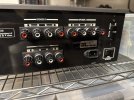
  • Speaker terminals were replaced with modern, high-quality connectors suitable for today's heavier-gauge speaker cables.
  • AC mains cord was replaced with a modern IEC inlet, offering flexibility for appropriate power cords.
  • Low-level signal switches, previously open-frame designs susceptible to oxidation, were replaced with sealed low-level signal relays to ensure clean switching and long-term reliability.
image.jpg
image.jpg

IMG_6999.jpeg

4. Methodology Matters:


Frame of Reference and Iterative Testing


A critical part of this project was the use of a "mule unit" — a carefully preserved TAN-8550 with original configuration and components, including original-specification dual capacitors, thoroughly tested to meet Sony’s original data sheet specifications. This mule was not used for daily listening but served a singular purpose:
  • Establishing a true frame of reference for the original sonic signature and performance envelope of the TAN-8550.

The evolution project itself took place over many months of iterative development and over two years from initial ideation to final completion.
Each change was carefully evaluated against the mule's sonic benchmark to ensure that no enhancement compromised the amplifier’s original strengths.

It is relatively easy to replace parts and claim an amplifier is "more reliable" — but in truth, the odds are heavily against achieving a sonic improvement unless every decision is grounded in disciplined referencing and technical care.
A poorly considered "recap" can easily degrade performance rather than enhance it.


Results:
The redesigned TAN-8550 exhibits:
  • Substantially improved imaging and soundstage precision.
  • Tighter, more authoritative low-frequency control.
  • Lower noise floor and improved microdynamic resolution.

These sonic improvements have been confirmed by seasoned listeners familiar with multiple examples of this same model — including some in excellent cosmetic condition but fitted with inferior-grade SMPS capacitors, original wire harnesses, or original PCBs whose limitations are well-documented compared to modern practices.


One particularly polite but revealing feedback quote from a fellow owner: "Wow - there is a difference. And not a small one"

Another Hi-Fi enthusiast visiting for an evaluation session simply did not want to leave, remaining in the listening seat for hours, deeply engaged by the sound.

Final Thoughts:


Similar to my Yamaha projects, this is an evolutionary tribute, this time to a Sony Legend.


Every decision made throughout this project was guided by a simple philosophy:

Respect the original spirit. Improve only where experience, materials science, and circuit evolution offer a clear and meaningful advantage.

The result is not only a far more reliable amplifier than the original, but one that — in a very real sense — outperforms the original sonic expectations without betraying the intent and character that made the TAN-8550 a classic.

I know that purists do not agree with this philosophy but at least I hope this project resonates with those who believe that evolution, when pursued with discipline, and passion, can honor and extend the life of these extraordinary classic designs.

For reference, I am attaching a related youtube video. You have to excuse my mental acuity and coherence during the recording of this video. Any hiccups I will blame on Bacchus :beerchug:
Final assembly:
IMG_6971.jpeg


Attachments

  • IMG_6995.jpeg
    IMG_6995.jpeg
    91.6 KB · Views: 20
Last edited:
Register to hide this ad
Incredible work Peter. Your efforts make everyone else’s look like child’s play. Your PCB design and implementation makes me drool…
Thank you Connor, I have to admit, the effort was not trivial but the results definitely make it worthwhile. Stay tuned for more of the same for some other popular models ;)

You do some very good work yourself and should be very proud of it. Cheers!
 
Last edited:
As a lucky owner of one of the TAN-8550 MK II amplifier from Peter, I absolutely can confirm that Peter's hard work resulted in an amplifier that has a unique / magical sound.
It is without question, at the level of one of his restored Yamaha B2 and B1 amplifiers in sound quality. But in ways, to my ears, it offers more magic the in the vocals and high frequencies (crystal clear / airy) areas that are clearly noticeable at first listen. Compared to the original TAN-8550 version, this amp is night and day. Imaging and soundstage are localized and clearly focused like I have never heard (when listening to music of which I am familiar). The bass response is so good, I no longer need a sub woofer. The bass was resolving such that I heard additional bass notes being played that I never heard when listening to familiar music. I can now understand wanting to re-listen to one's music library to discover new riffs that were previously not discernible As Peter showed in his video, the frequency response is within 1db 20Hz - 20KHz (ruler flat). I also confirm that the amp is dead quiet even when using my highly sensitive speakers 99 db (Altec 604E II Big Reds, and Altec A5 system with 288 / 511 compression drivers, and 515b LF drivers). This low noise floor makes the amp even more revealing / resolving throughout the audio spectrum.

I was so blown away by the sound of the MK II, that I immediately asked Peter if I could send him another original 8550 that I had in storage. When I play this amp, it is magical. The sound is comforting / soothing while being articulate and precise. I have enjoyed Peter's restored versions of the B3, B2 and B1 amps, but I think this is Peter's masterpiece. Hard to explain in words.

Thank you Peter for having the patience, know how, and experience to make this version of the Sony TAN-8550 something truly beyond the original. I am sure that the Sony original designers from the 1970s would give your MK II many:) :banana:"likes" if they could.
 
As a lucky owner of one of the TAN-8550 MK II amplifier from Peter, I absolutely can confirm that Peter's hard work resulted in an amplifier that has a unique / magical sound.
It is without question, at the level of one of his restored Yamaha B2 and B1 amplifiers in sound quality. But in ways, to my ears, it offers more magic the in the vocals and high frequencies (crystal clear / airy) areas that are clearly noticeable at first listen. Compared to the original TAN-8550 version, this amp is night and day. Imaging and soundstage are localized and clearly focused like I have never heard (when listening to music of which I am familiar). The bass response is so good, I no longer need a sub woofer. The bass was resolving such that I heard additional bass notes being played that I never heard when listening to familiar music. I can now understand wanting to re-listen to one's music library to discover new riffs that were previously not discernible As Peter showed in his video, the frequency response is within 1db 20Hz - 20KHz (ruler flat). I also confirm that the amp is dead quiet even when using my highly sensitive speakers 99 db (Altec 604E II Big Reds, and Altec A5 system with 288 / 511 compression drivers, and 515b LF drivers). This low noise floor makes the amp even more revealing / resolving throughout the audio spectrum.

I was so blown away by the sound of the MK II, that I immediately asked Peter if I could send him another original 8550 that I had in storage. When I play this amp, it is magical. The sound is comforting / soothing while being articulate and precise. I have enjoyed Peter's restored versions of the B3, B2 and B1 amps, but I think this is Peter's masterpiece. Hard to explain in words.

Thank you Peter for having the patience, know how, and experience to make this version of the Sony TAN-8550 something truly beyond the original. I am sure that the Sony original designers from the 1970s would give your MK II many:) :banana:"likes" if they could.
He He, you know a good amp when you hear one, Mr Magic Ears :) I guess those "Super Through" LKGs, came through.
Glad you enjoyed the first one. The EU model is on its way back home.
 
Last edited:
Some additional photos:

Floor noise of the amp is very good. See THD vs THD+N:
IMG_6703.jpeg IMG_6702.jpeg


Rearranging transistors based on rank, helps the amp be more balanced. Here are the "before and after" for two amps:
IMG_6680.jpegIMG_6681.jpeg


Deep cleaning is required for mechanical switches, albeit, the audio signal path is not longer subject to open to air mechanical switches:
IMG_6645.jpegIMG_6648.jpegIMG_6634.jpegIMG_6637.jpeg

Power supply assembles "waiting for deployment"

IMG_6537.jpegIMG_6531.jpeg
 
I don't know anything about the original amp but this is a VERY cool project!!
Thanks. Yes, it was a fun project. The original amp is a very good start, but even when running in all cylinders when in original configuration, they sound a bit dull.
 
Last edited:
Hey I finally got around to reading this thread.

I like what you are doing. it is not sacrilege rather an homage. If you didn't respect the basic unit you wouldn't bother.

I too was told decades ago that we basically listen to the power supply component of an amplifier. No great amplifier does it with a lousy power supply. I've said that on this site before but got cried-down. There was an amp designer here in Oz who preferred multiple smaller caps to high uF models. Something to do with the lower inductance of the paralleled cap bank. Fastidious designers independently regulate every stage. I don't know much about electronics(do not give me a soldering iron...) but I still like to understand why something is important even if that is all I know.

The amp designers who intrigue me are the ones who think up novel ways to get the job done. David Berning for example was an outside the box amp designer. Then there are way out there designs like the Futterman amps. Nelson Pass of course. Tim De Paravicini. I'm mentioning a lot of tube amps mainly because tube designs tend to regurgitate the same ancient circuits. Thus tube mavericks are really going against the grain.

Lynn Olson is a very interesting person for analyzing power supply influences on sound quality. He is another tube designer but his insights about power supply pollution on the circuit it is feeding is thought provoking. My own thought on system installation is to either have completely separate analogue and digital systems or to unplug the digital gear from the wall when listening to analogue. I wonder how much of the 'digital' sound that some don't like is derived from the pollution that the digital gear feeds into the mains power the rest of the components draw from.

We are lucky here at AK to have a small cadre of people who do incredible restores/improvements to a host of Japanese classics. In the process showing the world just how amazing many of these forgotten/overlooked gems are in fact. This thread joins that group.
 
Last edited:
Hey I finally got around to reading this thread.

I like what you are doing. it is not sacrilege rather an homage. If you didn't respect the basic unit you wouldn't bother.

I too was told decades ago that we basically listen to the power supply component of an amplifier. No great amplifier does it with a lousy power supply. I've said that on this site before but got cried-down. There was an amp designer here in Oz who preferred multiple smaller caps to high uF models. Something to do with the lower inductance of the paralleled cap bank. Fastidious designers independently regulate every stage. I don't know much about electronics(do not give me a soldering iron...) but I still like to understand why something is important even if that is all I know.

The amp designers who intrigue me are the ones who think up novel ways to get the job done. David Berning for example was an outside the box amp designer. Then there are way out there designs like the Futterman amps. Nelson Pass of course. Tim De Paravicini. I'm mentioning a lot of tube amps mainly because tube designs tend to regugitate the same ancient circuits. Thus tube mavericks are really going against the grain.

Lynn Olson is a very interesting person for analyzing power supply influences on sound quality. He is another tube designer but his insights about power supply pollution on the circuit it is feeding is thought provoking. My own thought on system installation is to either have completely separate analogue and digital systems or to unplug the digital gear from the wall when listening to analogue. I wonder how much of the 'digital' sound that some don't like is derived from the pollution that the digital gear feeds into the mains power the rest of the components draw from.

We are lucky here at AK to have a small cadre of people who do incredible restores/improvements to a host of Japanese classics. In the process showing the world just how amazing many of these forgotten/overlooked gems are in fact. This thread joins that group.
Thanks Steve,

Yes, you made inferences to this topic before and others should pay attention to your callouts because you are spot on.

I remember that at some point in the past we discussed the topic about preserving the LCR balance of the power supply. That is absolutely fundamental in a Class AB push-pull amplifier like this, especially one using V-FETs, where the + and – rails, power ground, and speaker ground are all dynamically interacting. The filter capacitors in this kind of design are not peripheral — they are in the signal path, implicitly. Any imbalance in parasitic inductance or resistance — particularly through the "zero-dead-zone" between rail transitions — can introduce asymmetry, ripple injection, or even transient distortion into the output.

You’re right to bring up the common practice of using multiple smaller capacitors in parallel to reduce inductance and flatten impedance. That approach absolutely has merit especially in new designs — especially where clean, high-speed current delivery is needed. But as you correctly suspect, in V-FET amplifiers, lower isn’t always better when it comes to ESR or charge rate. Here’s why:
  • V-FETs require their gate voltage to stabilize before the drain-source voltage ramps up. That means the sequencing of the gate and rail voltages must remain intact. A supply with too-low series resistance and an overly aggressive charge profile can violate that, risking improper Vgs timing.
  • Ultra-fast inrush current from a capacitor bank with near-zero ESR can also stress the transformer, particularly with vintage windings or long-term aged insulation.
  • Many modern designers who do use banks of low-ESR caps end up reintroducing a series resistor to temper this — effectively undoing some of the ESR reduction. This tells us that a nuanced resistance profile is often needed, not just tolerated.
  • In short, too much resistance is bad — but so is too little, especially in topologies like this one.

A lot of this practical, hard-won knowledge from the 1970s — about power supply behavior, sequencing, and system integration — has unfortunately been lost or ignored in many newer designs. As you point out, some modern amplifiers are little more than schematic regurgitations, with important subtleties omitted. The exceptions — designers like Berning, De Paravicini, and Pass — are the ones who continue the tradition of thinking about the whole system, not just a circuit block. Your mention of Lynn Olson is also deeply relevant here. His reflections on power supply pollution (not just in terms of ripple), speak directly to this topic.

We have excellent technicians on on DiyAudio and on this forum as well, technicians with decades of knowledge and depth of understanding about topics such as this. A lot of what I shared about this project is a reflection of what I learned from veteran engineers/technicians such as @ilimzn, @Oilmaster, @avionic, EW and other over the years. BUT, the more I read and learn from them and others, and from these types of projects, the more I realize how little I know.

Cheers,
Pete
 
Last edited:
Hello Gang,
After a long development and testing process, I wanted to share my work on evolving the Sony TAN-8550 V-FET amplifier — a personal project aimed not at restoring the amp to factory condition, but at carefully reimagining it as a "Mark II" version, guided by 50 additional years of materials science, field data, and circuit evolution.

I hope this write-up is useful or at least thought-provoking for others who care about preserving and honoring these remarkable vintage designs.

This not a restoration.

This project is an evolutionary enhancement of the TAN-8550, and each change undertaken with the utmost respect for the original design.
Rather than restoring the amplifier to its original 1970s configuration, my goal was to thoughtfully reimagine the unit — as if Sony themselves had created a "Mark II" version, equipped with the benefit of 50 years of additional data and materials advancements.
At no point did I seek to "modernize" the TAN-8550 for its own sake. The changes are rooted in preserving its original soul while evolving key areas where reliability, stability, and audio performance could benefit from today's best practices.


1. Power Supply Redesign: Strengthening the Core
In the original design, Sony used dual-can electrolytic capacitors — a relatively common technique of the era — to manage parasitic elements such as series resistance and inductance. However, these capacitors are now largely unavailable, and newer design practices have rendered such compromises unnecessary.

For the redesign, the focus was primarily on current flow, ground stability and signal integrity:

  • Replaced the original filter capacitors with audio-grade Nichicon LKG some of the best caps made for audio
  • Upgraded the bridge rectifiers to soft recovery diodes, significantly reducing high-frequency noise and switching artifacts.
  • Reworked the grounding topology with balanced ground potentials and symmetrical current paths, inspired by later designs from manufacturers such as Luxman and Accuphase.
Old vs new. In order to manage space limitations, a TH and SMD hybrid approach was the best option here.
Note the length of the old wire harness, between the filter cap and power supply, bridge rectifier and all. That is now eliminated :
View attachment 3492452

Side Note: Why the Main Power Supply Matters in a Push-Pull Class AB Amplifier - How this was explained to me by very smart people and how I can best explain it forward:

In a conventional Class AB push-pull amplifier — particularly designs like the Sony TAN-8550 that share a common ground between the power supply and speaker output — the main filter capacitors are not isolated from the audio signal. They are, in fact, an integral part of the signal path.

Here’s why:

  • During normal operation, the upper and lower output devices (in this case, N-channel and P-channel V-FETs) alternately draw current from the positive and negative supply rails.
  • Each half of the waveform (positive and negative) relies on the stability and instantaneous energy availability of its corresponding rail.
  • The ground potential, shared between the amplifier’s internal circuitry and the speaker return path, must remain balanced and undisturbed — even during rapid transients that cause heavy dynamic current flow.
  • Any instability, asymmetry, or voltage ripple on either rail, or imbalance in the ground reference, directly modulates the audio output, adding distortion, smearing dynamics, and collapsing the soundstage.

Thus:
  • The capacitors bridging each rail to ground act almost as extensions of the output stage itself.
  • Their ability to charge and discharge linearly, rapidly, and symmetrically across a wide frequency band is critical to maintaining signal purity.

By using audio-grade capacitors such as the Nichicon LKG, with their low, linear ESR, fast transient response, and high stability across frequencies, the amplifier’s rails remain stable and uncolored — allowing the V-FET output devices, in this case, to operate as intended, with minimal imposed distortion.

In essence:
We are not listening to the amplifier circuitry, we are listening through the power supply.
Choosing the right capacitors and proper supply PSU circuit layout, ensures that what reaches the speakers is a faithful, clean modulation of the input signal, not a struggle against rail sag, ripple or imbalance.


2. DC Protection Upgrade / Addressing "Lack of Protection":

Protecting the Unobtanium not just the Speakers

The TAN-8550 originally employed a crowbar protection circuit that shorts the output to ground in the event of DC fault detection at the output.
While it protects the speakers, it can expose the unobtanium V-FET output devices to catastrophic fault currents.

For this upgrade I replaced the crowbar circuit with a more modern time-delay relay protection system adapted from Sony’s own later TAN-5550 design (with some required modifications). This circuit redesign:
  • Provides controlled isolation of the speakers during faults without risking damage to the amplifier.
  • Introduces a startup delay, eliminating loud transients ("pops") on power-up — a notable improvement for high-sensitivity speaker systems.
View attachment 3492457View attachment 3492456

3. Practical Enhancements for Future-Proofing Reliability


In addition to the core improvements named above. I added modern features and revised legacy functions with modern techniques:
  • Speaker terminals were replaced with modern, high-quality connectors suitable for today's heavier-gauge speaker cables.
  • AC mains cord was replaced with a modern IEC inlet, offering flexibility for appropriate power cords.
  • Low-level signal switches, previously open-frame designs susceptible to oxidation, were replaced with sealed low-level signal relays to ensure clean switching and long-term reliability.
View attachment 3492464
View attachment 3492462

View attachment 3492459

4. Methodology Matters:


Frame of Reference and Iterative Testing


A critical part of this project was the use of a "mule unit" — a carefully preserved TAN-8550 with original configuration and components, including original-specification dual capacitors, thoroughly tested to meet Sony’s original data sheet specifications. This mule was not used for daily listening but served a singular purpose:
  • Establishing a true frame of reference for the original sonic signature and performance envelope of the TAN-8550.

The evolution project itself took place over many months of iterative development and over two years from initial ideation to final completion.
Each change was carefully evaluated against the mule's sonic benchmark to ensure that no enhancement compromised the amplifier’s original strengths.

It is relatively easy to replace parts and claim an amplifier is "more reliable" — but in truth, the odds are heavily against achieving a sonic improvement unless every decision is grounded in disciplined referencing and technical care.
A poorly considered "recap" can easily degrade performance rather than enhance it.


Results:
The redesigned TAN-8550 exhibits:
  • Substantially improved imaging and soundstage precision.
  • Tighter, more authoritative low-frequency control.
  • Lower noise floor and improved microdynamic resolution.

These sonic improvements have been confirmed by seasoned listeners familiar with multiple examples of this same model — including some in excellent cosmetic condition but fitted with inferior-grade SMPS capacitors, original wire harnesses, or original PCBs whose limitations are well-documented compared to modern practices.


One particularly polite but revealing feedback quote from a fellow owner: "Wow - there is a difference. And not a small one"

Another Hi-Fi enthusiast visiting for an evaluation session simply did not want to leave, remaining in the listening seat for hours, deeply engaged by the sound.

Final Thoughts:


Similar to my Yamaha projects, this is an evolutionary tribute, this time to a Sony Legend.


Every decision made throughout this project was guided by a simple philosophy:

Respect the original spirit. Improve only where experience, materials science, and circuit evolution offer a clear and meaningful advantage.

The result is not only a far more reliable amplifier than the original, but one that — in a very real sense — outperforms the original sonic expectations without betraying the intent and character that made the TAN-8550 a classic.

I know that purists do not agree with this philosophy but at least I hope this project resonates with those who believe that evolution, when pursued with discipline, and passion, can honor and extend the life of these extraordinary classic designs.

For reference, I am attaching a related youtube video. You have to excuse my mental acuity and coherence during the recording of this video. Any hiccups I will blame on Bacchus :beerchug:
Final assembly:
View attachment 3492460


I have two TAN-8550's that have gone through some restoration and are working. I have two stock 5550's that work, but need restoration. I have a third 5550 that only works on one channel. I'm told the V-fets on the dead channel are toast. I am interested in talking with you about regrooving them. Thanks.
 
I have two TAN-8550's that have gone through some restoration and are working. I have two stock 5550's that work, but need restoration. I have a third 5550 that only works on one channel. I'm told the V-fets on the dead channel are toast. I am interested in talking with you about regrooving them. Thanks.
they don't make'em like that no more
 
Have been watching your YT videos every now and again as my audio hobby/time dips and resurfaces.
Probably don't understand half of the technical side of it, but it's great to see improvement projects like these that'll prolongue and improve the longevity and quality of such great products.

Good stuff, will be on the lookout for any of your future endeavors!

Meanwhile I'm rediscovering the joys of my TA-N7B, after being pulled out of almost 3 years of storage.
 
Have been watching your YT videos every now and again as my audio hobby/time dips and resurfaces.
Probably don't understand half of the technical side of it, but it's great to see improvement projects like these that'll prolongue and improve the longevity and quality of such great products.

Good stuff, will be on the lookout for any of your future endeavors!

Meanwhile I'm rediscovering the joys of my TA-N7B, after being pulled out of almost 3 years of storage.
Great to see you around Stoffie. Guess what I have on the bench this weekend :cool:
 
Damn, Peter — I’m coming out from lurking just to say that this should have a NSFW tag. :’)

As someone who is fortunate enough to have a Yamaha C-1 and pair of B-3’s from Peter, I can only imagine how well these Sonys will sing.

You’re also making it difficult to not just give you my wallet.
 
Back
Top Bottom