This is the continuation of a discussion started in
Recording level, refresh my memory thread. Moved here, as I was asking about bias, not recording level.
--
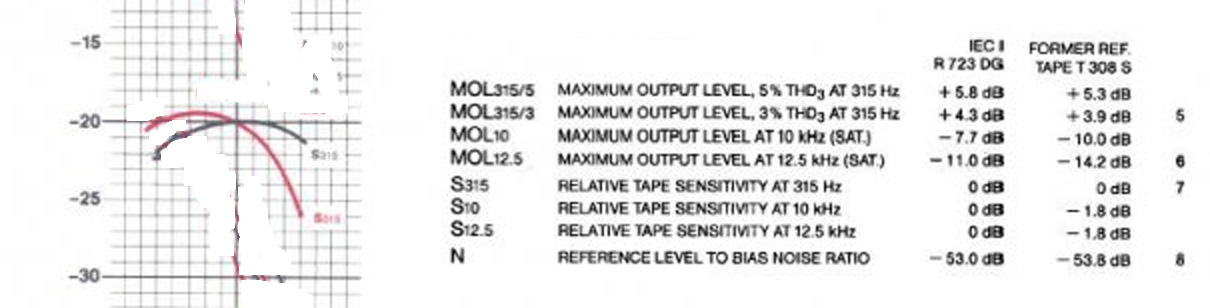
@WernerO, Sadly, your image is too low res, anyway. If we concentrate on these two curves, I believe the black one is response at 315 Hz, the red one... is it 10 kHz or 12.5 kHz? Seems like it is 12.5 kHz. They are recorded at -20 dB relative to 250 nWb/m, which is 1.2 dB higher than the Dolby level. (On my Technics deck 0 is 2 dB below Dolby level, or 3.2 dB below 0 dB DIN).
If you go from lower bias to higher, S12.5 goes from being higher than S315, then equal to it (at 0 bias setting of course, as this is a reference tape), then lower than S315. So, at -20 dB the responses from S315 and S12.5 are equal to each other AND they are equal to the input signal, -20 dB. This sort of "double" equality ensures correct Dolby tracking. Thirty or so years ago I read that a deck with fewer than 20 positions is useless for precise metering. Your BX300 has 20 positions, and it has five of them below -20 dB.
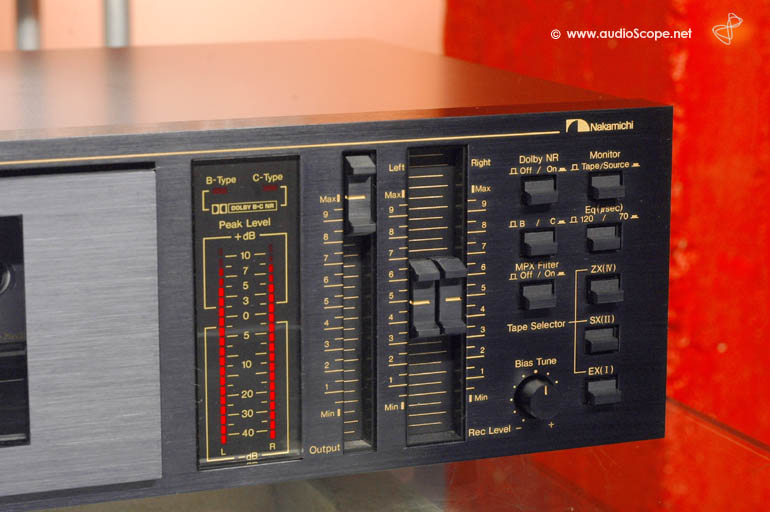
On my deck, -20 dB is the lowest indication, so I cannot really run the test at -20 dB. So, my idea is to run this test at higher level, closer to the middle of the meter, where I have four notches above and four notches below the middle position of -3 dB (which is -6.2 dB relative to DIN). Will my test will be invalid in relation to the reference data obtained at -20 dB DIN? Oh, man... Maybe I can do it at -10 dB on my scale (that is, -13.2 dB DIN) and it will be good enough?
Reading about your test setup, you write, "For each tape under test first the
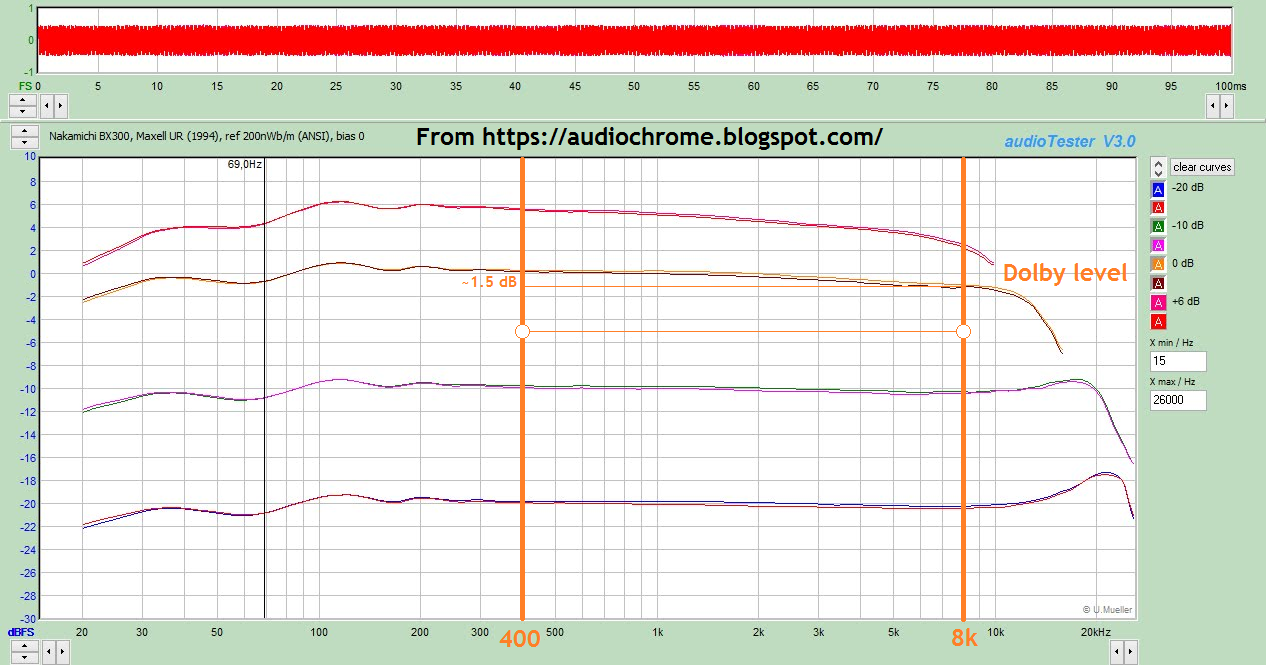
bias level is determined by making a frequency sweep at -20dB (relative to 200nWb/m ANSI), tuning the deck's front-mounted bias pot to obtain the flattest response below 10 kHz, while still reaching beyond 20kHz, and with up to 3dB peaking accepted above 10kHz." So, it is -20 dB relative to Dolby, not relative to DIN, for which you showed the reference tape specs. I wonder, why?
I don't do a sweep, I use two tones, one channel 400 Hz, another channel 8 kHz, just like some Sony decks. My entry-level deck is spec'd 40-14k within 3 dB, the Sony is 30-15k one deck, 20-17k another deck, within 3 dB (Type I, no Dolby, nice!). The question is, how it will correspond to the reference curve, and what sort of correction I need to make? Is this a simple linear correction?
Comparing results done at -10, -6, and -3 on my scale, I can see that the "window" with equal levels moves towards higher bias. That is, higher input level requires higher bias. Is this expected behavior?
Now,
what is the goal of this fiddling. If there is clear difference in treble vs bass response depending on bias, then one would set it where the output is equal, maximizing the bias. Say, in this case 0 setting is the best.
But if there is no difference for any of, say, 0 through 5 marks in the bias knob, which setting should I choose? Higher bias is supposed to give lower distortions, but I cannot verify this improvement (unless the distortions are really gross), also I've read elsewhere that there may be other sorts of distortions that are not defined by the standard, but people hear them (yeah, yeah, golden ears).
My life back then was simpler as my deck did not have bias adjustment

Heck, when I was a schoolkid I did not even have a proper deck.
I guess, since I cannot test at exactly the same conditions as the DIN reference, I should rely on my ears after all. But to me the point of this evaluation is to obtain a proper setting without doing multiple takes and comparing them. My deck is only a two-header, so I cannot do it in realtime.