• Please note that there are a few updates and clarifications made in the Audiokarma Rules, mostly relating to advertising and the addition of the new "Paying it Forward" & "Giving back" forums in the AudioKarma Audio Marketplace section.

The Fisher 202 - Full Restoration

QUiKSR20

AK Subscriber
Subscriber
I picked up this unit pretty cheap in good but extremely dirty shape from the original owner w/optional partial wood case.
After a thorough cleaning inside and out + all the controls with deoxit I was able to confirm it worked without any major issues.

Model - The Fisher 202 - Futura Series ( Looks to be the same as the 195 under the hood )
Serial # - 10861

IMG_1015.JPG IMG_1021.JPG IMG_1019.JPG
I am a person that not only loves this old gear but also the stories and history that comes along with it. Yes this is just a semi
basic 28wpc unit with not much collectability value but has some really good build quality. After a little research I found some
pretty interesting stuff which piqued my interest leading me to dive into the restoration path vs just selling or shelving.

Info found across the internet & here :

User @KentTeffeteller Writes -

The Fisher 202 was made in Japan by Hitachi under Avery Fisher's supervision. This was one of the last units made by the original
company before it was sold in 1971 to Emerson Electric (of ceiling fan fame). It's an excellent sounding unit and superb phono stage and tuner.

User @FisherWisher Writes -

Fisher was still building some highly descent equipment in The Futura Series 201/202. These receivers were the first outsourced Fishers ever built. The parent company (Emerson) would not allow continued production in the US except for speaker enclosures..and the 201 and 202 were both very much designed under the scrutiny of Avery Fisher. They are Japanese made "American" recievers. They are the last components Mr. Fisher permitted to be called "The Fisher". He demanded the removal of that traditional title when the quality control was taken from his domain by the powers that be...who totally screwed Fisher Radio...but The 201/202 are good receivers. They are not quite the same as the Transistor or Professional series....not near the relief and transparency...but, in my opinion they blew the socks of the Marantz 2215 which was not musical sounding. the Futuras were musical sounding as Fishers were. Something very good about these receivers: Their rear panels were Excellent. They had binding post speaker terminals that could be tightly done with finger or screwdriver and the backplate is steel! (Not cardboard as would be just around the corner). The Fisher will never die. The old classics will be the ones remembered (and used) by posterity. The years following are just another example of corporate greed and takeover.

Its has really nice build quality such as solid aluminum knobs, dual driver boards in slots for easy removal and full discrete outputs.

ads.JPG

- More info / Service Manual : https://www.hifiengine.com/manual_library/fisher/202.shtml
- Original Ad & Literature : https://www.hifi-archiv.info/Fisher/1970 The Fisher US/index.html

These are also called "The Hitachi Fishers" and you can read about the various models in this thread here.

Ok ok enough with the history, We have a ton to do so lets get on with the restoration!

IMG_2012.JPG

*Disclaimer* - I am huge audio enthusiast just starting on the repair side of things but not a full on tech, I take pride in my work and put a big focus on attention to detail.
I enjoy making these posts in hope to help others and pay it fwd with the knowledge ive learned from many of the smart people on here and other forums. If anything is written
in-correctly just let me know so I can correct it. Each board will be tackled one at a time to minimize on troubleshooting errors or mistakes. As a new tech starting my 2nd full
rebuild I find it much easier to do one board at a time and then test on the dim bulb. Once I can confirm the boards fully done and has no mistakes I move to the next.

This will not be a basic recap, its a restoration with around 100 pieces to be replaced. I worked closely with @Leestereo to put together a great
list of replacement parts ( some with upgraded values ) to make this 202 the best it can be. His knowledge and help has been invaluable.

If you have a question on a specific/individual part please feel free to reach out to me directly and id love to help out where I can.
 
Last edited:
Register to hide this ad
The first board I attacked is the Power Supply being its the heart of the operation its where I like to start.

Board # - PB4031-2517911
Parts to replace - 15 ( highlighted in green )

- Capacitors​
- Old Carbon Comp Resistors​
- Zener Diode Upgrades​
- Soft Recovery Diode Upgrades​

PS-Boardn.JPG
I also went a step further to see how far these original caps deviated by testing with my Atlas ESR70 cap tester. I already know these measurements should
be taken with a grain of salt and larger caps can test fine when using a 9v tester and fail under load which would be seen on an expensive tester. Im not really
interested to know if the cap is good to be honest, Its past its life regardless of how it tests but im always curious to see how far they have drifted out of spec.

Electrolytic's Replaced -

electro-drift-ps.JPG

Resistors / Diodes Replaced -

Location - D01
Original Value - V03C
New Value - SBYV27-200 ( Soft Recovery Upgrade )
Location - D05
Original Value - 16v 1W
New Value - BZX85B16
Location - R03
Original Value - 1.8kΩ
New Value - 1.8k Ω ( Metal Film Upgrade )
Location - D02
Original Value - V03C
New Value - SBYV27-200 ( Soft Recovery Upgrade )
Location - D06
Original Value - 33v 1W
New Value - BZX85B33
Location - R05
Original Value - 6.8kΩ
New Value - 6.8k Ω ( Metal Film Upgrade )
Location - D03
Original Value - V03C
New Value - SBYV27-200 ( Soft Recovery Upgrade )
Location - R01
Original Value - 68Ω
New Value - 68.1Ω ( Metal Film Upgrade )
Location - R06
Original Value - 220Ω
New Value - 220Ω ( Metal Film Upgrade )
Location - D04
Original Value - V03C
New Value - SBYV27-200 ( Soft Recovery Upgrade )
Location - R02
Original Value - 1kΩ
New Value - 1kΩ ( Metal Film Upgrade )
Location - R07
Original Value - 560Ω
New Value - 560Ω ( Metal Film Upgrade )

Before -

before-ps.JPG

After -

after-ps.JPG

While I was in there ( as we say in the car world ), I removed all the output transistors and gave them new grease and fresh mica insulators to ensure great heat dispersion.
When I removed the originals there was little to no grease left at all and the insulators were extremely brittle.

IMG_2026.JPG

The Outputs all appeared to be healthy which is always a great thing! ( Socketed Driver Boards Removed ) [ A feature I wish all brands used more ]

IMG_2039.JPG

Thanks for reading and stick around as I continue to work through this rebuild in my spare time.
 
Last edited:
Nice work so far.

Just a bit of additional information, the 202 is the successor to the 195. The two are identical, except for the faceplate trim: the 195 has wood veneer, while the 202 (and slightly lower spec 201) have textured black vinyl.
 
Nice work so far.

Just a bit of additional information, the 202 is the successor to the 195. The two are identical, except for the faceplate trim: the 195 has wood veneer, while the 202 (and slightly lower spec 201) have textured black vinyl.

Awesome and thanks for sharing ( added to the details above ), I was un-aware of the 195 and after doing a few searches they seem to be identical...
These seem to have above average build quality at their price point... My goal with these threads are to be a master thread for someone in the future.
 
Last edited:
Next up I tackled what they call the "Control Amp" or some would call the "Tone Control Board".

Board # - PB4031-2517921
Parts to replace - 21 ( highlighted in green )

- Capacitors ( 9 electrolytic / 8 film )
- Known Problematic Transistors
Control_Amp_Parts.jpg

Before replacing transistors I took gain readings so I could match them as close as possible before installation, From what I read this can
help reduce any channel inconsistencies.. It may be overkill or not needed but felt it was a best practice from other rebuilds ive seen.

IMG_2066.JPG

Electrolytic's Replaced -

newcontorlparts.PNG


The film capacitor's below rarely go bad but are in the signal path so we upgraded them to values that should yield better performance.

Transistor / Film Cap's Replaced -

Location - C501
Original Value - 0.22μF
New Value - 0.47μF ( Film Upgrade )
Location - C509
Original Value - 0.01μF
New Value - 0.01μF ( Film Upgrade )
Location - TR501
Original Value - 2SC458 ( known to go noisy )
New Value - KSC1815
Location - C502
Original Value - 0.22μF
New Value - 0.47μF ( Film Upgrade )
Location - C510
Original Value - 0.01μF
New Value - 0.01μF ( Film Upgrade )
Location - TR502
Original Value - 2SC458 ( known to go noisy )
New Value - KSC1815
Location - C505
Original Value - 0.01μF
New Value - 0.01μF ( Film Upgrade )
Location - C519
Original Value - 0.1μF
New Value - 0.1μF ( Film Upgrade )
Location - TR503
Original Value - 2SC458 ( known to go noisy )
New Value - KSC1815
Location - C506
Original Value - 0.01μF
New Value - 0.01μF ( Film Upgrade )
Location - C520
Original Value - 0.1μF
New Value - 0.1μF ( Film Upgrade )
Location - TR504
Original Value - 2SC458 ( known to go noisy )
New Value - KSC1815

Before -

IMG_2062.JPG

After -


IMG_2067.JPG

Will be starting the driver boards later tonight or tomorrow.
 
Last edited:
i picked one up not long ago. recapped it, did the kos transistors. nothin fancy.

it's a nice sounding unit.

in case you are interested, i used these for output coupling caps. they fit in the brackets with no spacers.


Hey Painttoad,

Thanks for the reply, I actually have all my parts already but I really appreciate you sharing the info as it might help someone else in the future.
Those caps were on back-order for me so If I saw this before I placed my order it would of been very helpful. Im slowly finishing this unit and so
far its coming along great.. Was yours working and you just decided to refresh it? Mine was working I just wanted a fun winter project.

So far the results are very positive.
 
Hey Painttoad,

Thanks for the reply, I actually have all my parts already but I really appreciate you sharing the info as it might help someone else in the future.
Those caps were on back-order for me so If I saw this before I placed my order it would of been very helpful. Im slowly finishing this unit and so
far its coming along great.. Was yours working and you just decided to refresh it? Mine was working I just wanted a fun winter project.

So far the results are very positive.
mine was working but the controls were dirty enough that it was sold as not working.
 
This section is kind of boring since many dont listen to AM/FM anymore, but required since this is a full restoration and not just a recap.

Boards that make up the tuner section -

- AM RF​
- AM / FM IF / Meter​
- Multiplex​

I thought it may have been ok to skip the tuner section but ive been informed otherwise since these boards are all powered from the same regulated power supply.
If an issue was to occur in the turner boards its possible it could affect the power supply regulation which would affect the performance of the preamp, phono stages
etc which are also powered by the same regulated power supply.

Board # - PB4031-2517931 ( AM RF )
Parts to replace - 1 ( highlighted in green )
am-rf.png

Didnt take a before & after, Its just a single cap replacement that looks original, You can see this board in the before & after pics of the "AM / FM IF / Meter" board.

Electrolytic's Replaced -

am-devi.PNG


Board # - PB4031-2517841 ( AM / FM IF / Meter )
Parts to replace - 9 ( highlighted in green )

am-fm-if1.png
I made a rookie mistake on this board above with C04, Well technically I am a rookie but still.. The rule of the thumb I've learned is :
  1. Check the schematic for the proper orientation
  2. Check the board's silk-screen
  3. Check the orientation of the part you are removing ( This is the most important one that takes precedence )
I goofed and ended up cooking a capacitor here, Thankfully I swapped it out and I was back in biz but there's a possibility it could of been worse.

This is what it looks like on my board ( The Board is Wrong ).

C04-WRONG_on_board.JPG

Electrolytic's Replaced -

am-fm-meter-devi.PNG

Transistor's Replaced -


Location - TR04
Original Value - 2SC458 ( known to go noisy )
New Value - KSC1815
Location - TR06
Original Value - 2SC458 ( known to go noisy )
New Value - KSC1815
Location - TR05
Original Value - 2SC458 ( known to go noisy )
New Value - KSC1815
Location - TR07
Original Value - 2SC458 ( known to go noisy )
New Value - KSC1815

Before -

before-am-if-fm.PNG

After -

after-am-if-fm.JPG


Hoping to get to the multiplex board done next which will complete the tuner circuitry and then I can move on to the remaining sections.
 
Last edited:
The last board for the tuner section is the Multiplex board, This is also setup in a neat way where its mounted on a hinge.
Once you remove two screws the board opens up like a door allowing access to its back and also helps you get easy access
to the AM / FM IF / Meter board above it.

Board # - PB4031-2517941 ( Multiplex )
Parts to replace - 13 ( highlighted in green )

multiplex.PNG

* I stopped measuring capacitor deviation, Its fun to know but they are all past their prime & out of spec regardless.

This board had the first cap I found that flat out failed ( C16 )

IMG_2157.JPG

Capacitors Replaced -

Location - C1
Original Value - 3.3μF / 25v
New Value - 3.3μF / 50v
Location - C10
Original Value - 3.3μF / 25v
New Value - 3.3μF / 50v
Location - C20
Original Value - 47μF / 16v
New Value - 47μF / 25v
Location - C2
Original Value - 3.3μF / 25v
New Value - 3.3μF / 50v
Location - C11
Original Value - 3.3μF / 25v
New Value - 3.3μF / 50v
Location - C23
Original Value - 47μF / 16v
New Value - 47μF / 25v
Location - C4 *on the backside of the board
Original Value - 100μF / 16v
New Value - 220μF / 50v
Location - C13
Original Value - 3.3μF / 25v
New Value - 3.3μF / 50v
Location - C27
Original Value - 47μF / 16v
New Value - 47μF / 25v
Location - C9
Original Value - 3.3μF / 25v
New Value - 3.3μF / 50v
Location - C16
Original Value - 3.3μF / 25v
New Value - 3.3μF / 50v

Transistors Replaced -

Location - TR07
Original Value - 2SC458 ( known to go noisy )
New Value - KSC1815
Location - TR08
Original Value - 2SC458 ( known to go noisy )
New Value - KSC1815

** I left the remaining 2SC458's on this board alone as it could affect the alignment of the tuner and I do not have the equipment or skill to align.

Before -

before-mpx.png

After - Front


IMG_2156.JPG

After - Back

IMG_2153.JPG
 
Last edited:
Finally got these driver boards out of the way, I know ive said this before but I wish more brands built receivers with socketed boards..
This makes everything so much easier when it comes to repairs or just getting stuff out of the way for more access to other areas.

Board # - PB4031-2517862
Parts to replace - 16 - [ 8 per board ] ( highlighted in green )

- Capacitors ( 4 electrolytic / 1 film per board )
- Carbon Resistors x2 per board
- Trimmer x1 per board

Driver_Board_Parts.jpg

When replacing the trimmer on these boards you have to extend the leads typically or get creative. Unfortunately they do not seem to make modern trimmers
with the lead spacing that some of these models have, Luckily ive faced this issue in the past when rebuilding the driver board of my Pioneer SX-770 ( thread ).

When looking at the original trimmer I noticed where the leads attached was similar to the new trimmers lead spacing, I was able to crack the leads out and then
attach the old leads back to the driver board and then attach the new trimmer to the leads. These 3 leads were super simple to extract as the board is very brittle.
Without much effort and side cutters they broke right out of the board cleanly.

Potentiometers.png

Capacitors Replaced -

Location - C01
Original Value - 1μF / 25v
New Value - 1μF / 63v ( Film Upgrade )
Location - C03
Original Value - 220μF / 16v
New Value - 220μF / 25v
Location - C07 *on the backside of the board
Original Value - 220pF
New Value - 220pF
Location - C02
Original Value - 100μF / 50v
New Value - 220μF / 50v
Location - C04
Original Value - 47μF / 25v
New Value - 220μF / 25v

Resisters / Trimmers Replaced -

Location - R06
Original Value - 22kΩ
New Value - 22kΩ
Location - R09
Original Value - 6.8kΩ
New Value - 6.8kΩ
Location - VR01
Original Value - 20kΩ Trimmer
New Value - 20kΩ Trimmer

Before -
IMG_2041.JPG

After - Front

IMG_2147.JPG
After - Back
IMG_2151.JPG

Once I completed the boards I reinstalled and set the center voltage/AC balance to ~31.5V ( half of pin 3's voltage ).

On this unit the process is super simple.

1 - Ground your meter
2 - Put positive probe on pin 5 underneath on the sockets and adjust VR01 until you reach ~31.5V ( repeat on the 2nd channel ).

So far this has been a really fun unit to work on and I can see the light at the end of the tunnel, Not too much more to go!
 
Last edited:
...Set Bias of each channel to recommended ~31.5V ( half of pin 3's voltage ), This is super simple on this unit, Just ground one probe and put the + on pin 5...
The VR01 trimmer adjusts the center voltage/AC balance; there is no bias adjustment available on the Fisher 202.
 
Today I tackled the preamp ( phono ) board, This was the most challenging board thus far due to a ton of parts in a small area.
Not only is there a ton of parts theres also like 20 wires the run right next to the board with very little room ( my back is not happy ).

Board # - PB4031-2517852
Parts to replace - 23 - ( highlighted in green )

- Capacitors ( 5 electrolytic / 8 film )
- Resistors
- Known Problematic Transistors
preamp-n.PNG

As before, transistors were gain matched to minimize any channel inconsistencies.

Electrolytic's Replaced -

Location - C01
Original Value - 10μF / 16v
New Value - 1μF / 50v ( MKS Upgrade )
Location - C09
Original Value - 100μF / 6.3v
New Value - 100μF / 25v
Location - C16
Original Value - 100μF / 50v
New Value - 220μF / 50v
Location - C02
Original Value - 10μF / 16v
New Value - 1μF / 50v ( MKS Upgrade )
Location - C10
Original Value - 100μF / 6.3v
New Value - 100μF / 25v

Transistors / Resistors / Film Cap's Replaced -

Location - C5
Original Value - 6.8nF
New Value - 2.7nF
Location - C13
Original Value - 2.2nF
New Value - 27pF
Location - R9
Original Value - 330kΩ
New Value - 332kΩ ( Metal Film Upgrade )
Location - C6
Original Value - 6.8nF
New Value - 2.7nF
Location - C14
Original Value - 2.2nF
New Value - 27pF
Location - R10
Original Value - 330kΩ
New Value - 332kΩ ( Metal Film Upgrade )
Location - C7
Original Value - 22nF
New Value - 10nF
Location - R5
Original Value - 1.2kΩ
New Value - Bypassed w/jumper
Location - TR01
Original Value - 2SC458 ( known to go noisy )
New Value - KSC1815
Location - C8
Original Value - 22nF
New Value - 10nF
Location - R6
Original Value - 1.2kΩ
New Value - Bypassed w/jumper
Location - TR02
Original Value - 2SC458 ( known to go noisy )
New Value - KSC1815
Location - C11
Original Value - 0.1μF
New Value - 0.47μF
Location - R7
Original Value - 12kΩ
New Value - 27.4kΩ ( Metal Film Upgrade )
Location - TR03
Original Value - 2SC458 ( known to go noisy )
New Value - KSC1815
Location - C12
Original Value - 0.1μF
New Value - 0.47μF
Location - R8
Original Value - 12kΩ
New Value - 27.4kΩ ( Metal Film Upgrade )
Location - TR04
Original Value - 2SC458 ( known to go noisy )
New Value - KSC1815

Before -

before_phono.JPG

After -

after_phono.JPG


At this point I can see the light at the end of the tunnel, I have 6 more parts to install plus a few cosmetic upgrades planned... Please stick
around and I hope you guys have enjoyed my build of what I believe to be the ultimate ( entry level ) Fisher 202 stereo receiver.
 
Last edited:
Tonight I attacked some of the major chassis components, not all but most of them ( ill get the rest shortly )..

Board # - N/A Chassis
Parts to replace - 4 ( highlighted in green )

- Capacitors ( Main Power / Output Decoupling / Stereo Beam )
* Stereo Beam Cap is kinda hidden under the MPX board in the corner

Top view - ( Red Square / Arrow is to show where C3 is located on the bottom under the MPX )

Capture.PNG

Bottom Corner View -

Stereo_Beamz.PNG


Electrolytic's Replaced -

Location - C7 ( Output / Decoupling )
Original Value - 2000μF / 35v
New Value - 6800μF / 63v
Location - C11 ( Main Power )
Original Value - 2200μF / 90v
New Value - 6800μF / 80v ( increased based on B+=62V ± 3V )
Location - C8 ( Output / Decoupling )
Original Value - 2000μF / 35v
New Value - 6800μF / 63v
Location - C3 ( StereoBeam Decoupling )
Original Value - 470μF / 25v
New Value - 470μF / 25v

If you want more info on why we increased the main power & decoupling capacitor values please see the following post.

I also replaced the factory main AC fuse with a 3amp fuse ( original was 2amp ), This should handle the increased values across the resto a little better.

Before -

IMG_2154.JPG

IMG_2023.JPG

After -

Capture.jpg


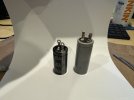
Adding a small ring terminal to these caps really makes for a much cleaner connection, I also always try to match the physical size of the
original components.. To the untrained eye I want this to look factory original, Im not going to use components that are much smaller and
then fill it in with filler like tape / rubber etc. That will work if the specs are ok but it also has to visually look good and can be done better.

IMG_2040.JPG

Bend / Attach / Solder

IMG_2314.JPG

IMG_2317.JPG

It should fit and look similar to when it left the factory

IMG_2320.JPG

I can see the light at the end of the tunnel, Few more components and this will be done........
 
Last edited:
Tonight I tackled some final parts I was dreading, Two phono gain capacitor / resistors that were buried under a ton of fragile wires.

phono-gain1.jpg

I debated skipping these but then spoke with a mentor who has helped me with the build and he stated they are in the signal path so its not wise to skip,
He also mentioned the hardest part to reach is just a ground that can be relocated.. Once I learned I could relocate the ground and saw both + leads were
easily reached from the top I was good to go plus it didnt feel right to do all this work and leave those two alone.

GAME ON! ( snip / remove and lets go )!

sleave-parts.JPG

Electrolytic's / Resistors Replaced -

Location - C1
Original Value - 47μF / 6.3v
New Value - 100μF / 25v
Location - R6
Original Value - 270Ω
New Value - 274Ω
Location - C2
Original Value - 47μF / 6.3v
New Value - 100μF / 25v
Location - R7
Original Value - 270Ω
New Value - 274Ω

Prepped the new parts & installed

parts-prep.JPG

parts-prep2.JPG

Few more cosmetic changes and this build is done, Hoping to have it all wrapped up in the morning.
 
Last edited:
Tonight I attacked some of the major chassis components, not all but most of them ( ill get the rest shortly )..

Board # - N/A Chassis
Parts to replace - 4 ( highlighted in green )

- Capacitors ( Main Power / Output Decoupling / Stereo Beam )
* Stereo Beam Cap is kinda hidden under the MPX board in the corner

Top view - ( Red Square / Arrow is to show where C3 is located on the bottom under the MPX )

View attachment 3105476

Bottom Corner View -

View attachment 3105461


Electrolytic's Replaced -

Location - C7 ( Output / Decoupling )
Original Value - 2000μF / 35v
New Value - 6800μF / 63v
Location - C11 ( Main Power )
Original Value - 2200μF / 90v
New Value - 6800μF / 80v ( increased based on B+=62V ± 3V )
Location - C8 ( Output / Decoupling )
Original Value - 2000μF / 35v
New Value - 6800μF / 63v
Location - C3 ( StereoBeam Decoupling )
Original Value - 470μF / 25v
New Value - 470μF / 25v

If you want more info on why we increased the main power & decoupling capacitor values please see the following post.

I also replaced the factory main AC fuse with a 3amp fuse ( original was 2amp ), This should handle the increased values across the resto a little better.

Before -

View attachment 3105466

View attachment 3105098

After -

View attachment 3105100


Adding a small ring terminal to these caps really makes for a much cleaner connection, I also always try to match the physical size of the
original components.. To the untrained eye I want this to look factory original, Im not going to use components that are much smaller and
then fill it in with filler like tape / rubber etc. That will work if the specs are ok but it also has to visually look good and can be done better.

View attachment 3105104

Bend / Attach / Solder

View attachment 3105105

View attachment 3105106

It should fit and look similar to when it left the factory

View attachment 3105101

I can see the light at the end of the tunnel, Few more components and this will be done........
I just got my 202 and saw that the 'traveling' light on the tuner (middle/left in this picture) is not working. I was wondering where you got your lamps or if you've run into this problem?
 
Back
Top Bottom