Thorens TD150 speed question

I just replaced the belt on my TD150 with a genuine Thorens belt as the generic one it had on was playing too fast and was making the switch from 33 to 45 quite noisey. Now with the new belt it still seems to be running a bit fast at 33 (coming in at 33.71 with a phone rpm gauge but plays spot on at 45. Is the speed increase at 33 out of the realm of normally accepted and what could be a possible remedy? Any info and help would be appreciated. Thanks in advance.
 
Register to hide this ad
I'm no expert but l don't think you'll hear a difference at. 33.71.
There maybe other things at play and someone more knowledgeable will be along soon
 
I'd clean the entire drive belt path with IPA, pulley and sub-platter, and wipe them dry, then try again. Where did you obtain the belt from? Is it really genuine?
 
I'd clean the entire drive belt path with IPA, pulley and sub-platter, and wipe them dry, then try again. Where did you obtain the belt from? Is it really genuine?
Thanks for the reply and suggestion. I got it at my audio store here in Portland. They’re reputable. I asked if it was a genuine Thorens belt, they said, ‘yes’ and it’s got the Thorens drive belt text in white on it. That’s all I’ve got to go on.
 
Motor azimuth could be off. Service manual will advise how to correct it - there should be an adjustment screw somewhere near the motor, probably hidden under the platter. The motor pulley is barrel-shaped to help the belt ride in centre of it. If the azimuth is off, the belt could be riding high / low and possibly rubbing on the speed selector arm very slightly. As suggested above, turn the main platter upside down and run at 33 rpm speed to see where the belt runs - if it's not dead centre of the pulley then adjust accordingly.
 
That's riding low in my opinion and the azimuth does look a bit off - see how the pulley seems to lean left slightly? That would also pull the belt low, which is what it is doing, and therefore the belt is stretched a wee bit.
 
Nice picture. Very helpful. Thanks.
I suspect two possible issues.
  • The suspension had sunk and the belt rides too low. You can try to adjust the suspension, tighten up a little bit, cause the sub platter to rise by some fractions of an inch, so it drags the belt with it up the pulley.
  • The pulley appears (this is based on the angle of the picture, so I'm not sure) to be a little off. The motor azimuth screw is responsible for adjusting that. IIRC it's the closest to the platter. You have to release the other two screws a little, to allow for some leverage, then adjust the azimuth screw (the one with the spring on the bottom of it) to straighten the pulley angle.
6rg3Zsk.jpg
 
Nice picture. Very helpful. Thanks.
I suspect two possible issues.
  • The suspension had sunk and the belt rides too low. You can try to adjust the suspension, tighten up a little bit, cause the sub platter to rise by some fractions of an inch, so it drags the belt with it up the pulley.
  • The pulley appears (this is based on the angle of the picture, so I'm not sure) to be a little off. The motor azimuth screw is responsible for adjusting that. IIRC it's the closest to the platter. You have to release the other two screws a little, to allow for some leverage, then adjust the azimuth screw (the one with the spring on the bottom of it) to straighten the pulley angle.
6rg3Zsk.jpg
Thank you! In regards to adjustment once I begin loosening the screw will the pulley adjust itself or how do I go about manually adjusting the PULLEY? How much do I loosen the screw? How much force if any do i exude straightening the PULLEY? I'm sorry, but I am pretty much a newbie in these matters
 
Thank you! In regards to adjustment once I begin loosening the screw will the pulley adjust itself or how do I go about manually adjusting the PULLEY? How much do I loosen the screw? How much force if any do i exude straightening the PULLEY? I'm sorry, but I am pretty much a newbie in these matters

Don't worry about the pulley for now - try to get the motor azimuth straight. I'm not 100% certain whether any force is required to adjust the azimuth or whether it's simply a matter of turning the adjuster screw. If you can get a small spirit level against the pulley, then adjust the screw, it should give an indication of where you're at. You could even try running the turntable with just the sub-platter and belt so that you can see where the belt is riding in real time while you make the adjustment.

As far the pulley itself goes, I can't say 100% where it is offset on the motor spindle. I was just going on what I could see in your pictures. When the motor runs, if you look down from above, does the pulley rotate evenly in a circular motion or does it appear to wobble? If it wobbles, it is off centre of the spindle.
 
Maybe we shouldn't get carried away trying to diagnose this from one quick cell phone picture. It is very hard to make anything look straight with those wide angle lenses. The belt does ride low but that would make it run slow.

First off, I would not rely on the RPM app exclusively. Place a mark on the platter edge, use a good stopwatch, and count the revolutions in three minutes. Should be exactly 100. If so, you're done.

If it really is running fast, some logical thinking is in order. The only things that can make an AC synchronous motor belt drive TT run fast are 1) drive pulley too large or belt too thick (which has the same effect), 2) inner platter too small, 3) line frequency too high. (The suspension height really has nothing to do with it; the belt will find its own place on the pulley and after a few revolutions, will ride on that same height on the inner platter.)

Unless somebody took a sander to the inner platter, we can rule out #2. The belt is genuine so that's also unlikely to be the problem. As for the drive pulley, it looks like the correct one to me. Is there any residue build-up on the lower section?

Which leaves us with line frequency. I have no idea what the power grid is like in your area (or anywhere else for that matter) but 33.71 is only 1.14% too fast. Probably not out of the question that your AC power is coming in at 60 x 1.0114 = 60.684 Hz.

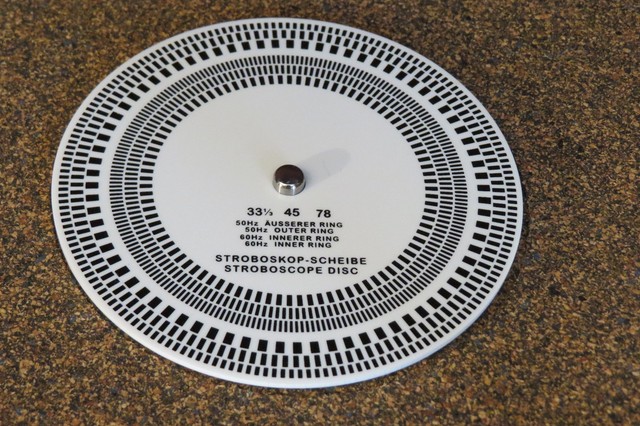
I would also use a good old stroboscope disc. Most people think those are speed checkers. Well, not quite, with an AC motor. Unless you have an independent light source, you're really checking one device running straight off of AC (the motor) against another (the light). Meaning it's possible the strobe disc will read perfectly but the speed is still off, because the AC frequency is off to begin with.

I'm going to stick my head out here and say the strobe will find it's running slow right now, because the belt is not running on the largest diameter of the drive pulley. If it's spot-on by strobe, but fast when you use your app or count the revolutions, then the AC frequency is your problem, and you can either live with it, or get a separate power supply that generates its own 60Hz wave.

 
I'm no expert but l don't think you'll hear a difference at. 33.71.
There maybe other things at play and someone more knowledgeable will be along soon
Gotta go with Thomo on this one. LP's were recorded at 33 1/3 (33.33), and the OP has checked the speed on his table for LP's as being 33.71. Which is a difference of +.38 in speed variation. I don't believe that I could hear the difference. But I am sure that there are some that can. I use a cheap strobe disc I bought eons ago. It has been pretty reliable in checking the speed on my Thorens tables.

s-l640.jpg
 
Thanks everyone for the quick and insightful input. I think I’m going to get a strobe disc and check for accuracy that way. From there honestly I’m probably just going to live with it for now, the speed isn’t really noticeable and if it becomes a bigger issue I’ll address it then. Thanks again.
 
Back
Top Bottom