• The move to the new server is done. There are some software and database maintenance updates in process. This has us passing the hat around to help out. We appreciate any donations. Seriously, even a dollar helps. The payment page may be found here - https://www.audiokarma.org/support.html

Turntable platforms

Friskiedgrrl

New Member
I'm reading about how turntable isolation platforms are supposed to isolate your turntable and I'm wondering about everyone's thoughts on the subject. To me, it seems like a heavy block of something (be it MDF or other material) to sit your turntable on. I'm thinking that a thick piece of marble with feet would work.

Anyone care to chime in?
 
Register to hide this ad
The type of table support that works best is usually dependent on whether the table is suspended or not, the type of floor and where the table is located in relation to your speakers.
Mass isn't always the answer.
If your floor is springy, a wall mount may be better.
etc
What table do you have and what's your floor like?
 
Last edited:
I
The type of table support that works best is usually dependent on whether the table is suspended or not, the type of floor and where the table is located in relation to your speakers.
Mass isn't always the answer.
If your floor is springy, a wall mount may be better.
etc
What table do you have and what's your floor like?

It is a Dual 510 that will be in my carpeted bedroom. No place on the wall for a mount.
 
If you have wood floors under the carpet, a stand with spiked feet and a heavy-ish platform on top could help with foot step bounce problems. If it's a slab floor, you really won't have a problem with floor transmitted vibration.
I believe the Dual has a semi-stiff suspension - like it's not very bouncy - so even airborne vibrations may not be a problem.
The last suspended table I had was a Linn, which I never warmed up to. I have a non-suspended table on a wall mount now.
 
My view is that best use for platform is to eliminate any micro-vibrations reaching the turntable, even for suspended turntables. So all my platforms are just blocks of industrial strength vibration insulator.
 
My view is that best use for platform is to eliminate any micro-vibrations reaching the turntable, even for suspended turntables. So all my platforms are just blocks of industrial strength vibration insulator.
This is not necessarily an optimal solution. Industrial vibration isolators work with a certain weight range and at certain frequencies. I used to do mechanical design and engineering and we would specify isolators for equipment based on motor RPM, pump type and weight for process pipping. In another field I was involved with, we specified the hardness / softness of isolators to lessen the transmission of vibration from aircraft structure to the interior components to lessen noise and cabin vibration.
Turntables in a room are not much different. Your solution could work for you but it's just luck if it does.
If you really need to isolate your table like this, a commercial product like a vibrplane is the best. Some of the sand boxes work nicely as well.
 
This is not necessarily an optimal solution. Industrial vibration isolators work with a certain weight range and at certain frequencies. I used to do mechanical design and engineering and we would specify isolators for equipment based on motor RPM, pump type and weight for process pipping. In another field I was involved with, we specified the hardness / softness of isolators to lessen the transmission of vibration from aircraft structure to the interior components to lessen noise and cabin vibration.
Turntables in a room are not much different. Your solution could work for you but it's just luck if it does.
If you really need to isolate your table like this, a commercial product like a vibrplane is the best. Some of the sand boxes work nicely as well.
I tried it on eight turntables, works great for every one except Rega P6 which sounds a little different with it, but not better. Rega is specifically designed to not conduct or develop any vibration. I do calculate weight/surface ratio for optimal loading, and sometimes put some buffer between plinth and insulator, not needed if bellow original feet (it can get unstable under already shaky feet, so plinth better unless suspension is tied to the feet not the plinth so it would bottom out).
 
Anyone care to chime in?

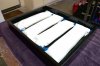
Sand effectively converts vibration to heat as the grains of sand rub together when reacting to a vibration. Sand boxes are often used to isolate turntables but they can be messy so I used sandbags versus loose sand when I built a platform for my SP-25. A couple of photos:

DSC_0040.jpeg

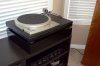
The TT sets on a piece of plywood that rests on the sandbags without touching the walls of the tray. It is effective.

DSC_0043.jpeg

The sandbags could be replaced with an inflated bicycle tube. The downsides of that solution are the tube will leak air over time and it is more difficult to keep the TT level.

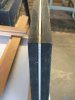
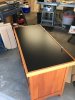
I have also used a Constrained Layer Damping (CLD) method comprised of 1/2" MDF - 3M CLD Tape - 1/8" aluminum plate - 3M CLD Tape - 1/2" MDF for the top of my current equipment cabinet. I used the same scheme for the plinth of my Technics SP-10 MKII TT. It is effective too.

IMG_2792.jpeg

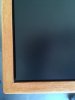
The CLD does not touch the side of the tray and sets on top of Sorbothane discs selected to match the weight of the top and the TTs that will set on it.

IMG_2825.jpeg

IMG_2822.jpeg
 
Back
Top Bottom