Typical Day In My Back Yard

Now comes the "nasty" part. After having been ripped in three directions, they'll disc it again, then level it with a scraper. Since it hasn't been irrigated since May, it's getting pretty dry. Here's the disc making a pass a few minutes ago. Our house is 50' to the left of me, and the wind blows in that direction. And, it will get even dustier before they're done.

Such is life!

disc.jpg
 
Last edited:
Today a scraper is doing a leveling job on the field. He just made a pass behind the office. Needless to say, the wife has postponed her window washing for awhile.

scraper.jpg
 
Well, they brought out the big boys yesterday. Since an almond orchard will last in excess of 25 years, and Tracy is quite windy, you want the trees to be able to shoot down a good root system. That being said, you really should do a deep rip - not like the earlier ones. Yesterday morning, I looked out the window and saw one of these. About an hour later, another showed up.

Here's the pair working - a D10N and a D10R:

D10RampN.jpg


The D10N by itself:

D10NrippingSCF0581.jpg


With the ripper lifted out of the ground:

D10N.jpg


The D10R:

D10R.jpg


And after they rip, the scraper makes a pass to smooth the ground out again:

Scraper2.jpg


D10s can consume about 17 ga. per hour. At just under $5 a gallon, you can imagine what it's costing the farmer to have this done. The tractors themselves - you can buy a used late 90s D10R for around $300,000.00 with 20,000 +- hours. A used 2011 D10T - about $1,250,000.00

Lot of money going on out here!
 
Last edited:
D-10s! D-8s and 9s are enormous, but those are gargantuan! I think I've seen 1 D-10 on a site in the last 20 years. The 8's and their ilk are a big part of the reason my hearing is so badly damaged, having worked around them for years.
 
Well, the REAL dusty part is finished. Now, it's time to mark the field for the trees. They had the field surveyed prior to working it, and now, setting the rows in place. Most modern tractors have a sophisticated GPS setup in them for getting rows straight and the spacings correct. This tractor is pulling a tool bar that has three markers 14' apart. After he's finished in one direction, he'll change the markers to 20', and cross the field.

markers.jpg
 
Last edited:
And the cross markers:

crossmarkers.jpg


The one in the center will be where the tree is planted. The other two is where the sprinkler line will go. They mark both sides because the tractor turns around at the end of the field, putting a single marker on the wrong side of the tree line.

At the north end of the field, just to the left of the tower, you can barely see a pile of white PVC mainline pipe. The old well that used to irrigate the field was at the southwest corner, but it collapsed early this summer. That was part of the decision to put in the trees. The natural fall of the land is to the northeast, but it won't matter for the pressurized mini-sprinkler system.
mainline.jpg
 
Last edited:
Thanks for this thread. Very interesting. Few people would have any idea what's involved in prepping a grove like this. I know I didn't. Hope your audio gear is covered up!
 
Thanks for this thread. Very interesting. Few people would have any idea what's involved in prepping a grove like this. I know I didn't. Hope your audio gear is covered up!
The dusty part is pretty much done. They're laying the mainline out this afternoon. We might get a shower this weekend. That would sure help!
 
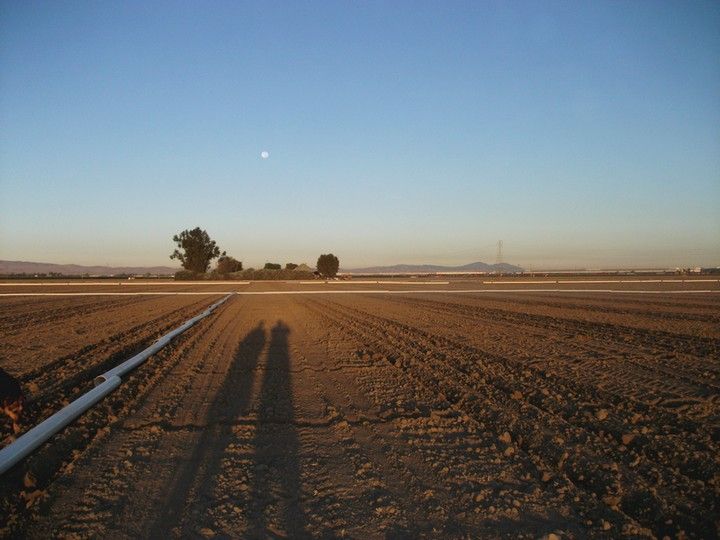
Not a very good photo, but here it is anyway. They started laying the mainline in the field for the sprinklers. We are walking in tire tracks, about halfway through the field crossways, and we're about halfway to the house. Note our pudgy shadows - the pipe sections are 20' long, and our shadows are about 80 feet long. It's just before 7 AM, and the sun has just come up over the Sierras behind us.

You can faintly see the moon - it's about over San Francisco (west). Again you can see Mt. Diablo, and the long white building is the almost completed Amazon Distribution center.
pipe1.jpg
 
Lots going to happen in the next week or so. We walked up to the yard today so you could see some of the parts that go into the system. This is just a part of them. Some are already in the field waiting to be assembled. There are T', couplers, pressure regulators, etc. for the micro sprinkler system. Like I said, there is quite a bit more.

parts.jpg


While the sprinkler system is being set up, they have started punching the holes for the trees. Here' they're using 2 for now, maybe 3 since they started the installation so early.

holes.jpg


Here's a closer shot. I'll get a better one when they're up by the office.

phdigger.jpg


Side note: Since my heart surgery in 2005, I'm supposed to walk 4 days a week. I decided that if I'm going to do it, I'll do it right. I walk 365 days a year, sick or holidays, rain or shine. I go out sometime between 6 and 7 am and watch the rest of the world wake up. Since I live in the country, I'd be crazy not to walk through the fields and enjoy the scenery. Although the wife has been walking with me lately, here is my usual companion. Max was about to go to the pound when we got him off of CL. He's a great dog, loves the wife and kids, but can be a little on the mean side. Our fenced yard is about 1/2 acre of lawn, dirt, and trees, so he has plenty to do. He walks with me in the AM, and I let him out late in the afternoon to chase rabbits and squirrels if the mood strikes him. He has arthritis pretty bad, and if we take him off the meds he has a rough time walking. Give him his pills, and you'd think he was a puppy. The vet says the pills are expensive, but they'll buy him a few years. He decided he wanted his photo taken this morning.

max.jpg


Don't know if they work on Sundays or not, but I'll be out there if they do. As I was typing this, another posthole digger came in on a truck, so they'll be running three. I spoke to the foreman this morning (he was in the yard assembling valves) and he said the trenchers would roll in Monday, so it's going to get pretty busy.

 
Last edited:
And, a hitch in the git-a-long. All those clouds in the earlier photos? Well, they decided to temporarily alleviate the dust situation today. A little late, but life isn't always fair. The puddle at the bottom is from the downspout on my warehouse. Hardly any rain, but enough to send the crew home for the day.
showers.jpg
 
Some assembly is now beginning before the system is put in the ground. Back in the "old" days, any time there was a joint or riser, you had to cut the pipe, then put in a tee, cross, coupler, or whatever. My, how times have changed. This 4" pipe was assembled last week. This morning, one worker walks along the pipe with a DeWalt cordless drill and a hole saw, and punches a hole in the appropriate spot. Later on, a worker will come by and glue the saddle on. I imagine they'll let it sit a day before installing the riser. Once the trench is dug, they'll follow it along and set the pipe in the ground.


risers1.jpg


One of the trenchers showed up on a truck awhile ago, and I imagine the others are on the way, too (he said there would be several). They brought in a tiny dozer last week. I imagine it will close the trenches afterwards.
 
Last edited:
Just so you'd know, most of this is about 1/4 mile from the house. The wife, dog, and I walk through the field so I can get up-close-and-personal photos. Here's the saddle glued to the 34" pipe:

saddle.jpg


A shot of some of the hardware that goes into the system:

hardware.jpg


One of the mainline valves plus other couplers, etc.

valve.jpg


I gave you some misinformation in a previous post - not all the pipes are gasket sealed. Some are glued, as are the tees and couplers. Here's a shot of both types. I don't know why one is used over the other, but will find out.

pipe2.jpg


And lastly, a closer shot of the posthole digger:
phd2.jpg


The trencher hasn't started yet. Soon, I would imagine.
 
Larry back in the mid 1970's my dad who had been a helicopter flight engineer back in the H-19 H-21 days (in the National Guard) was the commercial foreman for a heating and airconditioning outfit in Salem, They were putting the HVAC into a new mega store. The units weighed over 2000lbs and sat on top of the store. This would have required a pretty good sized crane.

My dad got to thinking and called Evergreen Aviation and asked f any of their big copters were logging in the area. Turns out that they had a Sky Crane that passed near to Salem on its way to and from a logging site to the East of Salem every day.

So dad placed the bid on the job based on 30 min of copter lift time. Instead of the cost of moving a crane down from Portland.

The copter showed up they dropped the logging line and Dad had a guy connect the first unit. They lifted it and moved about 40 ft lowering it onto the flange (dad and another guy had long pry bars to move the units as they were lowered. The instant the Unit was in place the hook was opened and they moved back over the other unit and repeated.

Total helicopter time was less then 15 min with no charge for transit since the bird was on a path almost directly over the Store anyway.

Turns out this was the first time anyone had done this in Oregon.

somewhere in my stuff I have some slides of the operation one of dads buddies took

Thanks for reminding me.
 
The trencher fired up yesterday. Not sure exactly where the water is coming from yet. This photo is facing due West, and there is a pump at the end of the mainline. However, there was another well in the southwest corner that collapsed. I don't know if they are going to use the center one (not too good, from what I've been told), or drill a new one to replace the old. Anyway, here's part of the mainline. The box in the trench keeps dirt out of the cross.


mainline1.jpg


Here is standing in the same spot, facing south. Our place is to the left.


mainline2.jpg


Another 12" cross: (edit: The list price on a Spears Sch. 40 12" cross is $199.00 That will give you an idea what part of this operation is costing!)

maint.jpg


The Vermeer trencher. It digs the dirt up, then drops it on a conveyor that piles it on the side. The guys follow along and assemble the line as they go.


trencher.jpg


This trencher doesn't have GPS, so they resort to more "traditional" ways of guiding themselves. You'll see a stringline just to the right of the track. Up to the front, you'll note a length of 3/16 chain hanging from a piece of angle iron. That's the marker guide. The driver keeps that chain dangling over the stringline, and the trench is straight.


guide.jpg


While typing this, a truck drove into their yard with another trencher. Time to get busy!!
 
Last edited:
Here's an overhead photo (2011) to give you an idea of the whole project. The oddball shaped piece outlined in red is mine. It's about 7.5 acres. The piece in blue is where the sprinklers are going - about 250 acres.

The white roof in the upper left is a Best Buy distribution warehouse. The clump of buildings top center is known as Banta - a bar, a school, and a bunch of houses.


project.jpg
 
Back
Top Bottom