
VPI introduces new arm

Bigerik

AK Subscriber
Subscriber
Now this is totally amazing technology!


VPI's Harry Weisfeld demonstrated a new one piece "3D printer" version of the long-running JMW Memorial Tonearm last Saturday, March 23rd at an open house attended by member of The New York Audio Society.
The unipivot tonearm is manufactured using a 3D printer that produces a one piece arm from head shell to counterweight stub, with no joints in between. The arm is formed from a plastic epoxy-like material that is said to produce an ultra-rigid, lightweight, self-damped structure. The shape of the tonearm shaft is said to produce further rigidity.

Weisfeld had Grado Gold cartridges mounted in both a standard JMW and a 3D printer version that allowed for quick and easy swaps and A/B listening. Attendees told me the differences were "profound" and all were in favor of the new tone arm. The Grado/3D printer arm combo produced an ideal 11Hz resonant frequency with but a 2dB amplitude.

No price was announced for the arm but the machine that produces it costs hundreds of thousands of dollars and takes a considerable period of time to produce just one, so it certainly won't be inexpensive.
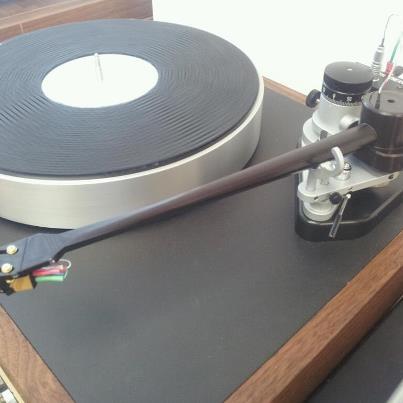

VPI.jpg


http://www.analogplanet.com/content...l-tonearm-and-new-direct-drive-turntable-moto
 
Register to hide this ad
Sweet! I hope the prices come down from whatever they'll start at...which I'm assuming won't be cheap given the overhead. I've been contemplating another arm wand for my VPI for a long time, as they're so easy to swap out. Thanks for the heads up!
 
As I said in my post in the other thread, the machine that makes the arms costs $350K, but it can make 12 arms at once. Build time is about 22 hours.

The arm is a snap-in replacement for the JMW-10.5 - that's why they could switch back and forth so quickly.

I can attest that the sound quality improvement is significant. The Grado Gold cartridge we were using, while nice, is probably not typical of the sort of cartridge that will be mounted on these arms, so I would expect an even greater improvement in normal use.
 
I envy you the opportunity to experience that. That really seems to me the future of record playback.

I must say I have had some fun visiting at TTWeights and seeing their new stuff. I still owe everyone a post on their latest tables.
 
That must be some 3D printer. We have one at work to create show and tell models of our designs to present to our customers, but it leaves a very rough surface and the tolerances are not very tight to begin with. Ours did not cost anywhere near what that one cost though. Very cool idea.
 
Hello, I understand that this is an old post, but I had to chime in here. I have a VPI Classic 3 that came with the massive JMW uni pivot arm, and in an effort to improve the low resonance, I went through a few different newer VPI tonearms, including the 3D unipivot FatBoy, the standard 3D gimbal, and the FatBoy 3D gimbal tonearms. While the original uni arm sounded excellent, it was a beast to maintain alignment. Every adjustment affected every other adjustment, similar to the convergence on an old RCA color TV. I got tired of fiddling with it every time I played a record. The 3D uni has a couple of flaws, like the “side azimuth weights. They are not tensioned with springs causing them to be just a couple of loose screws. And the arm itself has a taper that continues to the headshell. So the top taper actually continues all the way down to the headshell causing improper VTA alignment at the cartridge, but lowering the arm way down fixes this. On the FatBoy gimbal, the same is true, but here what happens is that the gimbal is far from center when the headshell VTA is aligned. A tapered shim fixes this, about 1-2 degrees or like 2mm in the back and 1mm in the front. Technically, the gimbal should be approximately centered with an average height cartridge, 18-20mm. What happens when I put an 18mm block on the headshell, is that the arm must be lowered significantly to compensate for this angle. The headshell should follow the center line from the bearing, not the taper of the arm. Anyone else notice this? I discovered this flaw after purchasing the Wally Tools reference tool. The pic shows a centered bearing and the taper at the end. I attempted to use the shim from Wally tools to compensate, but the angle is specifically made for this cartridge at a level VTA. Thank you JG
 

Attachments

  • IMG_3103.jpeg
    IMG_3103.jpeg
    101.4 KB · Views: 16
I have a Fat Boy arm on a VPI turntable made foor Mark Levinson and called a 515B. VPI is now selling their version called a Dragon. Both have Gimbaled arms which I much prefer. They are easier to handle manually and the idea of watching the arm resonate or wiggle while playing a record just scares me all most to death when using a singlepivot tone arm.

Having owned great sounding SME arms in the past for my other TT I much prefer the Gimbaled arm on my VPI 515B turntable. I now have a linear arm to replace the SME arms on the Thorens Td 125 since 76 or 77.


If I had the space I would have two Bergmann TT's with linear arms and vacuum LP hold downs. It also Might be fun to have a Clear Audio Ovation table with a TT-5 linear arm as a replacement for the TD 125 as it would fit. . Might be more fun to have a SME 35 turntable if I had the space. I always wanted one of the Big Aries Model 3D with a fat boy arm with a speed controller, but just didn't have the physical space. Plus I got the Mark Levinson for half price during Covid be fore the HiFi rush started. It was considered a demonstrater at a high fi show some where. Its a great table once you get it set up properly which is no easy task!!!
 
Hello, my experience with the 3D Fatboy uni was a bad one. If it were my company, I would have never produced this tonearm. There just isn’t enough mass at the pivot for satisfactory results. And those so called azimith weights… useless. If it were my company, I would have made an arm base to accommodate third party tonearms, something that they have completely avoided. Perhaps for the FatBoy Gimbal tonearm, producing an angled shim out of the same material to compensate for the angle of the headshell portion off the arm. I guess I am going to sell the deck with two tonearms for an unrealistic bargain of less than half, and invest in something more accurate like a Kuzma. I get so tired of fiddling around with unsatisfactory products, trying to find the sweet spot. That one also has a lot of noise that gets transferred from the motor. My 1200G has a similar problem with the tonearm height not going down enough to accommodate the 17mm cartridge. However the noise level of this deck is fantastic, which keeps me using it. Had they only made the spindle 1/2” taller, that deck would be perfect.
 
I a not convinced, 3D printing is more about printing what is possible to print , than printing what is needed.
 
Yeah, possibly in an effort to manufacture the tonearm without casting and machining metal. I had a 3D printed Zircon crown made in a few hours, so that was a good thing, perhaps a little bit off topic. The tonearm has a little bit of flexibility, which is a huge no no for a ‘high end” tonearm. I hate the metal finger lift as well. It looks cheap and generic, and is a little bit magnetic.
 
Back
Top Bottom