
s-petersen
Scott
Anybody know what this is? Is the tube a rectifier or Triode?
The filament transformer is good for 6.3v @ 35a


The filament transformer is good for 6.3v @ 35a



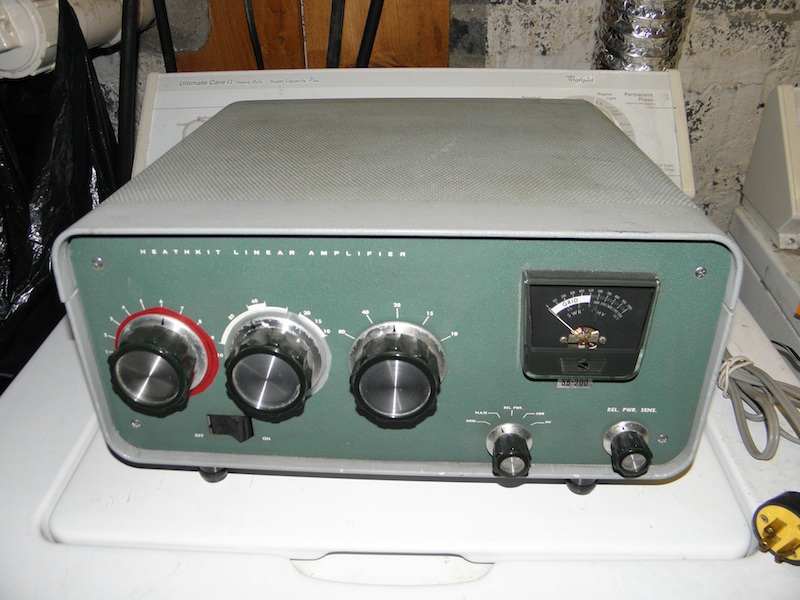


Looks like it could pump out 300W in single-ended class A service, idling at 3KV and 250mA, with about -75V grid bias, and no fan!It's a pretty hefty tube.

Looks like it could pump out 300W in single-ended class A service, idling at 3KV and 250mA, with about -75V grid bias, and no fan!


Bummer, I was getting kind of thirsty.The coiled white tube is some kind of inductor , it is a piece of heavy wire covered in something like Teflon, and supported on a nylon threaded rod.
The copper pipe has an insulated wire inside, also covered in Teflon

Not sure off-hand that any pentodes have been made in that form factor. Most of the transmitting tubes in that form factor were triodes, occasionally tetrodes. Some transmitting pentodes do exist, but they're either a LOT larger (5CX-series), or in a different form factor. Most of the transmitting tubes on this list are either triodes or beam tetrodes. The largest power pentode I could find listed was the 803, which looks quite a bit different than the T800-3 in the OP's device, and is rated for 'only' 53W in class B phone (210W in class C CW, which is less than a tenth of what the T800-3 is rated for in that mode).Why does it have to be a Rectifier or Triode? Maybe a Pentode?


