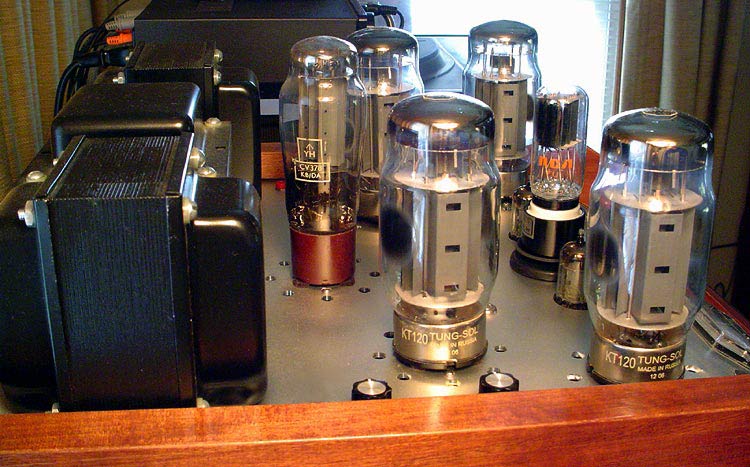
Where do I put the tube dampening rings?

My system IS Audio Research.I have also been specializing in the service and restoration of their products for several decades. What is your point?
 
In my experience, tube dampers made a big and immediate difference on my Audio Research amp and pre-amp. It lowered the noise floor and allowed me to hear deeper into the music. You don't realize the noise is there until it's reduced. They recommended two rings per tube (not the output tubes) as close to the top of the tube as possible.
As for the naysayers, its a tweek no different than say anti-vibration footers, correct speaker positioning, room treatment ect...I found it to be an affordable easily heard improvement in MY system.
 
edit: I think I may have missed your humor. I gather we're on the same page. :)

Yessir,we are indeed on the same page. I may have been a little too sarcastic,sorry about that.:beerchug:

Unfortunately,I have been unable to find my records of an analysis that I once participated in that specifically analyzed the effects of vibration (chassis and airborne) on generating sympathetic vacuum tube output,and also it's effects on waveforms actually being amplified by the device under test when subjected to these signals.We ran the entire gamut of frequency spectrum,using both swept and fixed frequencies,and at many different levels of amplitude.

The results were conclusive beyond any doubt: vacuum tube damping clearly reduced,and at some frequencies virtually eliminated, induced anomalies. The science does not lie. This is nothing more than basic engineering. Tubes are mechanical assemblies,and any variances in the dimensions between elements will generate spurious signals or modify signals being amplified. Certainly,some systems may be more susceptible to or more affected by these factors,but they exist no matter what. Whether or not you can hear them or have the equipment to measure these effects is immaterial. They exist.

Cheers,

Art
 
It take two, used together. Use the golden ratio; from the bottom, put an o-ring at the specified ratio point, and the reverse from the top. If that measurement is not precise down to fractions of an mm, it won't work and all you will detect is the aroma of curing o-rigs when the tubes get warm.
cheers,
Douglas
 
“MilSpec” materials come off the same production lines as commercial. They just pull the stuff and put it thru a test.

Well ... ya? Goes without saying really.

My favorite version of this business model is computer CPUs ... How many cores you're paying for depends on how many cores tested well in identical chips. My version of playing the lotto was buying a cheaper chip and seeing how much luck I had "unlocking" the "bad" cores that didn't muster up on final inspection.

Same with modern production tubes as well. They're all built in a limited number of facilities, and sold in bulk to private concerns like TAD or Psvane. They in turn do extensive burn in/testing/matching and reject a bunch that I'm sure the factory resells to less picky buyers.
 
Well ... ya? Goes without saying really.

My favorite version of this business model is computer CPUs ... How many cores you're paying for depends on how many cores tested well in identical chips. My version of playing the lotto was buying a cheaper chip and seeing how much luck I had "unlocking" the "bad" cores that didn't muster up on final inspection.

Same with modern production tubes as well. They're all built in a limited number of facilities, and sold in bulk to private concerns like TAD or Psvane. They in turn do extensive burn in/testing/matching and reject a bunch that I'm sure the factory resells to less picky buyers.

My point is MilSpec typically does not mean much.
 
My point is MilSpec typically does not mean much.

I was on the range once with my C1 (modified British L2A1 Sterling SMG) and dumped an entire mag downrange,despite my selector being set to single shot. We had received a complete shipment of undercharged rounds, which often lacked the oomph necessary to blow the bolt back onto the trigger locking sear. Range Officer gave me "the look".I just shrugged and rolled my eyes.
Life went on. Just another MilSpec day :cool:

Historical note: The SMG ( somewhat modified,haha) was used for the Blaster in the first Star Wars movie.
 
Historical note: The SMG ( somewhat modified,haha) was used for the Blaster in the first Star Wars movie.

I was at a joint US/Canadian Command on Whidbey Island for 3 yrs. I understand why the Canadian Military would get their weapons from a Hollywood props armory ;)

:beerchug:
 
I was at a joint US/Canadian Command on Whidbey Island for 3 yrs. I understand why the Canadian Military would get their weapons from a Hollywood props armory ;)

:beerchug:

Yep. Probably the same place we picked up that blue shoulder flash;)

2ppcli-flash.png
 
Mil-spec means, it’s performance meets design specifications, and it is tested in both the lab and “field” environments....Never meant it is the best.

Small arms magazines are a great example of making sure an item meets mil-spec. During the last Iraq war many purchased extra magazines for their weapons, we normally carried a double basic load or more, and many of those magazines were from “high end” sources.

Some of these individually obtained magazines produced some horrible experiences, magazines swelled and would not release, or contracted and fell out at the worst possible moment, in fact so many problems that commercially bought magazines by individuals were banned....

Many other examples, the Center for Army Lessons Learned (CALL), collects data like that and produces findings, believe each Department of Defense agency now has a CALL equivalent.....

Testing is extensive, it covers all types of environmental conditions, real and simulated.

Never think Mil-spec doesn’t mean anything, research what it was designed to do, and then decide if it meets your requirements (-;

Highest Regards,
Andy
 
Speaking of Canadian Milspec ... got me a real deal on a couple GZ37's a while back. Good luck finding any more though ... certainly not for what I paid, eh.

6sn7-installed.jpg
 
I have it pretty good, one of our vendors can get NOS JAN stuff pretty easy. Not that it’s any different than branded NOS stuff, just typically a lot cheaper for me :D
 
OK, no one has solid evidence they do anything positive but there are one or two "seems to" reports. There's a bit of theory behind their use too, but not convincing. There is also an "appeal to authority" argument that a major manufacturer uses and recommends them.

Against is that small signal tubes are the intended application and I want to use them on power tubes.

But I already had them so marginal cost is zero and they are qualified for the glass temperatures expected so no downside.

The winning argument?

They look COOL so pimp my amp!

Tube rings verticle (2).jpg Tube rings 8 installed.jpg
 
Last edited:
Back
Top Bottom