• Please note that Audiokarma will be offline briefly for updates early on Monday morning, September 28th.

New here, first Sansui AU-719

Mk1mk

New Member
Hi I'm new here although I did a fair bit of reading before joining.

I have recently bought my first Sansui an AU-719, I now need guidance on what is required to make it reliable.

The previous owner ( said he was an electronic engineer) had gone through the amp checked the bias/ dc offset cleaned all pots and switches and said it worked a treat.

So the first thing I have done is to check for the 4 black flags, which are still fitted!! They need changing asap are there any other parts that should be changed for reliability without going down the full restoration route?I can't seem to see any glue damage.
I have powered it up once to see what happened, all seems good no crackles on any switches and no cutting out or tripping. To be honest the sound quality has blown me away.
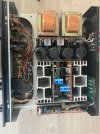
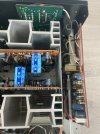
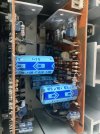
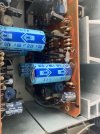
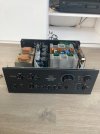
I have added a couple of photos to start with (how many can be added to a post ? so the experts can give me opinions/ advice on what is required apart from the black flags.
Thanks everyone.
 

Attachments

  • Au 719 (9).jpg
    Au 719 (9).jpg
    96.7 KB · Views: 41
  • Au 719 (8).jpg
    Au 719 (8).jpg
    144.3 KB · Views: 43
  • Au 719 (2).jpg
    Au 719 (2).jpg
    131.4 KB · Views: 42
Register to hide this ad
Wellcome to AK , first of all .
Hope you enjoy your stay and finally find what you were looking for !!!

The least you should do , as you said, is to get rid the black flags.
Then Change the trim pots … make alignments again.
What the previous sound engineer and owner said about the 50 years old electrolytic ? Maybe you need to consider changing those too for future reliability and more tight and controlled alignments.

If the glue is removed by the previous owner you have one off your plate !

Good luck !
 
Thanks,
Where can I find out what trim pots are required ?
Is that a diy job or need an expert ?

My long term plan is a full restoration, I would just like to use it for a bit with out the risk of damage.
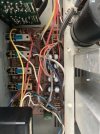
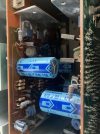
I have added some more photos.
 

Attachments

  • Au 719 (3).jpg
    Au 719 (3).jpg
    131 KB · Views: 19
  • Au 719 (4).jpg
    Au 719 (4).jpg
    127.6 KB · Views: 22
  • Au 719 (5).jpg
    Au 719 (5).jpg
    106.1 KB · Views: 22
  • Au 719 (6).jpg
    Au 719 (6).jpg
    116.6 KB · Views: 22
  • Au 719 (7).jpg
    Au 719 (7).jpg
    107.5 KB · Views: 20
You need to download the service manual,
It’s free on “HI FI engine “ to see values of components , mind that on your amplifier might be other values installed , you need to replace components with what is in your amplifier and not in the schematics.

It’s not a DIY job but you need to have some basic knowledge to do things by your self , if you don’t feel comfortable, it’s better you find a good tech , specialist in vintage amplifiers ( depending where you are located, you might find someone from this forum that is willing to take up the task)
and let him do the refresh/ restoration for you .

Regarding your question , you will need to remove the power amp modules , remove F-2926 and F-2927 and replace the DC offset trim pot ( VR-1 marked in the schematics) with a multi turn ( preferably ) 100ohm and the Bias current trim pot
( VR-2) 470 ohm.
On the schematics you will find the process how to re-adjust the values .

Forgot to say that the relay , if not replaced already from the previous owner, it needs to be replaced most likely too.
 
Get the service manual. DIY job is quite a question. If you have zero experience in electronics repair/upgrades, it will be your learning piece. Typically learning pieces are not items that you highly value and plan on keeping for a long time. That said, if you have some basic skills, the service manual, a good soldering iron/station, multimeter, some basic tools, the correct replacement components along with the ability to read a schematic and a cautious approach, it does not require an 'expert'.

50 year old PCBs can be very fragile. When removing and replacing components lifted pads, broken traces, cracked PCB boards, glue, and broken wires are all problems you need to be prepared for. Electrolytic capacitors are polarized and need to be oriented correctly. The risk of introducing problems during the 'upgrades' is quite high as you can see by reading the many threads on this site asking for help after attempted repairs/upgrades caused the working unit to fail.
 
AU-719 must do's

Sansui glue removal. (and removal/cleaning off every trace of it on PCB's, components, and connecting wires.
Speaker relay replacement, very likely (as already advised)
Black Flags (x4) - must be replaced.
Trimmer replacement - the 4 (2+2) on the driver boards are no trouble, providing you get the correct orientation trimmers. However there are another 2 on the Phono EQ board which when replaced with modern trimmers can be difficult to adjust, because of where they are on the board - needs care.
Thyristor 2SF656 in the protection circuit - needs replacing as they go faulty with age.
Transistors 2SC1313 should be replaced because they go noisy with age. (There are sometimes some 2SA transistors found which are also unreliable).

That's about all I can think of at the moment, the rest is just standard good restoration practice. :)
 
Last edited:
Firstly thanks everyone for your input and advise.
I'm an electrician by trade and did an electronic servicing course 30 years ago so I do have some idea about soldering etc. Probably a bit rusty but I'm sure it's all doable.
I guess I'm at a crossroads bite the bullet and get a full restoration by an expert or tackle some of the essentials myself.:confused: I'm sure it would take me twice as long as someone experienced so is it worth it!!

I'm Uk based any recommendations for a experienced tech to carry out a full restoration ?
 
Firstly thanks everyone for your input and advise.
I'm an electrician by trade and did an electronic servicing course 30 years ago so I do have some idea about soldering etc. Probably a bit rusty but I'm sure it's all doable.
I guess I'm at a crossroads bite the bullet and get a full restoration by an expert or tackle some of the essentials myself.:confused: I'm sure it would take me twice as long as someone experienced so is it worth it!!

I'm Uk based any recommendations for a experienced tech to carry out a full restoration ?
If youre an electrician & have basic soldering skills you should be able to do any soldering required to replace electrolytic caps or trimmers, Im an amateur but have been soldering lots of things since I was a teenager, with a basic pencil type solder gun I was able to replace all electrolytic caps & output drivers on my 719, theres lots of threads on here regarding these 719's, heres a link to my recap thread with info on what caps to get and some tips on replacing caps without fully removing the power/protect or phono/EQ boards. https://audiokarma.org/forums/index.php?threads/au-719-recap-questions.1051193/

If yours works & sounds good now with no excess noise or scratchy pots then chances are most things like transistors & the protect relay are ok to leave alone unless theres an issue. I consulted with a few professional techs before recapping and most said "if it aint broke dont fix it" regarding most other components. So I just did the glue removal, lytic cap replacement & all black flags caps, relay was clean & working great, big power filter caps tested withing spec so left them alone. Amps works & sounds excellent after the recap & dead left side output drivers.

Looks like the glue was removed from the blue caps on the amp boards, but be aware there are more caps with glue on the power/protect board too so check those. Surprised the prev owner didnt replace the known bad BF caps, can buy TDK C0G replacement for very cheap price. By all means if you want a full restoration then find a good tech to do that work, but IMO & experience, if its works & sounds good now, most the parts can be left alone and just replace the lytic caps. Same for the trimmers, if they work now & you can set bias/dc offset, they can be left alone, mine worked fine.

Good luck!
 
Welcome! There is nothing more satisfying than working on one of these machines, making restorations, and then having the amp work as good as factory or better on the other end. And you will find all of the support you need here to dive right in. Having said that, @Hyperion is near you and you will be hard pressed to find a more conscientious, skilled and enthusiastic Sansui technician in your part of the world. Good luck and keep us posted!
 
Last edited:
If youre an electrician & have basic soldering skills you should be able to do any soldering required to replace electrolytic caps or trimmers, Im an amateur but have been soldering lots of things since I was a teenager, with a basic pencil type solder gun I was able to replace all electrolytic caps & output drivers on my 719, theres lots of threads on here regarding these 719's, heres a link to my recap thread with info on what caps to get and some tips on replacing caps without fully removing the power/protect or phono/EQ boards. https://audiokarma.org/forums/index.php?threads/au-719-recap-questions.1051193/

If yours works & sounds good now with no excess noise or scratchy pots then chances are most things like transistors & the protect relay are ok to leave alone unless theres an issue. I consulted with a few professional techs before recapping and most said "if it aint broke dont fix it" regarding most other components. So I just did the glue removal, lytic cap replacement & all black flags caps, relay was clean & working great, big power filter caps tested withing spec so left them alone. Amps works & sounds excellent after the recap & dead left side output drivers.

Looks like the glue was removed from the blue caps on the amp boards, but be aware there are more caps with glue on the power/protect board too so check those. Surprised the prev owner didnt replace the known bad BF caps, can buy TDK C0G replacement for very cheap price. By all means if you want a full restoration then find a good tech to do that work, but IMO & experience, if its works & sounds good now, most the parts can be left alone and just replace the lytic caps. Same for the trimmers, if they work now & you can set bias/dc offset, they can be left alone, mine worked fine.

Good luck!
Thanks for taking the time to write such a in depth response and linking your thread. I'm sure I could do all the work required as I do like restoring things. Time is my issue due to various other projects (cars and houses) which are on going. I am going to think it over John (Hyperion) as offered to work on it so I have options.
 
I'm a master electrician that has a 519. Almost the same as 719.
I will 2nd the PCB traces are very fragile. The foil is thin and comes loose very easy.
Heat is most likely the enemy.
But even droping in new parts the legs can knock loose the traces.
Checking componiants sometimes means removing.
I would recomend a sodering station that you can set an exact temp.

As far as service manuals sometimes they are hard to read the copies you can look at a 519 instead.
517/717 are slightly diferent but it may be worthwhile looking at other models to gain more insite.

I put in 25 turn trimmer pots that had to to be mounted then bent down so the adjustment screw faced up.
For the bias mounted near the edge middle: 3296W-1-471LF-ND TRIMMER 470 OHM 0.5W PC PIN TOP
For DC offset mounted near the corner: 987-1502-ND TRIMMER 100 OHM 0.5W PC PIN TOP

One time consuming thing is figuring a bill of materials with what's available.

Besides the orignal electrolytic caps some of the resistors cause problems on these.
Some people call them fusable resistors. On this model they are just listed as non-inflamable.
Which means it burns up without a flame or called flameproof.
They were known for failing / going out of spec.
I had trouble also with the ceramics on this when hot going open.
Try not to touch the polystyrene capacitors. On drivers #C2 & #C3. May be other places. Heat sensitive.
Some double the size of #C16 & #C17 on the drivers.

Take it slow and don't do a lot of changes at once. That way it's easier to figure out if something went wrong.
 
I have had the AU-719 on the bench and although tired, it gave a good account of itself, delivering just over 100W into my dummy loads. Initially, the bias was set incorrectly, double what it should have been on one channel, and 30% low on the other channel. The bias drift characteristics of the channels is uneven, I should be able to even that out with a bit of invisible 'magic dust'. :) DC offset was reasonably stable, so no serious problems to iron out before restoration. ;)

The AU-719 itself is in almost pristine condition - a very nice example indeed.

I have just put in two parts orders - one from Mouser and the other from Digikey - arrival expected later this week. :)

I was pretty shocked by the disappearance of many parts that I used to purchase regularly, things are really changing in the 'new parts' world.
 
Last edited:
I have had the AU-719 on the bench and although tired, it gave a good account of itself, delivering just over 100W into my dummy loads. Initially, the bias was set incorrectly, double what it should have been on one channel, and 30% low on the other channel. The bias drift characteristics of the channels is uneven, I should be able to even that out with a bit of invisible 'magic dust'. :) DC offset was reasonably stable, so no serious problems to iron out before restoration. ;)

The AU-719 itself is in almost pristine condition - a very nice example indeed.

I have just put in two parts orders - one from Mouser and the other from Digikey - arrival expected later this week. :)

I was pretty shocked by the disappearance of many parts that I used to purchase regularly, things are really changing in the 'new parts' world.

Can't wait to see this come together.

I assume you were able to find suitable parts for the NLA's? Any predictions on what the future holds for being able to find everything needed to refresh these machines?
 
Last edited:
Any predictions on what the future holds for being to find everything needed to refresh these machines?
Well, low value electrolytics (even 10µF - used in so many locations), are getting difficult to find and just about any other wire ended components are disappearing at an alarming rate (from Mouser website). I was able to find everything I needed - but a year ago I would have made different choices for a number of the components - example:- I chose Nichicon UPJ capacitors where in the past I would have chosen UPM/PW/HE types. In a recent restore I used (Audio Grade) Nichicon FG capacitors in the protection circuit multivibrator, because 'ordinary' 4.7µF don't seem to be available - at least, not from my favoured manufacturers.

And the prices seem to be up, hard to say 'which' and 'how much', but definitely up, in my estimation.
 
Last edited:
I have had the AU-719 on the bench and although tired, it gave a good account of itself, delivering just over 100W into my dummy loads. Initially, the bias was set incorrectly, double what it should have been on one channel, and 30% low on the other channel. The bias drift characteristics of the channels is uneven, I should be able to even that out with a bit of invisible 'magic dust'. :) DC offset was reasonably stable, so no serious problems to iron out before restoration. ;)

The AU-719 itself is in almost pristine condition - a very nice example indeed.

I have just put in two parts orders - one from Mouser and the other from Digikey - arrival expected later this week. :)

I was pretty shocked by the disappearance of many parts that I used to purchase regularly, things are really changing in the 'new parts' world.
That's a good start John, no serious problems found.
 
One dificulty is replacement parts. Many parts that were considered substitutions are long gone.
While you can find something that will work, hard to say what effect it has on the sound vs orignal.
 
Well, low value electrolytics (even 10µF - used in so many locations), are getting difficult to find and just about any other wire ended components are disappearing at an alarming rate (from Mouser website). I was able to find everything I needed - but a year ago I would have made different choices for a number of the components - example:- I chose Nichicon UPJ capacitors where in the past I would have chosen UPM/PW/HE types. In a recent restore I used (Audio Grade) Nichicon FG capacitors in the protection circuit multivibrator, because 'ordinary' 4.7µF don't seem to be available - at least, not from my favoured manufacturers.

And the prices seem to be up, hard to say 'which' and 'how much', but definitely up, in my estimation.
When I did the recap on my 719 last year, mouser had the worst selections for common cap sizes used in this and many other amps of this era, most were out of stock or had long lead times for restock. I was able to find all the nichicon PM/PW caps I needed at digikey with low price fast shipping, and many more items like C0G for black flags and Sanken output transistors... I like digikeys search function too, seemed more user friendly than mouser.

But last I checked a few weeks ago for a AU20000 Im working on now, most the nichicon caps needed were still showing available with large amounts in stock... Im sure that is or will be changing soon though.
 
Back
Top Bottom