
No worries! These things are complex. Problems start when wrong information is presented as fact. This is not the case here.Excuse my ignorance for not knowing the difference


No worries! These things are complex. Problems start when wrong information is presented as fact. This is not the case here.Excuse my ignorance for not knowing the difference

I installed a 5-60pf variable capacitor and tweaked it until it gave me the result I wanted, which turned out to be 47pF. Pretty neat.Fun fact: he correctly estimated its value should be 47 pF which is the exact same value I usually use myself.

It can be bent. We use a mica insulated wire at work. Its meant for very high temperatures but it also works fantastically with radiation since there is no plastic or other petrochemical to disintegrate. No idea if the mica used for this is suitable for capacitors though, and honestly it probably would make for a larger roll than makes sense. I suspect its easier to do multi-layer in flat sheets if it just needs more capacity than a single layer can do at reasonable size. Basically like an MLCC type, just with mica instead of ceramic.Since the actual mica sheets would fracture if they were attempted to be bent into a cylinder
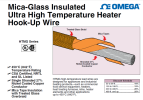
Interesting, a quick google search shows that the mica wire insulation may be some sort of composite where ground up mica is bound with another material. Then again another article I found says:It can be bent. We use a mica insulated wire at work. Its meant for very high temperatures but it also works fantastically with radiation since there is no plastic or other petrochemical to disintegrate. No idea if the mica used for this is suitable for capacitors though, and honestly it probably would make for a larger roll than makes sense. I suspect its easier to do multi-layer in flat sheets if it just needs more capacity than a single layer can do at reasonable size. Basically like an MLCC type, just with mica instead of ceramic.
View attachment 3823929
 craigwire.com

This is exactly what I was thinking. I have stacks of mica in the garage and it cannot be bent more than a hair before it snaps. I figured it was ground up and bonded to some sort of flexible medium. Very cool read is this threadInteresting, a quick google search shows that the mica wire insulation may be some sort of composite where ground up mica is bound with another material. Then again another article I found says:
What is mica paper?
Mica paper is actually a paper like material consisting of miniature flakes of either muscovite or phlogopite mica held together by natural cohesive force between adjacent flakes. This is not to be confused with “cellulose” paper. Mica paper is 100% mica.
What is mica tape?
Mica tape is an inorganic high dielectric tape manufactured with mica paper and laminated to various reinforcing substrates to enable ease of handling. Tapes are available in fully cured, VPI, resin rich (press cure) and B stage.
What are the backings for mica tape?
Backings are woven and non woven glass cloths, non woven polyester web, and various polyester films including polyimide.
What Is Mica Tape | Craig Wire Products LLC
What is mica and why is it used for electrical insulation? We answer your most frequently asked questions regarding mica tape and its applications.