• The move to the new server is done. There are some software and database maintenance updates in process. This has us passing the hat around to help out. We appreciate any donations. Seriously, even a dollar helps. The payment page may be found here - https://www.audiokarma.org/support.html

tool for fine vta adjustments?

cookthebooks

New Member
hi,

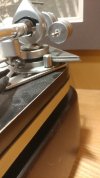
messing with my pro-ject 9 tonearm and noticing the vta is not where it should be for the new cartridge. definitely ham and egged my way through getting it set, but found myself multiple times in bad need of a third arm connected to the other two arms brain. has anyone found or improvised a tool that basically supports the tonearm during the raising/lowering portion of setting vta that provides support while allowing for very fine incremental changes? thanks!
 
Register to hide this ad
Hey @cookthebooks that's a nice tonearm you have there but I'm not very familiar with the intricacies thereof, aside from having done a rewire on one that a friend brought to me when the original loom had been damaged. As far as VTA goes, I did not have the opportunity nor was there a need to adjust.

Most tonearms have a lift mechanism, as does yours, that when the arm is in the "up" position it will be your "third hand" and hold it for you so one can loosen the (usually grub) screw(s) holding the arm base in place which then allows for upward and downward positioning of the arm therein to adjust VTA. @heyraz has given you a couple good ideas on how to keep it in place should you feel the need to do that.

Now, while VTA is certainly part of the big picture of getting cartridge setup correct, the arm must be raised or lowered in its base a full 4-5mm in order to effect 1 degree of difference in VTA!!! So, this kind of tells you that very small increments of change in VTA are not likely going to make a huge difference in what you are hearing. The bottom line for me would be.......listen (I do this whole process with headphones to hear more minute changes) and then adjust one way or the other. You will be able to get close by making up or down movements of around 1 to 2mm until you like what you hear.....beyond that, if I still don't like what I hear, I start thinking about other factors like azimuth, VTF or even antiskating can sometimes make more of a difference than what I might think.

Also, remember that you are going to be changing VTA each time you adjust the VTF and likely to greater degrees than when you actually move your tonearm base up and down. When you increase VTF, it collapses the cantilever a bit which, if you think about it, will tend to change the position of the stylus so that you get less of an angle......so, if you were spot-on at 92 degrees and increase the VTF it will move the stylus in a way that gets closer toward 90 degrees. How much depends on how much you increase VTF. The same is true in lowering VTF, which will take you from where you are upward in degrees.

There are multiple variables that I trust you know about which are interrelated and a change in one causes a change in another, which makes cartridge setup so much fun, don't it??? Carry on, amigo, and hope this helps a bit.

PS - I was playing around with this stuff one day and decided to use my Yamaha PX-3 turntable since it has VTA "on the fly" capabilities! Put on my headphones and a record that I know extremely well and started to go upward and downward with the base of the tonearm. While I was able to clearly hear the changes, I was a bit surprised that there was less of a change than what I had expected. My takeaway from that experiment was that what has been written on how much the base needs to be lifted or lowered just to get 1 degree of difference is true and that this difference is not as profound in changing the sound as I had imagined it might be. Don't read me wrongly here, it DOES indeed make a difference, just not as much as I was expecting. For those of us (not me) with "golden ears," this might be different so I should affirm that to some it might be a deal-breaker......dang, wish I had them ears (or do I???)!!! :rflmao:
 
Feeler gauges

1787858998991.png

or if you want bigger increments, gauge blocks exist in precise calibrated dimensions.

While I was able to clearly hear the changes, I was a bit surprised that there was less of a change than what I had expected.

have participated in a similar experiment and my conclusions were pretty much the same. There was a difference from end to end of the range, but not significant and not enough for me to really care about. None of mine adjust on the fly, and only two can even be moved. The Thorens is wherever it was when i got it, presumably which is where it was when it left the factory. The ROK I got the arm pretty much level and left it there.
 
@gadget, this old brain got jogged when you mentioned the feeler gages and yes, those would indeed be a great way to go!

Audio memory, for me, does not serve well enough to be able to tell minor differences so the "on the fly" feature of the PX-3 really let me hear it in real time. As you say, the difference lies in the extremes and since I was able to go from one to the other instantly, I could hear how the sound changed as I did that.
 
Last edited:
I'm usually pretty relaxed about it, but when I swapped cartridges on my td160 the height difference was huge. Stanton 881 to a Signet 5.0 left my arm at a very notable angle. Took 4mm worth of shims. Difference was actually very notable, even though those few degrees should not be. Tracking was much better.

Changers often had a vta optimized for the middle of a stack. If they did not, by the 5th or 6th record you would hear a difference notable enough to influence the design of so many.
 
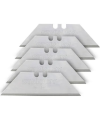
The thickness of a sheet rock blade is approximately 0.5 mm at the rear. Counting the number of stacked blades used after I have "dialed in the VTA" makes replication easy. In fact, I keep the number of blades used after setup in an empty pill vial for future reference.
 
The easiest way to change VTA in small increments is to change VTF in small increments. The cantilever will deflect more with increases in VTF, having the same effect as lowering the arm tower, and vice versa. Of course wile stating within the cartridge VTF recommended range. Or thereabouts.
 
The easiest way to change VTA in small increments is to change VTF in small increments. The cantilever will deflect more with increases in VTF, having the same effect as lowering the arm tower, and vice versa. Of course while staying within the cartridge VTF recommended range. Or thereabouts. (*made a few corrections as this is what I believe you were saying.....)
This is true, @W9TR, which is why I mentioned it in the post above......yet there are other aspects of styli interaction with the record surface through increase of VTF which are also altered. Some can be desirable, such as greater stability of the stylus in the groove which can lead to less sibilance and distortion caused by the stylus "banging around" less in said groove, but it's only good up to a point beyond which there can be actual damage to the groove (and even stylus, over time) which is why your point about "staying within the cartridge VTF recommended range" is important.
So it's another way, albeit with a limited range, of getting to the "sweet spot" of the VTA. In fact, I've often seen the suggestion to "run your cart at the top end of the manufacturer's stated tracking force recommendation." Also, simply altering tracking force can be a lot less complicated than raising or lowering the tonearm to change VTA.

When you dive into all of this, it becomes fairly clear that what we're doing is often making compromises in one area to improve outcomes in other areas and then coming to the realization that there is very little, if anything, that is "perfect" about the technology of dragging a tiny nail through a wax (vinyl) groove.....it's amazing that we can get it to sound as good as it does. Typically that tends to happen through considerable effort and, no doubt, no small measure of plain luck, at least in my case! But hey, I find the process intriguing, something I like to do and the bonus is that I get to listen to a lot of music which makes it so, so worthwhile.

It seems we have strayed a bit, perhaps, from @cookthebooks original question but hopefully provided a little more food for thought towards a solution??? Carry on, amigos......
 
Hi, What cart are you using, you do not need to worry about VTA with many cartridges, only if you have a Shibata of Miro Line stylus (or variations of these profiles)
If you have one of these styli, you need to adjust the Stylus SRA (stylus rake angle) to around 92 degrees, which will mean adjusting the VTA.

Cheers
 
hi,

messing with my pro-ject 9 tonearm and noticing the vta is not where it should be for the new cartridge. definitely ham and egged my way through getting it set, but found myself multiple times in bad need of a third arm connected to the other two arms brain. has anyone found or improvised a tool that basically supports the tonearm during the raising/lowering portion of setting vta that provides support while allowing for very fine incremental changes? thanks!
Your tonearm should be set according to manufacturer spec, and usually this means tonearm parallell to the record. If you want to change VTA, which is a cartridge/cantilever specific issue, you need to use angled headshell shims between cartridge and headshell. VTA is critical for all types of stylii since it is a cantilever angle and not stylus angle (SRA) parameter.
 
hi,

messing with my pro-ject 9 tonearm and noticing the vta is not where it should be for the new cartridge. definitely ham and egged my way through getting it set, but found myself multiple times in bad need of a third arm connected to the other two arms brain. has anyone found or improvised a tool that basically supports the tonearm during the raising/lowering portion of setting vta that provides support while allowing for very fine incremental changes? thanks!
Unless it is absolutely miles out don't worry about it.
It takes 6mm from level to arrive at a distortion that a human can perceive with a single tone and when I say perceive only some people and just. It takes 10mm from level from the golden eared to be able to pick the tiny distortion increase in music and 10 mm is huge.
Adjusting a mm or two you are wasting your time, add to this not all stylus ( especially factory) are even close to being mounted properly anyway.
Chris
 
This is true, @W9TR, which is why I mentioned it in the post above......yet there are other aspects of styli interaction with the record surface through increase of VTF which are also altered. Some can be desirable, such as greater stability of the stylus in the groove which can lead to less sibilance and distortion caused by the stylus "banging around" less in said groove, but it's only good up to a point beyond which there can be actual damage to the groove (and even stylus, over time) which is why your point about "staying within the cartridge VTF recommended range" is important.
So it's another way, albeit with a limited range, of getting to the "sweet spot" of the VTA. In fact, I've often seen the suggestion to "run your cart at the top end of the manufacturer's stated tracking force recommendation." Also, simply altering tracking force can be a lot less complicated than raising or lowering the tonearm to change VTA.

When you dive into all of this, it becomes fairly clear that what we're doing is often making compromises in one area to improve outcomes in other areas and then coming to the realization that there is very little, if anything, that is "perfect" about the technology of dragging a tiny nail through a wax (vinyl) groove.....it's amazing that we can get it to sound as good as it does. Typically that tends to happen through considerable effort and, no doubt, no small measure of plain luck, at least in my case! But hey, I find the process intriguing, something I like to do and the bonus is that I get to listen to a lot of music which makes it so, so worthwhile.

It seems we have strayed a bit, perhaps, from @cookthebooks original question but hopefully provided a little more food for thought towards a solution??? Carry on, amigos......
Great post, thanks! You have to adjust the arm tower at the right height to get VTA close, then you can play with VTF which also impacts other variables as well. Even how tight or loose you set the grub screws in the arm tower will make a difference.

My turntable came with the helpful direction to tighten those screws ‘just enough, but not too much’ to get the best sound.

I guess that’s why I like vinyl playback so much. It requires a thoughtful approach to get the best sound, and everything interacts to some degree.
 
Even how tight or loose you set the grub screws in the arm tower will make a difference.
Now there's something that not many will perhaps relate to, but you are so correct......at least with some turntables!!

Tom Fletcher, the originator of the turntable I have (Nottingham Spacedeck), makes a special point of paying attention to this and I can tell you, it DOES make a difference and not a subtle one at that! I did a bit of experimentation some time ago and noted that over-tightening left the sound kind of lifeless, the soundstage was very much diminished and not pleasing at all. After loosening the grub screws that hold the tonearm in place in its base while leaving them snug enough to hold it firmly, everything seemed to return to "normal." Another thing I noticed, and this may be at least a part of the dynamic, was that cranking down on those screws resulted in a movement of the tonearm (yikes!!!) which caused a departure from the parameters that I had spent hours to arrive at until I had what I considered the best possible settings!!

So, yeah, go figure......sooooo many variables but like you say, enjoying our hobby sometimes means we have to really get "thoughtful" about our approach! Carry on, amigo......

PS - Might you have a Nottingham turntable???
 
The cantilever will deflect more with increases in VTF, having the same effect as lowering the arm tower, and vice versa.
The cantilever will be at the same angle relative to the record, but the initial magnet-to-coils position will change. Altering VTF also alters the compliance, as it ads tension to the suspension.

Does anybody set VTA for every record thickness? I guess once having the records catalogued/marked for thickness and with a nice dial to raise/lower the tonearm, that would be the easiset thing to do; shimming not so much. If one sweats over tenths of a milimeter, this is the way to go. Insuring the record being flat as much as possible (flattener, weight, clamp, outer ring, vacuum...), should be done as well.
 
The cartridge makers have most of this figured out for you. If the top of the cartridge is parallel to the record, you're 97.3% there. Plenty good enough for most. There seems to be a consensus that slight tail down is desirable, so you might try just lowering the adjustment by 1 mm or so below the parallel point. I've also heard that the best way to listen for changes is with a true mono recording of vocals, looking for clarity and centering. You heard all this on the internet so it must be true!
 
Does anybody set VTA for every record thickness?
That's a good question, @borchee! I have this sneakin' suspicion that there might be a contingent of folks who do, but my ears are far too removed from "golden" to hear those kinds of differences so I just use one of my favorite records to gage sound with (e.g., Donald Fagen, The Nightfly), get it as good as it gets to my ears, and then live with it......I'll trust the good folks here, e.g. @cafe latte, who above describes the relationship between the height of the tonearm in its base and the corresponding changes in VTA pretty much as I understand it, meaning you have to change the height by a great deal to get even minute changes in the VTA. So, get close, listen carefully (I like headphones for this as I've mentioned before) and tweak a little and then do some listening......pretty much does it for me!
 
Tonearm height adjustments are first of all there to adjust tonearm. Not cartridge VTA. Tonearm has a design goal to make the cartridge track the best it can. This could be pivot point in line with record surface, or some small distance from that to track best. The change you do by height changes, even it if it small, is dynamic tracking force. VTA adjustment is done between headshell and cartridge.
 
Back
Top Bottom