• The move to the new server is done. There are some software and database maintenance updates in process. This has us passing the hat around to help out. We appreciate any donations. Seriously, even a dollar helps. The payment page may be found here - https://www.audiokarma.org/support.html

Official O.B. Gallery.....bought or built, anything goes.

I've noticed that Eminence Alpha 15's seem to be the darling of the OB world, and usually in pairs per channel.
Why two of them? Is the factor that makes them good for open baffle also a factor that renders them faint enough to need two of them? Or is it the fact that there's no box to localize and augment the bass the reason for doubling up?

The Alpha 15A woofer is very popular because it is easy to work with in a dipole speaker and it is very reasonably priced, the quality control at Eminence is also very good. You would typically use a pair of Alpha 15A drivers per side to raise the system output to match a more efficient mid or full range driver. Many people are using the Alpha 15A woofer with a 6" or 8" full range driver which is significantly more efficient. Rather than over driving a single Alpha 15A with too much input power the better option is to add a second Alpha 15A per side. Two Alpha 15A drivers per side can produce a huge sound in your room which a smaller box speaker can not approach.
 
It may well be more difficult to replicate what I'm doing with my MiniDSP in passive crossover form than I originally thought. Going passive would also greatly reduce my options in driver selection. This was already difficult with my OB line array build as the mid-woofers need to spec well for OB, like a high qts for instance.

In my build I would have had to either find different mid, different tweeters or both unless I also wanted to add a lpad which I didn't.

For me, active/dsp is a perfect fit. I have the freedom to use just about any drivers I want and if necessary, can make countless changes on the fly. The active/dsp has firmly cemented itself as the most significant and fun component in my system.

I agree with everything you have said. A passive crossover only works in a few select situations with drivers that are hand picked to be compatible on an OB. For pairing many different drivers and swapping in and out different combinations an active crossover is the ticket to make it all work.
 
I'd like to ask again what is needed to calibrate a minidsp. What mic is used and is that a necessity or is it possible to calibrate by ear?

cubdog
 
I am using a dBx Driverack active crossover which I believe is a digital crossover. It is a good crossover and I do not hear extra noise or funky artifacts, I cannot fault the performance. I just have found that when I listen to a speaker using my active crossover and two identical amps, usually as I am designing and building a passive crossover, that the final passive configuration just sounds better to my ears.

You're touching on something that has become a bit of a hot topic for some of us recently (and surely you've heard all this before). We can clearly see that DSP is a useful and enormously beneficial technology and a few of us (namely myself) are chompin' at the bit to implement it. But there's a bit of reluctance (or at least uneasy suspicion) to do so because we fear the sound quality delivered by the converters in the DSP units will be inferior to the sound quality of either a finely honed, purely analog source (vinyl, tape) or a digital source that has been converted by a high-end, stand alone DAC. We can't help but think the processing will deteriorate the quality of our "sweetened up" analog signal and not by imparting noise or artifacts necessarily, but by simply stripping away some of the signal's analog purity in the process of all the digital filtering and reconfiguring back to analog. Your experiences may, to some degree, help confirm this since you observed an improvement in SQ when you removed the digital processing from the chain and everything else was held constant. What has been your source (if digital, what was converting to analog?) when making your observations regarding SQ suffering with the use of the Driverack vs passive networks?

And I've used the Driverack PA+ myself and got rid of it because I didn't care for the resultant SQ it was providing. I had been using an Ashly active analog unit prior and heard an immediate and obvious improvement in SQ when I went back to it. But as nice and transparent a unit the Ashly is, it doesn't offer nearly as impressive and useful a feature set as the typical digital unit. Kind of frustrating as some those features not offered by the analog actives are critical when implementing a DIY speaker project. For instance, I saw how with your Dipole 15/Lowther project the performance of the AE drivers benefited when you dialed in a first order slope for them. Well, I have Dipole 15's and would like to implement them in a OB project but my Ashly is fixed fourth order, so I'm kinda' screwed in that regard. But clearly the handicap isn't restricted to the Dipole 15's as any number of drivers could find better performance with a slope other than fourth order and the Ashly simply doesn't offer the flexibility for me to address that.
 
The Alpha 15A woofer is very popular because it is easy to work with in a dipole speaker and it is very reasonably priced, the quality control at Eminence is also very good. You would typically use a pair of Alpha 15A drivers per side to raise the system output to match a more efficient mid or full range driver. Many people are using the Alpha 15A woofer with a 6" or 8" full range driver which is significantly more efficient. Rather than over driving a single Alpha 15A with too much input power the better option is to add a second Alpha 15A per side. Two Alpha 15A drivers per side can produce a huge sound in your room which a smaller box speaker can not approach.

Help me understand this as I have not heard any of these systems. As I look at the 15A specs it's rated at 97db/watt and 200w RMS and that seems very efficient to me vs. say an AN Super 8N which is 97db/watt and 30w RMS.

It just seems to me in my limited understanding these should play well together and in an active x/o system there would be enough variability for a single 15A.

I'm not arguing as I see a lot of 2 driver designs I'm just having trouble computing.
 
I'd like to ask again what is needed to calibrate a minidsp. What mic is used and is that a necessity or is it possible to calibrate by ear?

cubdog

The MiniDSP doesn't get calibrated. With just the MiniDSP and a laptop, or desktop if it's close enough for a cord to reach, you could set slopes, crossoer points etc. and let your ears tell you when it's right. I only use a mic to takes initial measurements to get things roughed in, or to show other people here a curve.

The only thing a mic is used for is to take measurements if you want to see exactly what your speakers are doing. How flat they are, phase etc. The mic does not tie into the MiniDSP, but rather is used with a measuring program like Room EQ Wizard, and plugs into your computer.

I use the Umic-1 that MiniDSP sells. http://http://www.minidsp.com/products/acoustic-measurement/umik-1


Some use this.
http://www.parts-express.com/dayton-audio-emm-6-electret-measurement-microphone--390-801
 
Help me understand this as I have not heard any of these systems. As I look at the 15A specs it's rated at 97db/watt and 200w RMS and that seems very efficient to me vs. say an AN Super 8N which is 97db/watt and 30w RMS.

It just seems to me in my limited understanding these should play well together and in an active x/o system there would be enough variability for a single 15A.

I'm not arguing as I see a lot of 2 driver designs I'm just having trouble computing.

IME the 15a simply isn't capable of much SPL output at the lowest frequencies. It's easy to reach a point where it starts to lose composure if you're asking it to reproduce content in the first octave...in my case I usually heard it happen somewhere between 85-90 db with a pair of 15a's in H-frame type OB enclosures. Doubling the number of drivers simply enables one to achieve greater SPL output beyond that point where just a pair starts to experience distortion and cone slap. If you only listen at low levels and in a fairly small room maybe a single 15a/panel is all you'll need. But for anyone who listens at moderate to somewhere beyond moderate output levels and in a medium to large room a just a single 15a/panel will not be able to keep up with the full range driver....perhaps even run out of steam before the full range driver ever reaches the point where it's able to deliver its full dynamic capabilities.
__________________
 
Help me understand this as I have not heard any of these systems. As I look at the 15A specs it's rated at 97db/watt and 200w RMS and that seems very efficient to me vs. say an AN Super 8N which is 97db/watt and 30w RMS.

It just seems to me in my limited understanding these should play well together and in an active x/o system there would be enough variability for a single 15A.

I'm not arguing as I see a lot of 2 driver designs I'm just having trouble computing.

The Eminence data sheet says 97 dB (make sure you read the fine print at the bottom of the spec sheet). Looking at the curve the low end value is 94 dB and the curve rolls off at about 100 Hz. None of this is consistent with the T/S parameters shown on the left. But all these values are accurate for the conditions under which they were measured.

I have four Eminence Alpha 15A wwofers and have measured the T/S parameters for each. The Eminence datasheet T/S parameters are close to what I measured. For these parameters the SPL/W/m is 92.5 dB and the SPL/2.83V/m is 93.8 dB These values are all assuming an infinite baffle.

If you now mount the Eminence Alpha 15A in a finite OB the bass will start to roll off around 100 Hz due to the wrap around of the back wave which will start to cancel the front wave. At 100 Hz the SPL is 90 dB/2.83V/m and starting to roll-off, at 50 Hz you are down to 87 dB/2.83V/m. Pairing this up with your 97 dB full range driver does not look like a winning combination without an active crossover and signficant boost (or two Alpha 15A woofers with a little boost).

Bottom line is if you do the engineering based on measured T/S parameters you have a very good chance of having the first build work really great, you can tweak from there to dial in the last little bit. No engineering and no measurements, unless you get really lucky it will probably sound bad and you would have been better off duplicating somebody else's proven design.
 
I have no complaints with the sonic performance of the Driverack. My problem is that it is locked into certain frequencies and slopes. The passive crossover by interacting with the driver impedance the actual acoustic crossover and slope is variable with frequency, changing the value of a cap or coil slightly can tweak the crossover.

As for the problems you hear with the Alpha 15A, I just have not experinced these issues and I have used the drivers in several systems that others have really liked.
 
The only thing a mic is used for is to take measurements if you want to see exactly what your speakers are doing. How flat they are, phase etc. The mic does not tie into the MiniDSP, but rather is used with a measuring program like Room EQ Wizard, and plugs into your computer.

Everything Rob said is dead on but allow me to mention here (mainly for the your benefit, cubdog) that you won't need a mic at all if you go with a measurement system like the Dayton Omni mic (which includes its own mic). I bring this up only because I know you want something "easy" you can use and believe me REW is anything but as I've used both. Compared to REW, the Dayton OmniMic is so much more user friendly and easy to get up and going with it's laughable. REW is attractive because it's free (well, not exactly as you have to buy a proper mic) and many have the time and skills to take advantage of that. But it can take a good bit of time and effort to learn how to use the (complicated) REW software which can be a very frustrating, if not totally discouraging, experience.
 
As for the problems you hear with the Alpha 15A, I just have not experinced these issues and I have used the drivers in several systems that others have really liked.

Hmm. Interesting. What sort of ouput levels have you been able to achieve with the 15a's in H-frames before you hear them start to lose composure?
 
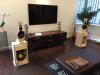
I made the mistake of throwing these kits together without proper finish to see if they were keepers.

attachment.php
 

Attachments

  • IMG_0796.jpg
    IMG_0796.jpg
    68.5 KB · Views: 113
Hmm. Interesting. What sort of ouput levels have you been able to achieve with the 15a's in H-frames before you hear them start to lose composure?

No idea about a numerical value of dB. Loud enough to draw complaints from my family, produce vibrations in the floor that are felt, and loud enough not to want much more. They are always crossed over very low, rolling off by 200 Hz with a second order slope. I listen to acoustic jazz and usually small group recordings, no electronic heavy metal or rock and not a home theater application.
 
^^^

I too could get them loud enough to do the things you say (with the exception of not wanting more...if even just a little) but they simply couldn't approach the sort of output I was accustomed to hearing from boxed LF drivers...and I'm not talking about club or frat house levels. More like levels that create a satisfying and invigorating tactile experience...but, then again, being a drummer I might be a bit harder to please than most. I suspected it was the limited excursion of the design and still feel that's to blame.
 
Last edited:
Rolled out at a recent get-together... The POO1


Currently working on the POO2. The second one.

RC
 
Pretty cool John. The angled side of your baffle reminds me of the Carver Amazings. So what are your impressions of OB, IB and boxed? Which do you prefer?

My room is a problem. I find that an OB will not "blossom forth" unless you can get the panels out maybe 3 feet from the front wall. In that case, you can't beat it. That setup is hard for me to do, I'm always rearranging things trying to get good sound, OB or otherwise. I'm also still playing with OB bass, haven't decided yet what I think.
 
Nice. What did the Linkwitz kit build wind up costing you?

Just the kit cost and miniDSP 4x10HD to give them a shot. I had 3 QSC CX-404 laying around which was the only reason I decided to try them - I could minimize the costs as I had enough amplification. Soon after I bought a pair of Outlaw 7500s to drive them.

I sold all my working turntables before our move 4 months ago, so I've been focusing on the digital side. Currently using DLNA from my Synology to a Mac Mini running Jriver -> Matrix Audio USB to AES3 converter -> miniDSP. I have Jriver converting everything to 96/24 on the fly to feed the miniDSP at its native rate.
 
^^^

I guess it wouldn't be fair to ask you to compare digital to the purely analog experience since you switched speakers when you switched over to digital, but do you find yourself missing vinyl much?
 
Back
Top Bottom