• The move to the new server is done. There are some software and database maintenance updates in process. This has us passing the hat around to help out. We appreciate any donations. Seriously, even a dollar helps. The payment page may be found here - https://www.audiokarma.org/support.html

AR3a - Measurements

Zilch

Curve Junkie
Subscriber
Incoming unit #2 has the original NPE caps, but the pots have been "upgraded" with L-pads:

attachment.php

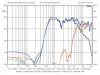
Measurements on tweeter axis and midline, no attenuation, i.e., as if the mid and tweeter pots have been removed:

attachment.php


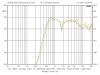
Added the 25-Ohm resistors across the drivers as recommended by RoyC at CSP, then put on the grille:

attachment.php

The results of the resistor addition at L-pad max setting is substantially the same as earlier found with AR4x: there's a small amount of attenuation across the bandwidth, and differentially a bit more at highpass and just above as the filter frequency moves slightly upward.

Putting on the grille swamps all of that with substantial attenuation in the high frequencies, and the mid must be attenuated to balance and flatten the response:

attachment.php

Mid pot is intermittent on unit #1, but here's a first look at the summed mid/twt response in comparison to #2:

attachment.php

[Yeah, I know what to do.... ;) ]

Incoming unit #1, all original and early, w/front terminal mid and tweeter, pots now bypassed but remaining in-circuit, i.e., both "Max:"

attachment.php

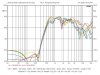
Individual driver and summed responses comparing Unit #s 1 & 2 per legend; #2 with 25 Ohms in parallel with both mid and twt, no grilles:

attachment.php

Divot in midrange response is precisely at 1.8 kHz (well, 1.7996520, actually). Tweeter response is "compromised" by comparision, but still sums well on-axis. Again, ~4 dB mid driver attenuation required for maximally flat. #1 mid highpass filter is a bit lower, perhaps an aging capacitor issue.

Polars:

Inboard is toward the mid driver:

attachment.php

Outboard is edgeward from the tweeter:

attachment.php

Perhaps the conversion of the 1.8 kHz interference notch into a reinforcement off-axis outboard affords a clue as to its source?

L-pad attenuation on the mid driver axis:

attachment.php

It'll take some surgery for a direct comparison to the stock pot, but I removed the 25-Ohm resistor and normalized for one setting here, Black, max. The L-pad behaves like L-pads do, without introducing frequency shifts or other significant anomalies.

Surgery completed, here's 16-Ohm pot attenuation in 2-Ohm increments for comparison:

attachment.php

And an 8-Ohm L-pad without a resistor in parallel with the driver under identical conditions:

attachment.php

Reflected impedance analysis here:

http://www.audiokarma.org/forums/showthread.php?p=2561858#post2561858
 

Attachments

  • Incoming #2 Pic.jpg
    Incoming #2 Pic.jpg
    44.5 KB · Views: 825
  • Incoming #2 MLS.jpg
    Incoming #2 MLS.jpg
    70.7 KB · Views: 818
  • Incoming #2 + Rs & Grille.jpg
    Incoming #2 + Rs & Grille.jpg
    76.2 KB · Views: 781
  • Incoming #2 Atten Flat.jpg
    Incoming #2 Atten Flat.jpg
    64.9 KB · Views: 750
  • Incoming Both.jpg
    Incoming Both.jpg
    61.6 KB · Views: 750
  • Incoming #1 Pic.jpg
    Incoming #1 Pic.jpg
    48.2 KB · Views: 684
  • Incoming Both Detail.jpg
    Incoming Both Detail.jpg
    74.9 KB · Views: 675
  • Inboard Mid.jpg
    Inboard Mid.jpg
    76.2 KB · Views: 660
  • Outboard Mid.jpg
    Outboard Mid.jpg
    76.7 KB · Views: 654
  • Pot Atten.jpg
    Pot Atten.jpg
    82.2 KB · Views: 584
  • L-Pad No Ra.jpg
    L-Pad No Ra.jpg
    78.6 KB · Views: 582
  • L-Pad + 25 Ohmsb.jpg
    L-Pad + 25 Ohmsb.jpg
    80.6 KB · Views: 580
Last edited:
Register to hide this ad
Hi, Zilch!!

Nice work!!

Need a little help understanding your graphs. Looking at just the tweeter in your 2nd chart, it looks like the biggest differences between the with 25 ohms and without occur at 6,000 to 7,000Hz and then again at 10,000.

Am I reading this right??

Also looks like 1db at 6,000 and maybe .5db at 10,000??

Next, what's going on at 1.8K?? Is that a room resonance?

If not, then possibly an electrical resonance?

Lastly, Zilch, what do you now think about my scheme to pad the mids in order to force more voltage to the tweeters? I realize this is a bit premature until you measure the woofer. Nevertheless, what's your inclination?

Regards,
Jerry
 
Last edited:
but how do they sound?

probably lacking bass with no woofer :D

So huge 9db suckout at 1.8k and then falls off the map again at 5k and never really recovers more than a few db remaining 8 to 5 db down to 20k?

I must say I am surprised that it goes that high, i figured it would drop like a brick above 15k
 
Now that I look closer there is a "dip" at 1.8K that shows up again at 18K??

Regards,
Jerry
 
Need a little help understanding your graphs. Looking at just the tweeter in your 2nd chart, it looks like the biggest differences between the with 25 ohms and without occur at 6,000 to 7,000Hz and then again at 10,000. Am I reading this right?? Also looks like 1db at 6,000 and maybe .5db at 10,000??
Yes. Installing the grille swamps all of that.

Next, what's going on at 1.8K?? Is that a room resonance? If not, then possibly an electrical resonance?
It's not a room resonance at 1.8 kHz, and I doubt it's electrical, though I can measure the transfer function to determine if the crossover's behaving badly. I doubt it has to do with the woofer not being there, but that's a possibility; let's hope it's something like that doing it.

Edit: Put cardboard over the woofer hole. That ain't it.

Lastly, Zilch, what do you now think about my scheme to pad the mids in order to force more voltage to the tweeters? I realize this is a bit premature until you measure the woofer. Nevertheless, what's your inclination?
If you look at the two summed curves at the top, you'll see that it's the mid propping up the tweeter response to the point that the small difference in tweeter output is all but academic.

In evaluating these early measurements, bear in mind the following:

1) I'm doing these "as found" for a baseline. They have not been recapped or anything, just the L-pads installed by whoever owned this one, but it's clear the drivers are working more or less to spec, or, at least, there's no apparent performance deficit.

2) Small lateral movements make major differences in the summed reponse, as shown in the first graph. There's a bunch of phase interference going on here between the mid and tweeter which won't be fully appreciated until I do the off-axis polars. Without the grille in place, at least, it's reminiscent of OLA.

3) Some of what's going on may be revealed in comparison to the earlier unit. I'm moving on to that one next.... :yes:
 
Last edited:
but how do they sound?
Surely, you jest.... ;)

So huge 9db suckout at 1.8k and then falls off the map again at 5k and never really recovers more than a few db remaining 8 to 5 db down to 20k?
The mid driver? Yes.

I must say I am surprised that it goes that high, i figured it would drop like a brick above 15k
Carl also measured the AR3a tweeter and found they had good extension:

http://www.classicspeakerpages.net/IP.Board/index.php?act=attach&type=post&id=4357

I believe he got that nicer result on a flat baffle, though, not in the cabinet, as I am measuring.... :dunno:
 
:lurk: Yes, a definite lurker thread!
Nice work so far Zilch.
With regard to your 1st post and the effect of the grille addition, I have found AR used a few variations of grille cloth over time with some better than other's with respect to HF thruput.
What's your assessment of the open area of the grille cloth you used for your first pass tests?
 
Now that I look closer there is a "dip" at 1.8K that shows up again at 18K??

Regards,
Jerry

and the 1.8kHz dip is present or both units... :scratch2: I'm guessing cabinet diffraction effects, or the mic position. Zilch said the mic was centered on the tweeter - I wonder how it looks when the mic is centered on the mid? :thmbsp:
 
Last edited:
Zilch has probably already seen this, but for anyone who hasn't here are AR's published on and off axis response curves for the 3a's drivers. A little hard to read, but the highest-res scans I've found anywhere.
 

Attachments

  • AR-3a Brochure One Page 2.jpg
    AR-3a Brochure One Page 2.jpg
    119.2 KB · Views: 142
Thank you for the scan, Gkimeng. I had not seen that, actually.

Except for the 1.8 kHz suckout, we agree on the mids, looks like.

Tweeter results look more like what Carl measured.

Note: It says "with grille and decorative molding removed."

It also says "shown separately so that interference patterns ... are eliminated."

It's not as if none of that matters:

1) With no lowpass on the mid, it's running full range to natural rolloff and significantly altering the tweeter response when acoustically summed.

2) Half-wavelength of 1.8 kHz is 3.77", by my calc. Do we see a potential issue there?
 
Last edited:
Note: It says "with grille and decorative molding removed."

It also says "shown separately so that interference patterns ... are eliminated."

It's not as if none of that matters:

I went looking last night for copies of the old Audio or High Fidelity magazine test reports, for which I'm pretty sure the reviewers did not tear off the molding (not so sure about the grills because I don't know if the reports were done before or after AR started velcro'ing them). But I never scanned those, and so far no luck digging through the mountain of book boxes never unpacked since our last move. If I find them, I'll scan and upload.
 
Suckout's at 1715 Hz (3.94") on #2, and 1780 (3.81") on this one.

Center to side = 3.625".

Center to top = 4.750".

The inner edge of the moulding itself is 0.313" further out.
 
Last edited:
Where do you typically get the most cabinet resonance problems, sides, top and bottom, or back? Or is there a "typical"? And are those cabs not stuffed? Or just not well stuffed?

Weems says to put damping material on the back, one side and either the top or bottom panel to stop reflections.
 
Where do you typically get the most cabinet resonance problems, sides, top and bottom, or back? Or is there a "typical"? And are those cabs not stuffed? Or just not well stuffed?

Weems says to put damping material on the back, one side and either the top or bottom panel to stop reflections.

Zilch is measuring mids and tweets only in a pair of speakers whose woofers have been removed for refoaming (and from the photo he has posted, the stuffing has apparently come out as well). So as measured so far, these speakers have no stuffing.

3a's are loose-stuffed. The stuffing is determined by weight and fluffed to distribute evenly throughout the cabinet, so should not be concentrated in any particular region of the cabinet volume. The mid and high drivers both have closed backs, not open as in the woofer.

I think cabinet-related issues being discussed so far are not resonance, but possible interference caused by portions of the structure that may protrude into the drivers' sound fields.
 
More data @ #1, baseline almost done, now:

So am I reading correctly, you are measuring both speakers with pots and L-pads turned full up?

FWIW, the "white dot" settings for the original pots are 3.25 ohms mid, 1.75 ohms high, but AR's recommended setting for "flat" response was both pots turned full up plus a "slightly" (whatever that means) higher setting on amplifier treble control.
Yes, the mids run 4 dB "hotter" than the tweeters, at least on-axis.

The "correct" setting for the mids would be in balance with the woofers, but we don't know where that might be as yet. Then the tweeters are balanced with that combination, and it would appear from the factory recommendation the tweeters may not have enough output for it all to work without some boost from EQ.

This would all be consistent with common experience with AR3a, that they are "laid back, easy listening" at the high end. I suspect there's more to this, though, as we are about to see.... :yes:
 
Last edited:
Back
Top Bottom