• The move to the new server is done. There are some software and database maintenance updates in process. This has us passing the hat around to help out. We appreciate any donations. Seriously, even a dollar helps. The payment page may be found here - https://www.audiokarma.org/support.html

Harman Kardon hk770 Upgrade Project

Leestereo

Super Member
Here are pictures from my Harman Kardon hk770 power amplifier project. This was the TOTL stereo power amp in the Harman Kardon consumer line-up in 1979. Its a true dual mono, stereo power amplifier whose design is based on the research of Dr Matti Otala on amplifier slew rate and audibility of TIM and IIM distortion ( Matti Otala - An Amplifier Milestone. Dead or Alive ).

In stock conditon the amp sounds good, but not as good as its pedigree would suggest. Its sound was bettered by the following power amps in-house: a Marantz 170DC (recapped), a Technics SE-9060 (recapped), a Bryston 2B-LP and a Sima W-3050.

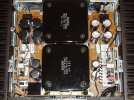
Restore/Upgrade (Part 1): The original 34 year old capacitors in the driver stage PS (2 X 2200µF/63V) and the power amp PS (4 X 4700µF/50V) were replaced with 2 X 3300µF/63V and 4 X 6800µF/50V, respectively. The total power supply capacity was increased to 67,600µF (33,800µF per channel) from the original 46,400 µF (23,200µF per channel).
770c_AK_zpsf1283641.JPG

Stock condition shown on the left and new capacitors on the right.
 
Last edited:
Register to hide this ad
There used to be a seller on Audiogon who sold recapped equipment who has nice things to say about the HKs when recapped.

Watching the developments. :lurk: :beer:
 
Restore/Upgrade (Part 2):

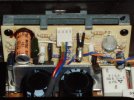
The main 6800µF power supply caps are United Chemicon KMQ (low ESR, 105°C). For the driver stage PS, I wanted to use smaller diameter (<22mm) and shorter (<50mm) caps to allow for better air flow around the driver stage board. This smaller size requirement and a 10mm lead spacing limited the choice of caps that I could use. In fact, the only quality cap which I found that met all the precribed requirements was the 3300µF/63V Nichicon KW (which measured 20mm x 40mm. I typcially use low ESR 105°C capacitors in all of my power supply rebuilds, but in this particular case, the size constraint had the final word.

770b_AK_zps28aba14e.JPG

Close up of the driver board and its power supply.

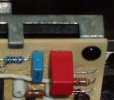
On the driver stage board, the 100µF/10V electrolytic input capacitor and the 0.1µF/50V polyester shunt cap (green "chicklet" in picture) were replaced with a 4.7µF WIMA MKS2 polyester cap (red rectangle in picture) and a 47nF Kemet PHE426 polypropylene cap (blue rectangle in picture), respectively. Harman Kardon did specify the use of 1% metal film resistors in the signal path, but they also specified a number of fusible resistors which are known to be problematic as they age. Hence, all fusible resistors as well as 5% carbon film resistors were replaced with 1% metal film resistors. The original 10µF/25V zener shunt capacitors showed signs of heat stress (shrunken plastic sleeve) and was replaced with 47µF/25V United Chemicon KY low ESR, 105°C caps.

770d2_AK_zps0f1ed2e8.JPG
 
Last edited:
Watching this with interest as well. I have some HK gear that need recapping (HK-870's) as well.
 
IIRC, the hk870 is very similar in design to the hk770: dual mono stereo design with independent power supplies (one transformer, but dual secondaries). And apart from the implementation of FETs in the driver stage front end, the drivers and the outputs are of the same topology. I think that many of the changes/upgrades that work for the hk770 will also apply to the hk870.
 
After some tweaking hour on hk870s, the only leak ring I have found was on the back to back EL input capacitors (2x Elna for Audio 220uF).
After getting rid of them (first shortening them) the sound opened a lot.
For safety ( :D ) now there are placed some MKP capacitors that, more or less, don't impact on sound as as much as the old ELs did.
I did not see the hk 770 electrical diagram but I suppose may be similar to hk870.

On the other hand, I didn't hear any change by recapping (and soldering additional by pass capacitors) on power supply unit.

Now some picture that can be helpful for someone.
back to back input caps
http://img683.imageshack.us/img683/8088/img0491o.jpg


by-pass caps
http://img860.imageshack.us/img860/6812/img0495a.jpg
On the bottom left you can see one of the (new) blue input MKP capacitors.
 
Last edited:
Restore/Upgrade (Part 3):

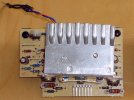
Although there are very substantial heatsinks for the output stage, there is a only a small, thin bent aluminum piece for the driver stage. Its particularly problematic in this unit since the design biases the driver stage "hot" (from other AK threads this is not uncommon for h/k amps). And to exacerbate the situation, this power amp uses a the small chassis space (10.5" X 10" X 2.5") that is packed full. The driver board heat sink gets "finger-burning" hot, probably 65°C - 70°C).

770d_AK.jpg

With the extra space in the front of the heat sink that the smaller driver stage PS caps afford (see part 2 above), there was now the possibility of improving the heat dissipation of the stock heatsink with some additional material. A dead computer ATX power supply donated some useful heatsink material. The ATX PS heatsink was cut to size with a hacksaw and tapped for M3 screws for attachment to the stock heat sink.

770e_AK.jpg

hk770 mod ak.jpg
 
Last edited:
Damn! That is cool (sorry couldn't pass up the chance at a pun :D). I have a couple of those chassis' around will have to pull them out.

Restore/Upgrade (Part 3):

Although there are very substantial heatsinks for the output stage, there is a only a small, thin bent aluminum piece for the driver stage. Its particularly problematic in this unit since the design biases the driver stage "hot" (from other AK threads this is not uncommon for h/k amps). And to exacerbate the situation, this power amp uses a the small chassis space (10.5" X 10" X 2.5") that is packed full. The driver board heat sink gets "finger-burning" hot, probably 65°C - 70°C).

With the extra space in the front of the heat sink that the smaller driver stage PS caps afford (see part 2 above), there was now the possibility of improving the heat dissipation of the stock heatsink with some additional material. A dead computer ATX power supply donated some useful heatsink material. The ATX PS heatsink was cut to size with a hacksaw and tapped for M3 screws for attachment to the stock heat sink.
 
Restore/Upgrade (Part 4):

The upgraded driver stage heatsink runs significantly cooler than the stock one, and although it is still quite warm (~55°C-60°C) after ~30 minutes of being on, this is preferred to the original "burning hot" situation. The hk770 is now hooked up for some listening sessions in the system (Rotel RDV-1060, NAD 106 preamp, modded JPW speakers) that currently uses the Marantz 170DC power amp. For these initial listening sessions, it will run "topless" to allow quick access to the amp interior to monitor DC offset, bias and temperature.

hk770g_AK.jpg

Some initial listening impressions: the hk770 is dead quiet, even with my ear an inch away from the speakers, there is total silence. With the Marantz 170DC hooked up, in this same set up, there is a barely perceptible background noise (again with one's ear at the speaker). Compared to the Marantz 170DC, the original hk770 was brighter sounding and the bass seemed to lack body/weight. In the upgraded hk770, the bass range is more visceral (better than Marantz 170DC). Bass notes have gained depth and body, and one is able to discern the timbre of bass instruments more easily. The midrange of the original hk770 was quite good and clear, comparable to the Marantz 170DC in this area. The upgraded hk770 seems to be a bit better in this area than before; vocal nuances/ticks are more easily heard. The treble range in the original hk770 was brighter than the Marantz 170DC, but seemed be somewhat harsh and "unfocused"(location of percussion instruments in the stereo image was indistinct). The treble range in the upgraded hk770 is much improved: percussion instruments sound very real with proper "attack" and "decay". I think that the upgraded hk770 now betters the Marantz 170DC in the treble range. Overall, the Marantz 170DC has a more "laid-back" presentation which is always "musical" and is more forgiving of the source recording, whereas the upgraded hk770 lets one listen through the recording, with more of a "warts-and-all" presentation.
 
Last edited:
If you wanted the HK to dominate anything you compare, you should have used high voltage slew rate caps in the driver and power stage. 100V/uS at least. I've been told that really helps.

Cheers.

I was a bit confused when you mentioned about capacitor slew rates - typically this is not a spec for capacitors. a bit of googling turned up this

http://www.tnt-audio.com/clinica/ssps1_e.html

If I understand what this article and you are trying to say, you are essentially suggesting low esr filter caps. Am I correct ?
 
I am suggesting higher Voltage slew rate caps. Its a standard specification for caps. People bypass poly caps trying to cheat on this but it rarely works. A higher V/uS is a domain on its own.
 
So the general consensus is that its rubbish published by manufacturers?

Reading the DIY forum thread btw.

Not sure what you're referring to here. No need to doubt manufacturer technical specs that are based on standardized and/or published testing protocols. Its the interpretation of said technical and verifiable parameters and ascribing a "sound" to them that I am skeptical of.

Not that I'm against subjective evaluations; that's what opinions are, but opinions are not necessarily facts. I actually believe that the objective (technology) and subjective (ear) approach can complement each other. For example, in the late 60s, when transistors were being introduced to the consumer market, many noticed that these solid state units measured much better than their tube predecessors, but many also noticed that the tube stuff sounded better. The conclusion shouldn't be that the technical approach is wrong and useless. It isn't that one side was wrong; they were both right, the more accurate conclusions are: the ear is an excellent judge of sound and the technology of the day wasn't measuring the right parameter(s).

Fast forward to the present and will are still having the same debate. In some cases what we measure (e.g., THD) is inadequate to fully describe the sound of an amp. In other cases it is sufficient, depending on the question: "What is the residual ripple by using this size and type of capacitor in this circuit?" Both approaches have to utilized to get best out of any piece of equipment.
 
Here is what Ken Kantor says on the topic.

The "slew rate" of a capacitor is simply a matter of the ESR and size of the cap... it isn't really a meaningful spec. ESR is still the relevant spec. In fact, if some company is making an issue of it, I would say they are digging.

In any event, slew rate is something that isn't gradual. It's kind of like clipping.... if you are below the slew rate, it has zero effect, it could be 2V/us, or 20,000V/us. It only has an effect once you try to exceed the limit. Since 99.99% of signals never get even close to today's typical SR's, it isn't worth worrying about. -k

This is great since you two concur. I can flush down my worries when buying big caps about this voltage slew rate deal.

Learning stuff at Ak every day. :wave:
 
I have much respect for Ken Kantor and have admired his work since his days at AR.
The DIY article I linked to earlier also corroborates Ken Kantor's point of view, it just doesn't express it as succinctly.

The slew rate of an amplifier essentially determines the upper limit of its power bandwidth; any amplifier with high fidelity pretensions will have a power bandwidth that extends to at least 20kHz (which is really the bare minimum that is acceptable).

Incidentally, the Harman Kardon hk6900 is a very nice amp with a sophisticated topology (I read that Bob Odell who later designed PS Audio amplifiers, had worked on the hk6900 when at harman kardon).
 
I spent 2 mins listening to this unit today, it's dead quiet and has really nice sound. I will spend more time listening I'm sure, Leestereo did a great job with it.
 
Back
Top Bottom