• The move to the new server is done. There are some software and database maintenance updates in process. This has us passing the hat around to help out. We appreciate any donations. Seriously, even a dollar helps. The payment page may be found here - https://www.audiokarma.org/support.html

MOSFET Madness Strikes: Hitachi HMA-8500 Mk II

wualta

permanently nonplussed cat
Subscriber
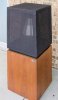
The matching HCA-8500 Mk II preamp is on top, where it should never be placed, but it looks good in photos:
amp plus HCA-8500 Mk II preamp-a.jpg

100 w/ch using doubled pairs of the famous 2SJ49 / 2SK134 TO-3 MOSFETs, a headphone output, capacitor and direct inputs, bridgeable, and fortunately for those who have to ship them, no toggles. Ya gotta love the sheer brutal massiveness of the thing. It looks mean.

And best of all (for some), REALLY BIG METERS with spooky-green panel illumination. Good MOSFET sound. Runs really warm (like low on a hair dryer) but not hot. I'll be hunting another one to try this bridging maneuver.

And just as I decide to go the Hitachi route, another PCR800 shows up on That Auction Site...
 
Last edited:
Register to hide this ad
i had this amp for 4 years ,also wanted a second for mono
then i bought a second .the problem is with speakers like old infinty ,elektostats the amp switches in protect at a bit louder levels
the amp sounds nice but is not very stable
result depends very much on speaker impendance
 
Last edited:
I think I once saw an amplifier that looked identical to this advertised under the brand of "Lo-D" or something a few years back.
 
Lo-D is Hitachi's sub-brand in Japan, like Mitsubishi/Diatone, Sanyo/Otto (plus Fisher since '77), JVC/Victor, Aurex/Toshiba etc
All of these Hitachi biggies were Lo-D in Japan.
 
junkaudio said:
..the amp sounds nice but is not very stable..
Wow, I'd never heard that the old line of Hitachi MOSFET amps were in any way unstable. They should be just the opposite. Maybe bridged isn't such a good idea after all.

Did the amps go into thermal shutdown, or was there something other than heat at work?
axel said:
Lo-D is Hitachi's sub-brand in Japan, like Mitsubishi/Diatone, Sanyo/Otto (plus Fisher since '77), JVC/Victor, Aurex/Toshiba etc.
Yes, Lo-D! I always wondered what that meant. Here's where I came across the mystery Hitachi offshoot::http://www.amp8.com/tr-amp/hitachi/hitachi.htm

Interestingly, it doesn't appear as Lo-D on the English version of the site. The amp depicted, by the way, must be the Mk I version. The transformers are uncased in the Mk II and there are other differences.
 
Last edited:
Run mine with everything from 3 to 16 ohms - no problems.
Speaking of Hitachi - does anyone have any info about HCA-8300 pre amp?
Can't find anything. Help!!!
 
Okay, pretty soon we'll find out which of the MOSFET/VFET amps here at The Lab (it certainly doesn't look much like a chic domestic interior, much less an apartment, but that's what you get when you let nerds move in) can really take it in the gut and come up smiling. This weekend a pair of very nice but aging Ohm Fs is going to arrive after a nine-hour round trip / expedition to the deepest darkest wildest parts of central Illinois. Reputed to be an amp-stresser if not -killer, the Ohms may be the answer to the question "What do I do with all these leftover computer fans?"

I'm hoping the Hitachi pictured above will shine brightly (though not because it's gotten hot to the point of incandescence). If not, there are other candidates..
MYohm-3a.jpg
 
Last edited:
I was recently given an Ohm driver like yours, perhaps a bit smaller, but only one at any rate... - was thinking of making an enclosure for it but have no idea how they are inside: sealed? br? what volume?
It would be handy for all of these films in mono I watch :D
 
They gave you the driver only? Is it the newer type that's enclosed in a short, perforated cylinder? Usually those go into a vented box tuned very low. They didn't tell you which model it belonged to, did they?

The newer, simplified version of the Walsh driver is much cheaper, easier to drive and more efficient, so you shouldn't have too much trouble with turning this mystery can into a very nice center speaker. In fact, since bass isn't needed, you could install it atop just about any kind of box.

Not an amp killer, and a fun project.
 
Don't understand having instability problems with HMA8500s. Used to run one of those, HARD, bridged, on a JBL B380 subwoofer with the BX63A crossover (which boosts the bottom end below 30 Hz!)... and NEVER a problem. Well, except for one overly-enthusiastic co-worker, who played the "digital cannons" on the Telarc 1812 overture too loud, and hyper-extended the cone assembly on the B380 (fixed the woofer, and it all went about playing away merrily, afterwards) once...

Regards,
Gordon.
 
depends on the speaker .i use one hitachi in stereomode on the infinity kappa9 no problem.them i did it with 2 hitachi in bridged mode shut down at any higher level.i now run 2 mcintosh mc2100 no problem here
my neigbors are happy!
 
I can understand problems with an Infinity Kappa 9 in bridged mode. That speaker is like a 3 ohm load, to start with... on a bridged amp, you're running it on the equivalent of a 1.5 ohm load, per channel. Unless you're talking a Krell or something in a PA amp, nothing's really made to handle that...

The MC2100 is different... autotransformer output. Matches the impedence better...

Regards,
Gordon.
 
I agree with Gordon on this one. I'm not going to try to bridge the Hitachi to drive the Ohms; in bridged mode, the lowest speaker impedance most amps, including the Hitachi, are rated for is 8 ohms-- the only real disadvantage of bridging a conventional amp.
 
Last edited:
I've got me one of those Sherwood S-6040CP MOSFET thingys. Good old fashioned power IMO. MOSFET can be cool - not just for car stereos. "M" for muscle.
 
The Sherwood is one of the candidates for the Ohms. Nice amp, obtainable for surprisingly little.
 
axel said:
I was recently given an Ohm driver like yours, perhaps a bit smaller, but only one at any rate... - was thinking of making an enclosure for it but have no idea how they are inside: sealed? br? what volume?
It would be handy for all of these films in mono I watch :D

If you can see two metal sections of the cone but it has no bottom paper section, then it is a driver for the original Ohm G speaker. It was used in a passive radiator box about 20 liters of volume.
I should also tell you that waht you have is perhaps oneof the rarest pieces ever - Ohm itself has no record of any surviving G model. About 6 years ago I had (and stupidly LOST) the oportunity to bid on a par of these drivers on eBay, and talked with some people at Ohm about them.
Essentially it is the top two sections of the Ohm F cone, uses the same motor assembly (alnico magnet and all!) and coil, and sadly, the same foam surround that deteriorates and usually spells the end of life for a model F.
Making an enclosure to fit is not straightforward with these drivers, but it is not entirely problematic if you know what it is. The TS parameters have to be measured and a box constructed for it, but the insides must be made very absorbant because the point is to absorb what would normally be the front wave on a regular cone.
My advice would be to do whatever you can to locate the other unit! As a center channel you will never be able to hear what these remarkable speakers are capable of. Then, a good speaker repair guy could replace the surrounds (although it is VERY difficult to get the exact ones needed, and they do need to be as similar as possible as their role is somewhat different than in normal speakers).
 
hello Zeljko :wave:
how's life?

So it is an Ohm G indeed - only two metal sections: one grey-ish, one silver-ish. The surround is intact :)

The other driver was damaged beyond redemption by water and subsequently junked by its original owner...
 
ARGH! Actually, it could have been saved, it was probably only the surrounds and centrator that were damaged, the rest is metal.
The grayish is titnium, the silverish is aluminium. It's a Walsh-style almost full-range driver. It could probably also work in a sealed enclosure, but originals were passive radiator (which is really a sub-variant of a ported box). IIRC 40Hz to 20kHz, all with one driver, but with abysmally low sensitivity (even alnico magnets were too weak for this, newer rare earth ones would work much better these days).
It should be noted that these are true Walsh drivers with straight sided cones. Don't let the similarity to the regular cone speaker fool you, the operating pronciple is quite different, it works by sending a 'bending wave' down the membrane from the coil to the surround. The surround is chosen to dampen the 'end' of the wave and to prevent it from being reflected back to the coil, which is why replacement of thes urround is so crytical. The angle of the cone is chosen such that the speed of the wave propagation times it's cosine equals the speed of sound in air. This way, when the speaker is set to 'fire downwards', the horizontal projection of the wave is an exact analog of the acoustic wave in the air, creatinga completely coherent cylindrical wavefront - in theory. Because the driver is relatively short, the wave looks more like a barel, which is closer to what an ideal point source would create. A pair of these speakers would, on a scale of 1 to 10 in the discipline of imaging, score about 12 :)
It should be noted that the current 'walsh' drivers from Ohm are not really rue Walsh transducers, but they are still bending-wave based (the manger driver is also one from this family of transducers). AFAIK the only company currently making true walsh drivers is German Physics (at a very high price).
You might notice that the driver has vertical slits and scorings on the membrane, as well as a few small pieces of stick-on kapton tape stuck on the inside. Do not remove them or disturb them, they are there to damp membrane imperfections. For the same reasons, carefully avoid any damage to the membrane, such as bends or kinks, as it destroys the ability of the driver to create a consistent bending wave on the cone surface.

PS Life is more or less fine, but most days very busy :)
 
Impressive - mind-boggling I should say!

What happens if I plug only one? (since I only have one...)
Do I need two TA-N80ES bridged for phase + and phase - to feed it??

oh well, I guess I'll keep this G(ee) driver as... as... I don't now what!
 
Back
Top Bottom