


I love it! All this hidden Walsh-driver knowledge comes pouring out!
Mods: feel free to shove this over into the Speakers forum.
But there was another 2-part Ohm cone:
This is the Ohm A, extremely rare. If you have one of these, you have something really special.

Ilimzn's right, though-- you're more likely to have a G driver.
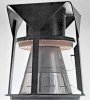
True about the price, but perhaps they're not "true" Walsh drivers (or even Dick drivers) either, since a conventional cone woofer is used to produce the bass, from about 150 Hz on down. Beautiful workmanship, though.
Now-- in the limited time remaining, tell us how you've come to be so intimate with the Walsh design, and am I too far off in thinking that bits of antenna theory have been applied to loudspeaker design in this case?
Mods: feel free to shove this over into the Speakers forum.
Not sure what a centrator is. Probably what we would term a spider, a circular folded treated-fabric suspension bit designed to keep the voice coil centered as it moves, but yes, there's a good chance Axel's Walsh driver could've been saved if the metal cone had come through unharmed.ARGH! Actually, it could have been saved, it was probably only the surrounds and centrator that were damaged, the rest is metal.
But there was another 2-part Ohm cone:
This is the Ohm A, extremely rare. If you have one of these, you have something really special.
Ilimzn's right, though-- you're more likely to have a G driver.
Yep. It sacrificed the coherence of the low end of the Walsh A and F and gained some efficiency and economy.The grayish is titanium, the silverish is aluminium. It's a Walsh-style almost full-range driver. It could probably also work in a sealed enclosure, but originals were passive radiator.
Excellent distillation of the operating principle. Hadn't heard about the barrel distortion of the wave. Assuming the wave can fit on the cone, wouldn't the wavefront tend to be cylindrical?The angle of the cone is chosen such that the speed of the wave propagation times its cosine equals the speed of sound in air. This way, when the speaker is set to 'fire downwards', the horizontal projection of the wave is an exact analog of the acoustic wave in the air, creating a completely coherent cylindrical wavefront - in theory. Because the driver is relatively short, the wave looks more like a barrel, which is closer to what an ideal point source would create.
Interesting you should say that. Doubters maintain staunchly that Ohms create eight-foot-wide flutes and anamorphic Pavarottis. Could you give us some arguments pro?A pair of these speakers would, on a scale of 1 to 10 in the discipline of imaging, score about 12.
Depends on how you define "true", but in a sense yes. Tweeters replace the titanium section (above 8 to 10KHz) and the vented box replaces the cardboard section. Their wild 360-degree dispersion has also been tamed and shaped to make them easier to place in domestic rooms.It should be noted that the current 'walsh' drivers from Ohm are not really true Walsh transducers, but they are still bending-wave based.
http://www.german-physiks.com/index1.htmlAFAIK the only company currently making true Walsh drivers is German Physiks (at a very high price).
True about the price, but perhaps they're not "true" Walsh drivers (or even Dick drivers) either, since a conventional cone woofer is used to produce the bass, from about 150 Hz on down. Beautiful workmanship, though.
Fascinating bit of information, and important for owners whose guests might be tempted to gefingerpoken. Thanks, Zeljko!You might notice that the driver has vertical slits and scorings on the membrane, as well as a few small pieces of stick-on kapton tape stuck on the inside. Do not remove them or disturb them, they are there to damp membrane imperfections. For the same reasons, carefully avoid any damage to the membrane, such as bends or kinks, as it destroys the ability of the driver to create a consistent bending wave on the cone surface.
Now-- in the limited time remaining, tell us how you've come to be so intimate with the Walsh design, and am I too far off in thinking that bits of antenna theory have been applied to loudspeaker design in this case?
Last edited:

