• The move to the new server is done. There are some software and database maintenance updates in process. This has us passing the hat around to help out. We appreciate any donations. Seriously, even a dollar helps. The payment page may be found here - https://www.audiokarma.org/support.html

$1000 Per Month on Groceries Normal?

Our family of 4, all adults, spends at most $160 a week on food. The key is to shop smart. Prepared foods and stuff like cereal drives up the cost. Cereal prices are ridiculous. We try to only buy it on sale or we buy it at a store that discounts it. We use coupons. We buy very little meat (one daughter and myself are vegetarians anyway.) Don't buy the extra large eggs, buy the large. Buy store brands. Orange juice prices are crazy, always buy the one on sale. Buy the cheapest toilet paper, napkins and paper towels. Better yet, buy them at a discount store. We go to more than one store, and buy certain items only at the discount store. We don't buy pre-made frozen dinners or entres. Drink water instead of pop. We use a water filter pitcher instead of buying spring water. Don't buy detergeant, shampoo and dishwashing liquid at full price, buy it at a discount store.
 
Guess my Dad's answer when I shopped with and for him "I don't look at the price if I want it I buy it" seems about right for many I've known since then! Ourselves the Wife and I spending Food only for a Family of 5 was normally around 600-700 and we had plenty of so-called Junk Food/Treats to go around for all.Wife took care of all other Household needs seperately and I have no idea what that came to but we never starved or went broke:)
 
Wife, myself and the two year old average about $80 a week including household products. I think the difference is we don't buy any processed foods.
 
Food Costs

Me, Wife, dog and two boys that only stay with me one week a month … and we spend $800 a month - not including eating out. Groceries are crazy high these days. Produce, meat, snacks … everything has gone up!!!
 
Speaking of prices, went to buy a pack of wieners the other day. $8, EIGHT DOLLARS for a pack of wieners. Admittedly they're not your basic mushdogs, but still they're not artisanal (they were Ambassador brand, my favorite commercial brand) and not even a pound?? Wow...

Holy crap! $8 bucks for dogs?! I agree there is no need for a sub-par dog but there should be room to buy some quality dogs for less then that.

I recently read that beef prices have gone up because of the overseas demand...so I guess selling it over the waters is one reason for the higher cost. The almighty dollar speaks again...ack.

Are food prices going up as a kind of ploy to try and get everyone to eat fast food?! Is there any room for a conspiracy that big businesses are driving food prices up so we will be forced to eat cheap crap?
 
:yikes: $1000/month!

Hmmm, what's the math.

$1000/4 = $250 per person per month
$250/30 = $8.33 person per day
$8.33/3 = $2.77 per meal

$3 per meal is not really too whacked. If that includes all the non-food items, its actually OK.

Damn, money just isn't worth anything anymore.
 
I was JUST having this conversation today with my brother.

Yep, $1000/month for a family of four in metro-Portland OR.

And that does not include any alcohol or anything else and careful shopping.

Food prices continue to escalate - it is my second largest living expense behind the mortgage.
 
We spend about $ 600.00 a month for 2 people, making big pot stew or similar last several days or can be frozen in smaller portions.
Meat is not cheap anymore so watching sales and no junkfood brought down the cost from $ 800.00 as we had before.
Fresh fruit is really high of course, but good for you :)
 
We watch the sales papers of the 3 local chains. Each week, we stop by and load up on the items that have a long shelf life. It is not unusual to have a year worth of coffee, peanut butter, or tuna fish in the pantry. These are the things that we are going to buy anyway and can be had for 1/2 or even 1/3 what people who buy week to week spend.
.....Bravo, Jhtstone, I do the same thing along with purchasing beef I find in a refrigerated markdown section at Kroger the day it reaches it's date and is placed there....being retired, I have plenty of time to drop by my Kroger about every day around noon....the meat employees work the meat cases around 10a, and stock the markdown section around 11a.....

.....today I found two pounds of ground "round" for 2 bucks a pound and used it tonight to make spaghetti....couldn't have tasted better....two evenings ago I had a HUGE charcoaled porterhouse steak I found at Kroger for 8 bucks that "was" over 18....people simply aren't buying expensive cuts of beef, so I wait for them to be priced half or less in the markdown section.....

.....anyone who thinks grocery prices are eventually going to go down are fooling themselves, imo....no need to get depressed over it, just use your head and load-up for much less.....
 
I remember when I was about 12 or 13, back in 1976, my mom had 65 bucks a week for our family of 6. We always had enough good food to eat, but absolutely no junk food or coke.

My wife and I spend 120 Euros a week. That´s including beverages, meat, sweets and laundry detergent. That´s plenty even for a lot of fresh fruit and sweets :)

My brother (from America) visited us about 20 years ago and came shopping with me. He said the prices at the supermarket were quite high here in Germany. Things must have changed in the last 20 years.
 
I have the same size family and my kids are older but I live in Virginia Beach area and routinely paid less than each month. Taking advantage of generic brands and limiting sweets (which has other benefits besides saving $) is a key. When some of the staples go on sale- stock on them when possible.
 
Most of the world's population live on $2 a day for food. To illustrate the point, there is an annual challenge/fundraiser to see who of us in the western world can do it. Of course it is possible if you eat nothing but rice and noodles, but for the part-time participant in the experiment, they find the food way too bland. The people that do it on a daily basis have spices to give it flavour.

Fresh, healthy food is the cheapest there is, and if you remember the food pyramid, the expensive foods like meats should only make up a small percentage of your dietary intake, then fruit and veg, with the bulk being grains and cereals. They are the cheapest of the lot. An initial investment of say $50 in a good range of spices will make a bland yet healthy meal taste fantastic.

The caveat to all this is it does take a little extra time to prepare, but since food preparation and listening to music go hand in hand, I don't mind at all. Just make sure your kitchen system (or B speakers) warrant the time spent in the room.

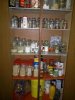
Here's a picture of our pantry. You'll notice a lack of packaging and brand names.

attachment.php


A lot of pastes are pre-made and stored in the freezer. Initially in ice cube trays. Just means I don't have to smash out a vindaloo paste with the mortar and pestle ever time I want to cook one.
attachment.php


The pulses and grains. There is another pantry that houses three types of rice, puls noodles and pasta in bulk.
attachment.php
 

Attachments

  • 2014-08-15-524.jpg
    2014-08-15-524.jpg
    83 KB · Views: 123
  • 2014-08-15-525.jpg
    2014-08-15-525.jpg
    77.8 KB · Views: 123
  • 2014-08-15-526.jpg
    2014-08-15-526.jpg
    83.9 KB · Views: 123
gas and groceries are the slow economic bleed...and now they both go on credit cards. If 51% of shoppers were sensible I wouldn't be so concerned but you should see the carts that go through the checkout at my store...and the people pushing are way overweight.
 
I track income, spending and investing using Personal Capital, a fantastic free tool. 9% of total spending is on groceries, with another 6% on restaurants. A mere 1% on hobbies. ;)

Savings rate is > 60%, as I'm a very careful shopper. Costco, Grocery Outlet (just watch the "best by" dates) and Goodwill (clothing, always brand new) are my big three, Trader Joe's when I feel like spending a bit more.
 
$1000/mo for 4 is a little high. But it depends on the location. Also, if you are not eating out every week then that is OK.

Family of 5. Spend about $150-$200 per week in central MA (food and household goods). We don't go crazy on soda, snacks, or meats. We do eat meat 3-5 times a week but not expensive roasts or hams. We also try to eat the left overs if we can, but do throw out sometimes. My wife shops generic brands when possible. Quality is still important so for some items we don't.

Look at what your $250 buys you per week, and question the expensive stuff. This doesn't have to be a big argument to see what you can sacrifice. But watching what you spend your money on and buying wisely does help. Sometimes this also helps with food quality. The expensive foods sometimes are just bad for you.

And as others have said, don't forget about Aldi, Sam's club, BJ's, etc. Also, price around the regularly bought items. There are expensive grocery stores out there that are not worth the price. We shop Walmart for the generic stuff. The meats, baked goods, dairy, produce are often bought elsewhere though.

Oh, and a small vegetable garden can sometimes help, and it's healthier for you too. It's surprising how much produce a 10x10 garden can supply. It's educational for the kids too. You can even can some of it for use during the winter.

Explore your local farms. We buy dropped apples from a local farmer (at the peak time). You can get 3-4 large bags of apples for $20. We eat a few of them (although they are dropped they are just as good), but use most of them for making pie filling (then freezing). You could also make apple butter, apple sauce, etc. Again, these type of things are great family events if you get the kids involved.
 
$250 a week does not sound crazy for a family of four. I live single, and probably spend a quarter of that weekly, on average. My advice is to shop smart. A good start is to track what you buy to the penny for a whole month. Write everything down, including purchases outside of grocery day (ie. stops at fast food, takeout coffee, grabbing a candy bar when purchasing gas, etc.)

After you track this, you can see where you actually spend money. Make necessary changes in your purchases and diet - think healthy not convenient. Think of it this way... if you were able to save just $10 a week, that would put $520 in your bank account. Small changes add up fast. Also consider how often you stop to shop. Remember, each trip to the store means gasoline used. That adds up too.

I personally shop Aldi and shop sales. I keep my purchases at Sam's Club to a minimum as I end up overspending. I go to Sam's to bulk purchase thinks I know I'll use such as paper goods, etc.
 
I average around $45 per week minus the pet food. A family of four who can keep it under $200/wk is doing pretty well, I'd say.
 
Back
Top Bottom