
• Please note that Audiokarma will be offline briefly for updates early on Monday morning, September 28th.

10DC(N) diode pair replacement

Tio Tony

New Member
Hi, I'm restoring a pair of RA-500 spring reverb units with a bad hum, and was suggested to replace D503, which appears to be a diode pair listed as a "10DC(N)". Would someone kindly suggest a modern equivalent?

Searching this forum I see mention of a 10DC-1 and 10DC-1R (https://audiokarma.org/forums/index.php?threads/10dc-1-and-10dc-1r-sansui-771.863843/), but I'm not sure if it relates or not.

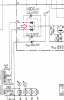
There's a schematic for the unit here: https://medias.audiofanzine.com/files/sansui-ra500-owner-service-manual-472142.pdf and I am attaching a section of the schematic with an arrow pointing to the diode in question.
 

Attachments

  • D503.png
    D503.png
    325.7 KB · Views: 61
Register to hide this ad
D503 is a dual rectifier, and you are unlikely to find a direct equivalent. However you can make one up using 2 separate rectifier diodes, and I would recommend 2 x 1N5393 for this. The original has 3 leads, if you join the replacement diode cathodes together (this is the connection to the right), and the anodes to the left form the 2 connections to the left. The marked band on the replacement diodes indicates the cathode.

Like this:-
anode -----I>I----- cathode.
 
Another option is to install a replacement dual rectifier, although the lead spacing is going to be different. Most of the modern duals will also require a separate heat sink. A STTH30W02C would have almost the correct spacing, and can accept a bolt-on heat sink such as the 657-10A .
 
Hi, I'm restoring a pair of RA-500 spring reverb units with a bad hum, and was suggested to replace D503, which appears to be a diode pair listed as a "10DC(N)". Would someone kindly suggest a modern equivalent?

Searching this forum I see mention of a 10DC-1 and 10DC-1R (https://audiokarma.org/forums/index.php?threads/10dc-1-and-10dc-1r-sansui-771.863843/), but I'm not sure if it relates or not.

There's a schematic for the unit here: https://medias.audiofanzine.com/files/sansui-ra500-owner-service-manual-472142.pdf and I am attaching a section of the schematic with an arrow pointing to the diode in question.
It's a Common Cathode rectifier diode. I use the MUR1620CTG for these. At 8 amp rating, you don't need a heat sink either.
 
Another option is to install a replacement dual rectifier, although the lead spacing is going to be different. Most of the modern duals will also require a separate heat sink. A STTH30W02C would have almost the correct spacing, and can accept a bolt-on heat sink such as the 657-10A .
30A is definitely a bit of overkill for this unit. :D But will be great for something that needs it. :beerchug:
 
Having done some of this for larger CC rectifiers, it's easy to stock fewer parts for multiple purposes, and yes it is complete overkill.
 
It's a Common Cathode rectifier diode. I use the MUR1620CTG for these. At 8 amp rating, you don't need a heat sink either.

Hi, I think you will find that the 8 amp per diode leg is with a suitable heat sink, the data sheet shows that for an ambient of around 40 - 60 deg C it is just over 2 amps (assuming that I am reading the derating graphs correctly, and that it would be easy to get an ambient temp adjacent to the diodes in this range).

Cheers
John
 
Hi, I think you will find that the 8 amp per diode leg is with a suitable heat sink, the data sheet shows that for an ambient of around 40 - 60 deg C it is just over 2 amps (assuming that I am reading the derating graphs correctly, and that it would be easy to get an ambient temp adjacent to the diodes in this range).

Cheers
John
I use them all the time to replace the 10DC dual diodes. Quick and easy and they don't break a sweat. Sure, you could fiddle around and use 2 axial diodes and they would function just fine in this low amp circuit. But then you might have exposed leads to worry about depending on the location. With the TO-220 package, the leads are tucked nicely away and look professional.
 
D503 is a dual rectifier, and you are unlikely to find a direct equivalent. However you can make one up using 2 separate rectifier diodes, and I would recommend 2 x 1N5393 for this. The original has 3 leads, if you join the replacement diode cathodes together (this is the connection to the right), and the anodes to the left form the 2 connections to the left. The marked band on the replacement diodes indicates the cathode.

Like this:-
anode -----I>I----- cathode.
The center is the common cathode. ---->I-I<---- ;)
 
this would be a direct drop in replacement? Having the same delima currently.
It's a TO-220 package so you will only have to carefully bend the leads to fit the holes. As long as the center lead is in the center hole, you cannot get them backwards.
 
The transformer winding associated with this dual rectifier is rated at 150mA - and some have made substitute suggestions for 30A or 8A rectifiers, and heatsinks! WTF! for goodness sake! 'get real' guys! :rolleyes:

Using the TO-220 package dual diodes looks professional. Wiring two axial diodes together looks sloppy, at least to me.
 
Back
Top Bottom