• The move to the new server is done. There are some software and database maintenance updates in process. This has us passing the hat around to help out. We appreciate any donations. Seriously, even a dollar helps. The payment page may be found here - https://www.audiokarma.org/support.html

1218 cueing cylinder removal help

dd123

Active Member
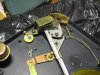
Does anybody know how to remove the cueing piston and cylinder in a Dual 1218? It is different than in a 1229. Mine needs to be refilled and I'd like to clean it before refilling. I got the tonearm lever and cueing lever disconnected underneath -- see photos. There's isn't quite enough clearance to get the knurled nut off the top of the cylinder after removing the 'C' ring. Even if I could get the knurled nut off, it don't seem like that would help because the cylinder isn't moving at all right now, up or down.

If it is a real pain to get the cylinder out, can I just refill without removal? If so, how? Thanks.

.
 

Attachments

  • IMG_7378.jpg
    IMG_7378.jpg
    56.4 KB · Views: 99
  • IMG_7380.jpg
    IMG_7380.jpg
    81.9 KB · Views: 96
Register to hide this ad
Been decades since working on this model. Outer tube is probably welded to chassis. Rod within needs to be removed. Pull plastic cap and little C-clip. Rod should then pull out with a spring, from the bottom.
You need the real-deal cue paste of at least 300,000 viscosity. Nothing but this sticky-gooey stuff will work.
 
That's the ticket! Good call, NoTrans. After I wedged the fluted cap at just the right angle to get it off, there was the second clip. Geez, could Dual have made these clips any smaller? If they didn't want me to disassemble things, why didn't they just say so?:D

The spring didn't come out with the rod, it stayed in the cylinder. And the top part of the rod is spring loaded into the bottom part. So there are two springs involved. I can't get the top and bottom parts of the rod separated.

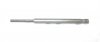
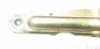
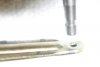
I have some 500,000 silicone oil -- more like paste, as you said. Where do I put it? Into the bottom hole of the rod, or into the bottom hole of the cylinder the rod slides into (see pics), or both?
Do I completely fill the cavities with the paste, or just use a little bit?
 

Attachments

  • Cueing rod.jpg
    Cueing rod.jpg
    11.6 KB · Views: 62
  • Bottom hole of cueing rod.jpg
    Bottom hole of cueing rod.jpg
    23.8 KB · Views: 74
  • Bottom hole of cueing cylinder.jpg
    Bottom hole of cueing cylinder.jpg
    61.1 KB · Views: 78
The rod will remain as one assembly.

Clean, clean, clean. Then place some paste at the mouth of the tube. Insert rod, rotating as you go.
Use no condom.
You will be able to tell if it is thoroughly coated.
 
After I get the paste into the opening in the tube, it looks as though the cueing lever being held tightly against the tube opening is all that keeps the paste from leaking out -- see pics. There is a spring that goes underneath the cueing lever that can make it press up against the tube opening, and I know the paste is thick, but will is really be kept in the tube? Or am I missing some kind of cap that goes over the tube opening?
 

Attachments

  • IMG_7418.jpg
    IMG_7418.jpg
    32.4 KB · Views: 50
  • IMG_7421.jpg
    IMG_7421.jpg
    24.8 KB · Views: 56
The only time that it leaks out is when the newly-repaired turntable bakes all day in the summer sun, within the UPS truck, on its way back to the customer.
 
Oh man, I feel your pain! I guess anything turns into a runny liquid if it gets hot enough.
 
Actually, the fluid WILL eventually leak out of the tube due to gravity. It usually takes several years, though.

However, that's why the fluid in these types of damping mechanisms needs to, at some time, be replenished.

Doug
 
Well, I got it done and it seems to work fine. Thanks for the help gang.

EDIT: With the cueing mechanism back together, I see that the fluted cap adjusts the vertical position of the cueing rod, and therefore sets the height of the tonearm. What is the proper way to adjust it?

Also, any ideas for shining up the dulled black top surface of the TT?
 
Last edited:
The usual way to adjust the tonearm height is to set it so the top of the headshell just clears the bottom record in a stack on the automatic spindle. That way, it will always lift high enough so it won't drag on the top record on the platter if the maximum number of records is on there.

Is the whole top surface dull or just one area?

Doug
 
Many models seem to have a mat finish from the factory, that gets glossy with the decades of dusting and polishing. I recently got a free 1229 [broken speed lever], and the chassis is mat. Same with my 1219.

Also, that fluted sleeve sets maximum arm height during auto-functions. First set max arm height with the fluted-head screw at rear of gimble. Desired height is just below the highest point of arm rest. Then set the fluted plastic sleeve just a bit shy of that, so as to leave some slack when the auto-mechanism lifts the arm. The underside of a stack of records is usually the height of the arm rest.

Make sense?
 
Last edited:
Two comments: 1: re-emphasize the clean clean clean. Silicon fluid leaks out faster if any oil contaminants are there. 2: There are two grooves in the smaller part of the rod. Try to make sure that silicon gets into those grooves. This will make it last a lot longer. Good luck.

No - (politely said) this is completely wrong. The thinner part of the shaft that you reference doesn't come in contact with anything. It wants to be dry. The E clips fit into the slots on that shaft, and most of that shaft is above and out of the cylinder that holds the silicone paste.
 
Good advice on tonearm height adjustments. I'm not a record stacker, but this Dual is going as a Christmas present, so who knows.

And thanks, Bill, for the (polite) correction to the post about silicone on the thin part of the piston. I had already realized that, but it's good to hear verification from a pro.

Yep, black mat finish. My 'duh'. Didn't think to check the 1219 that is next to get refurbished.
 
Two more things just came up:

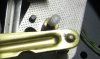
1) Should I do any lubricant on the dimple at the end of the cueing lever (next to the guide white in the photo). Both contact the wide end of the tonearm lever. I know the guide needs to be dry in order to move the tonearm lever properly, but I don't know about the dimple. There is a continuous rub mark where the dimple presses against the tonearm lever.

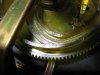
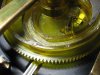
2) Maybe this should be a separate post: I just noticed (should have caught it earlier) there is a rut in a portion of the tonearm lever track in the cam wheel -- see pics. How the heck does something like that occur? The tip of the tonearm lever pin that rides in that track is nicely rounded and smooth. Maybe the screw at the pivot point of the cueing lever should be tighter so the dimple doesn't press so hard against the tonearm lever?

More importantly, is it a problem? Seems like it will produce mechanical noise during start and stop cycles, if nothing else.
.
 

Attachments

  • Guide white and dimple.JPG
    Guide white and dimple.JPG
    41.5 KB · Views: 44
  • IMG_7424.jpg
    IMG_7424.jpg
    71.6 KB · Views: 45
  • IMG_7430.jpg
    IMG_7430.jpg
    81.5 KB · Views: 41
A far as the "rut" in the big cam, it looks like somebody ran it without any lubricant in there.

There needs to be a fairly heavy grease (wheel bearing grease for instance) in that groove as there is spring tension against the arm lift lever.

It is one case where the old rule of the less the better does NOT apply.

Doug
 
:tears
No - (politely said) this is completely wrong. The thinner part of the shaft that you reference doesn't come in contact with anything. It wants to be dry. The E clips fit into the slots on that shaft, and most of that shaft is above and out of the cylinder that holds the silicone paste.

:tears: My bad. It's been too long since I worked on turntables. Most cueing shafts have grooves on them to help retain the silicone.
 
A far as the "rut" in the big cam, it looks like somebody ran it without any lubricant in there.

There needs to be a fairly heavy grease (wheel bearing grease for instance) in that groove as there is spring tension against the arm lift lever.

It is one case where the old rule of the less the better does NOT apply.

Doug

If any of that wheel bearing grease wanders to other parts of the cam, it will really screw things up. The peg that runs in the gear's track is tipped with nylon. The thinnest lube is just fine.
AND KEEP ALL LUBES FAR AWAY FROM THE GEAR TRIP PRAWL. NEEDS TO BE DRY.
 
Back
Top Bottom