

You are using an out of date browser. It may not display this or other websites correctly.
You should upgrade or use an alternative browser.
You should upgrade or use an alternative browser.
16 ohm vs 8 ohm, problem?
- Thread starter Nezpique
- Start date
Register to hide this ad


Nezpique
Active Member
No, the crossovers will be fine. There are things like the crossover point is different with a 16 ohm driver, and sensitivity differences, but it won't hurt to hook them up and try them out.
Awesome, thank you!
Nezpique
Active Member
They are actually the same driver (Selenium D220TI) just different impedance. My intentions were to run one of my wooden horns set on top of the CS 1.5T's. I set them up on a switch so that I can change between the wooden horn and the original horn. I think the original horns are too bright in my opinion, maybe the wooden horn will help.

Retrovert
Addicted Member
I just built a pair of Crites CS 1.5T's. They are 8 ohm speakers but I'd like to try them with a 16 ohm mid driver, it would be plug and play. Just want to hear what the 16 ohm driver sounds like. Will it do any damage to my xovers if I give them a short listen??
Do Not Do This.
Read the enclosed math and it will explain why you risk damaging your horn, and why the sound will be terrible.
The crossover is a filter, so it will not be damaged by the change in driver impedance, but your horn may be damaged by low frequencies it cannot properly reproduce. Even if it is not damaged, it will sound terrible because it will be overlapping with the woofer, so the sound will be too loud in that region. along with heavy distortion. As a bonus, maybe it burns out.
The crossover is a name for filters. The frequency of a filter critically depends upon the nominal driver impedance. Alter the impedance, alter the frequency. This alteration can destroy a horn, as these must not reproduce frequencies below a critical point, and the frequency will drop.
That looks like some sort of two-way with a horn? If you double the driver impedance you will downwards shift the low-pass point of the crossover, overlapping with the driver below, and upwards shift the high-pass point of the crossover. Which, since this is a two-way, doesn't exist in the usual sense, but the crossover (I didn't look for it) may use an inductor to form a higher-order filter and that point will shift.
Because of the overlap with the woofer, and driving the horn with low frequencies where it distorts, the sound will be terrible and the driver may be damaged if it cannot reproduce the frequencies it is passed.
If you want to attenuate the horn you may use an L-pad to reduce the volume while maintaining a constant impedance. Swapping drivers of different impedances, particularly horns, is guaranteed to (at best) sound awful because of the overlap, and (at worst) damage or destroy the driver because of energy at lower frequencies than the driver can handle or too much excursion from lower frequencies, which damages the cone or voice coil.
Here's some material on the calculations I've elsewhere posted. These formulas are well accepted and will not lie to you. You may trivially verify all of this using a simple search with Google.
First the formulas:
Given:
R is Nominal Speaker Impedance (Ω)
C is Capacitance (Farad)
L is Inductance (Henry)
f is Frequency (Hertz)
L = R / (2π x f) (Henry)
f = R / (2π x L) (Hertz)
R = 2π x L x f (Ω)
C = 1 / (2π x f x R) (Farad)
f = 1 / (2π x C x R) (Hertz)
R = 1 / (2π x C x f) (Ω)
L is inductance in Henry.
To convert from Henry (H) to milliHenry (mH) multiply by 1,000.
To convert from milliHenry (mH) to Henry (H) divide by 1,000.
C is capacitance in Farad.
To convert from Farad (F)to microFarad (uF) multiply by 1,000,000.
To convert from microFarad (uF) to Farad (F) divide by 1,000,000 or multiply by 0.000001.
R is Nominal Speaker Impedance (Ω)
C is Capacitance (Farad)
L is Inductance (Henry)
f is Frequency (Hertz)
Inductor Formulas:L = R / (2π x f) (Henry)
f = R / (2π x L) (Hertz)
R = 2π x L x f (Ω)
Capacitor Formulas:C = 1 / (2π x f x R) (Farad)
f = 1 / (2π x C x R) (Hertz)
R = 1 / (2π x C x f) (Ω)
L is inductance in Henry.
To convert from Henry (H) to milliHenry (mH) multiply by 1,000.
To convert from milliHenry (mH) to Henry (H) divide by 1,000.
C is capacitance in Farad.
To convert from Farad (F)to microFarad (uF) multiply by 1,000,000.
To convert from microFarad (uF) to Farad (F) divide by 1,000,000 or multiply by 0.000001.
It may therefore be seen that for the high-pass portion of the midrange band-pass filter (realized using the capacitor) has f ≈ 1 / R. So if R doubles while C remains constant, then f. is halved, reducing the crossover point by one half. If it was, say, 800 Hz it is now 400 Hz. If it was, say, 1,500 Hz it is now 750 Hz.
For the low-pass portion of the midrange band-pass filter realized using the inductor we see that f ≈ R. So if R doubles while L remains constant, then f doubles. If it was, say, 2,500 Hz it is now 5,000 Hz.

mhardy6647
Lunatic Member
8 vs. 16 ohm (nominal) change in load will result (nominally) in a two-fold change in crossover frequency (one octave).
Last edited:
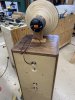
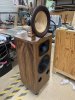

Nezpique
Active Member
The horns look pretty cool. Where did you get them?[/QUOTE
I turned them on my lathe.
Nezpique
Active Member
That’s awesome man. I can see you have a nice shop in the background.
Did you use a plan for the size/shape?
No, just made them about 1" deeper than the horn in the CS 1.5T's