• The move to the new server is done. There are some software and database maintenance updates in process. This has us passing the hat around to help out. We appreciate any donations. Seriously, even a dollar helps. The payment page may be found here - https://www.audiokarma.org/support.html

1626 Line Stage (thoughts and opinions)

Hi All,

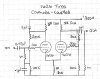
I've been work on this line stage amplifier for some time now and it utilizes the 1626 tube. I'm need help with your thoughts and opinions on its design, performance and alternative design if you have any.

Not sure how many of you are familiar with this tube 1626, but i hear it has almost same specs as the 12B4?

So i'll be using two 1626 tubes per channel as per the schematic.
Any input would be greatly appreciated.

Thanks!

attachment.php
 

Attachments

  • 1626-line-stage.jpg
    1626-line-stage.jpg
    60.8 KB · Views: 225
Register to hide this ad
I'm not sure i understand why you are doing it that way , if i was going to go to that much trouble for a line stage i would use it as a differential amp and take the output off between the two plates and not the second plate to ground .
 
This is good info, I loved the 12B4 when i finally got it tweaked in, and have a buttload of these little tubes. They are right nice looking too, with the small ST shape and brown base.
 
Agree with Mark... a differential amp or LTP is "cathode coupled" if you take the signal off the opposite side.
 
1k in cathode is too low for any type of LTP or diff pair. It has to be as high as possible within reasonable circuit parameters. Or even use penthode CCS there (if you do not want depletion mode MOSFET for that role).
 
This is an interesting design you have got here. If you can iron out a few kinks as previously discussed (the big one being the need for a significantly larger tail resistor via the use of a negative rail voltage supply, or the use of a CCS), I think this will make a very good sounding preamp.

Basically you have a first stage buffer that drives the second amplification stage via its cathode. It's able to do this because the grid of the second stage is grounded. The modulation of the second stage tube occurs by varying the cathode voltage with grid grounded, instead of the more typical method of varying the grid voltage with cathode grounded. It's a less common topology but does work quite well. You may want to take a look at the "Grounded Grid Preamp" by Bruce Rozenblit, which is a commercial offering utilizing this design. You need to buy his book to get his schematic.

If you can work out some kinks which are touched on in his book, the use of the 1626 tube in this topology I think will be a real rock star performer.
 
This is an interesting design you have got here.
Interesting, but what does it do that can not be done with a standard LTP?

You may want to take a look at the "Grounded Grid Preamp" by Bruce Rozenblit, which is a commercial offering utilizing this design.
Glad to see you put the "Grounded Grid Preamp" in quotes, because it is not actually one.:nono:
 
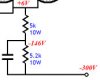
In Bruce Rozenblit book, he utilizes a negative rail voltage at the cathodes. I think i might use his design. A negative rail voltage and two 5k 10w resistors.

attachment.php
 

Attachments

  • neg.jpg
    neg.jpg
    5 KB · Views: 107
Interesting, but what does it do that can not be done with a standard LTP?

Maybe not a lot. I haven't investigated his design enough to know deeply its merits or weaknesses.

In Bruce Rozenblit book, he utilizes a negative rail voltage at the cathodes. I think i might use his design. A negative rail voltage and two 5k 10w resistors.

Sounds better. I'll be curious how this project ends up and how it sounds.
 
Also, I forgot to ask why use power triodes for a line stage, it is going to drive an even larger power tube(s) that need the grid current?
 
Maybe not a lot. I haven't investigated his design enough to know deeply its merits or weaknesses.


Sounds better. I'll be curious how this project ends up and how it sounds.
I suggest try a design with penthode CCS. If you use TV sweep tube, you may get good result with negative supply as low as 100V.
 
Why power triodes for line stage? the only logical reason that i can come up with, i have a batch of them sitting in my work shop, gotta do something with them? besides they look cool with their "coke bottle" style. They will be feeding an 1979 Marantz 245.
 
It's an interesting looking design. If I'm not mistaken there is a way to increase the tail resistor without resorting to a negative power supply rail. You could elevate the grids to about 150V using a simple potential divider from the HT. Or you could could reference the grids to just below the cathode voltage and have a larger resistor below that, similar to the commonly seen phase splitter.
 
Go to at www.turneraudio.com.au in the MISCELLANEOUS
SCHEMATICS 2.
I have bulit my variation of line amp #4. I am using Mullard
12au7s using a LM-334 for the cathodes. It is driving a 6N7/46 SET to Fe127 metronomes. I am not disappointed.
 
After further review and help from members, here is what i came up with as my final draft for my 1626 line stage, utilizing three 1626 tubes. Let me know what you think?

Thank you so much.

attachment.php
 

Attachments

  • 1626-Line-Stage-v-2.jpg
    1626-Line-Stage-v-2.jpg
    64.1 KB · Views: 89
Back
Top Bottom