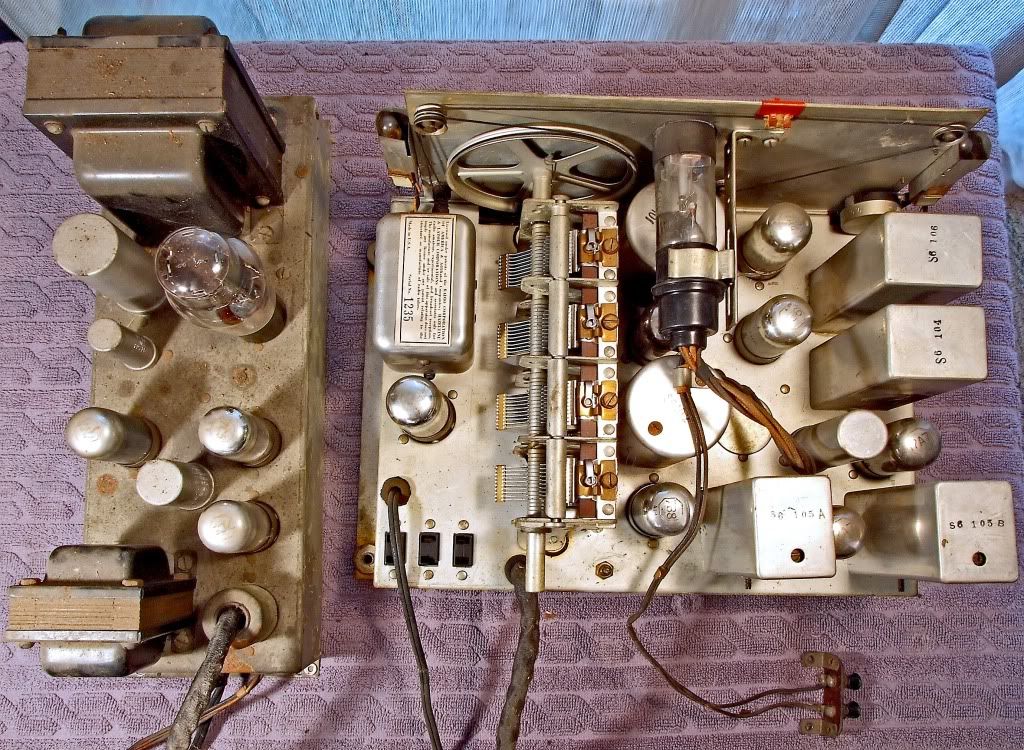
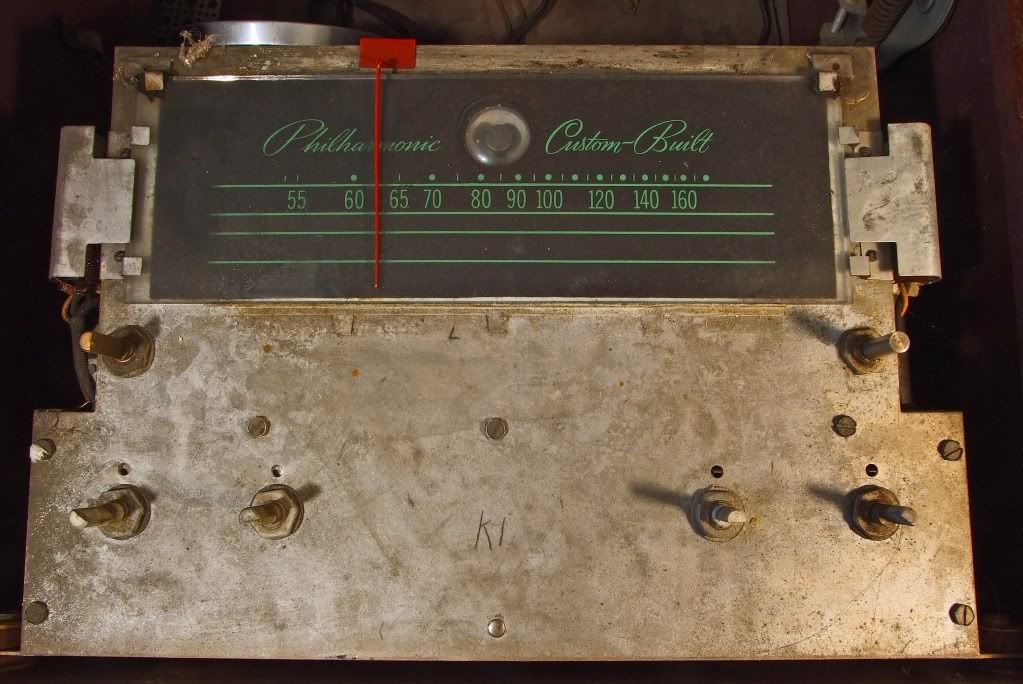
I heard back from my contact at the Smithsonian today. I asked for and received permission to post photos of their 1937 Philharmonic Futura for comparison with my 1941 Philharmonic Futura K-1. Unfortunately, the Smithsonian's Philharmonic is not currently on display and unlikely to be so anytime soon.
The biggest difference is the location of the PP output tubes. On the '37 Futura they are located on the main chassis with the tuner. My '41 Futura K-1's 7C5 output tubes and the 7N7 (driver/phase inverter?) tube are on the power supply chassis. The use of primarily loctal tubes on my '41 Futura also seems to have raised a few eyebrows. I have no clue why Philharmonic chose to do so.
My 1941 Philharmonic Futura K-1 Chassis:
The Smithsonian's 1937 Philharmonic Futura Chassis:
(Photo courtesy Smithsonian Museum of American History)
(Photo courtesy Smithsonian Museum of American History)
(Photo courtesy Smithsonian Museum of American History)
1937 Philharmonic Futura - Face:
Note below, in small print at the bottom of the dial face: "FISHER RADIO CORPORATION - N. Y." Which, I believe, indicates that this in not the original dial scale and may have been added to strengthen the link between Philharmonic Radio Co. and Fisher Radio Corp.
Victor Brociner, one of Avery Fisher's partners and co-founder of Philharmonic Radio, took exception to Fisher's claim that the '37 Philharmonic Futura was a "Fisher" radio. He wrote several letters to the Smithsonian to point out that this was a Philharmonic radio and not a Fisher. I have a hunch that Avery Fisher and Victor Brociner did not part on very good terms when the original Philharmonic partnership broke up during WWII.
That very murky period in Philharmonic/Fisher history probably has as much to do with the likely bad blood between Philharmonic's partners as with the secrecy surrounding Philharmonic's wartime projects. I really doubt that Avery Fisher sold his interest in Philharmonic willingly or happily. I suspect he lost control of the company as Philharmonic was forced to increase capitalization in order to finance their rapid wartime expansion.
(Photo courtesy Smithsonian Museum of American History)
(Accession document courtesy Smithsonian Museum of American History)
Garrard RC10:
This is the changer that accompanied the '37 Philharmonic Futura. There is also good evidence that the earliest Philharmonics used a Garrard RC6. I don't know if Garrard model numbers were issued numerically in chronological order. You'd think that the RC6 was an earlier model.
(Photo courtesy Smithsonian Museum of American History)
Regarding the original turntable for my 1941 Philharmonic: it eventually dawned on me that it was very unlikely that mine came with a manual Garrard. I had assumed it would be Garrard since all of the earlier Philharmonics offered them. The reason Garrard probably wasn't supplying Philharmonic at that point became fairly obvious once I considered that they were a British company based in the town of Swindon, England. It seems almost certain that they would have been engaged in the manufacture of war material for some time prior to 1941. I can find next to nothing on the Webster-Rauland turntables that may have supplanted Garrard during WWII.