

You are using an out of date browser. It may not display this or other websites correctly.
You should upgrade or use an alternative browser.
You should upgrade or use an alternative browser.
1961 Fisher Statesman
- Thread starter mcsteam22
- Start date


Gorgeous!:thmbsp:
Just wanted to post with some updates on the disassembly of the components for resto work.
Thought I'd start with some pictures of the speakers and speaker related items. In later posts, I'll add the Garrard changer, and the receiver and amp details.
So, here's the speaker stuff:
It's apparent that the Statesman has sat for a while, accruing much oxide and decay of materials (speaker surround mold, oxide on rheostats, wiring). Nothing appears to be beyond hope. In fact, everything looks very good; just some things that I may benefit from with the group's inputs.
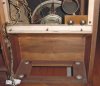
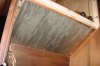
The side that housed the amplifier had a stepped speaker box back panel with a heat reflector shield. Apparently Fisher considered all aspects of keeping the equipment cool even re-directing the radiate heat of the amp out towards the back! The reflector panel is not so reflective anymore. But, that is one item that will get shined up or replaced with something that is a good IR reflector material.
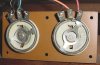
Speaker enclosures are vented with tuned port tube. All speakers have a ground bonding wire looped at a mounting screw, jumping from speaker to speaker, to crossover, etc.....All wiring is soldered. No connectors. That's great for low resistance connections. But, it is a nightmare for disassembly. I believe the correct thing to do is to replace the wiring with new. Is there any advantage to keeping the vintage wire? Any wire recommendations?
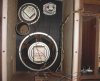
Also shown is some mold that is growing on the woofer surround. My thinking is to gently brush it away and just leave it at that. The surround appears to be rubberized fabric and doesn't look like it has been affected by the mold. Have any of the members dealt with mold on speakers?
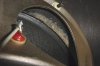
There is a picture of the "Brilliance" and "Presence" rheostats, showing the light film of oxide. I'll slowly clean that up with Deoxit, unless there are better means known. Just lots and lots of cleanup work needed here.
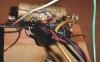
The crossovers are all hand-assembled; plywood square with the choke and caps mounted to it. It's so impressive to see the quality of design and manufacturing that was put into these machines. All made in the USA. It is a beautiful thing to behold.
One final question would be how to test the crossover capacitors?....or just replace them with new?
Thought I'd start with some pictures of the speakers and speaker related items. In later posts, I'll add the Garrard changer, and the receiver and amp details.
So, here's the speaker stuff:
It's apparent that the Statesman has sat for a while, accruing much oxide and decay of materials (speaker surround mold, oxide on rheostats, wiring). Nothing appears to be beyond hope. In fact, everything looks very good; just some things that I may benefit from with the group's inputs.
The side that housed the amplifier had a stepped speaker box back panel with a heat reflector shield. Apparently Fisher considered all aspects of keeping the equipment cool even re-directing the radiate heat of the amp out towards the back! The reflector panel is not so reflective anymore. But, that is one item that will get shined up or replaced with something that is a good IR reflector material.
Speaker enclosures are vented with tuned port tube. All speakers have a ground bonding wire looped at a mounting screw, jumping from speaker to speaker, to crossover, etc.....All wiring is soldered. No connectors. That's great for low resistance connections. But, it is a nightmare for disassembly. I believe the correct thing to do is to replace the wiring with new. Is there any advantage to keeping the vintage wire? Any wire recommendations?
Also shown is some mold that is growing on the woofer surround. My thinking is to gently brush it away and just leave it at that. The surround appears to be rubberized fabric and doesn't look like it has been affected by the mold. Have any of the members dealt with mold on speakers?
There is a picture of the "Brilliance" and "Presence" rheostats, showing the light film of oxide. I'll slowly clean that up with Deoxit, unless there are better means known. Just lots and lots of cleanup work needed here.
The crossovers are all hand-assembled; plywood square with the choke and caps mounted to it. It's so impressive to see the quality of design and manufacturing that was put into these machines. All made in the USA. It is a beautiful thing to behold.
One final question would be how to test the crossover capacitors?....or just replace them with new?
Attachments

Welcome to AK!
It's pretty obvious that you are a kindred spirit from the get go. I'd replace those caps, since they're a mere 50 or so years old. Perhaps if you post the values you might get a donation or two.
If that black one is really a 0.47uF cap, I may have an extra Sprague 118P or Vit Q that would do nicely....:thmbsp:
It's pretty obvious that you are a kindred spirit from the get go. I'd replace those caps, since they're a mere 50 or so years old. Perhaps if you post the values you might get a donation or two.
If that black one is really a 0.47uF cap, I may have an extra Sprague 118P or Vit Q that would do nicely....:thmbsp:
worldoftone
New Member
Freaking sweet.
- WOT
- WOT


TheRed1
Console Conservationist
I have to say that your console appears to be just a tad better constructed than mine. My TA-600's output tubes are vented well enough but there is no shielding to prevent the top of the cabinet from getting fairly warm. The cats love it, though, and it hasn't caused any problems with the exterior finish.
One similarity I note is the yellow oxide on the nuts that fasten the speakers in place. What does your acoustic insulation look like? This is what mine came with (on the right side) and I suspect it's rock wool which is known to cause corrosion and should be replaced.

Interesting that both our consoles came with three way speakers which in 1961 were ported but in 1960 were not. Fisher doesn't mention that in their advertising. Those horns probably make a big difference in overall clarity, too. An extra $200 and a 1 year later model seem to make for a significant step up. In the photo you can plainly see the yellow fungus on the nuts as well as on the tweeter. It cleans up easily with a little baking soda, warm water and a toothbrush.
I replaced my three-way Jensens with full-range Audio Nirvana 10s (tried the 12s but they wouldn't fit) - and I somewhat regret it. I still have the original speakers and will probably replace them and rebuild the crossovers when I eventually have the 600 rebuilt. I think you lose a lot of the characteristic console sound with modern speakers - it's just too crisp and maybe a little thin around the middle. I did replace the original speaker wire but not with anything too fancy, just ordinary 14 gauge speaker wire.
I'm looking forward to your Garrard post as I have an non-console Type A I'd like to put into service and I'm glad there are a few other anachronists who find console anatomy as fascinating as I do.
One similarity I note is the yellow oxide on the nuts that fasten the speakers in place. What does your acoustic insulation look like? This is what mine came with (on the right side) and I suspect it's rock wool which is known to cause corrosion and should be replaced.
Interesting that both our consoles came with three way speakers which in 1961 were ported but in 1960 were not. Fisher doesn't mention that in their advertising. Those horns probably make a big difference in overall clarity, too. An extra $200 and a 1 year later model seem to make for a significant step up. In the photo you can plainly see the yellow fungus on the nuts as well as on the tweeter. It cleans up easily with a little baking soda, warm water and a toothbrush.
I replaced my three-way Jensens with full-range Audio Nirvana 10s (tried the 12s but they wouldn't fit) - and I somewhat regret it. I still have the original speakers and will probably replace them and rebuild the crossovers when I eventually have the 600 rebuilt. I think you lose a lot of the characteristic console sound with modern speakers - it's just too crisp and maybe a little thin around the middle. I did replace the original speaker wire but not with anything too fancy, just ordinary 14 gauge speaker wire.
I'm looking forward to your Garrard post as I have an non-console Type A I'd like to put into service and I'm glad there are a few other anachronists who find console anatomy as fascinating as I do.


Modegard
Well-Known Member
Wow! very nice Fisher console.
AK member modegard, has a completly restored SA-100 and it is a sight to behold :thmbsp:. If there ever was a console worthy of a restoration that would be right up there.
Have fun with the resto.
RC
Sharp console. The SA-100 is really a nice amp. I love mine. You are very lucky to find such a nice console. Good luck.
Thanks for the good feedback, everyone. Tropical Storm Fay activities have finished and I'm happy to report that the Statesman is fine. I should now be able to focus more on my restoration work and resume regular reading of Audiokarma.
Some questions here:
Were Jensen speakers standard OEM drivers in Fisher consoles?
TheRed1, you are correct; rock wool insulation IS what is used on mine too. I didn't know about the corrosive out-gassing nature of that stuff. I've heard that simple poly-fill pillow stuffing is good for speaker enclosure damping. What is your recommendation for good acoustic padding?
Also, your speaker upgrades sound like they'd be excellent. I noticed in the speaker pictures of your Premiere, that you re-wired everything in the spirit of Fishier (i.e. all soldered connections). I was planning on keeping the original drivers to keep within the pure realm of vintage sound. But, I'd really want to savor the amp's qualities with some nicely matched external speakers for comparison. Sometime after restoration is complete, I'll pursue that. For now, it's still in disassembly and rebuild modes of operation.
I'll post back soon with additional pics of hardware and the Garrard Type-A. I have since aquired the Sams photofact of the Type-A for rebuild. I'm currently studying over that and researching the correct lubricants to use. Too much to discuss all at once.
Some questions here:
Were Jensen speakers standard OEM drivers in Fisher consoles?
TheRed1, you are correct; rock wool insulation IS what is used on mine too. I didn't know about the corrosive out-gassing nature of that stuff. I've heard that simple poly-fill pillow stuffing is good for speaker enclosure damping. What is your recommendation for good acoustic padding?
Also, your speaker upgrades sound like they'd be excellent. I noticed in the speaker pictures of your Premiere, that you re-wired everything in the spirit of Fishier (i.e. all soldered connections). I was planning on keeping the original drivers to keep within the pure realm of vintage sound. But, I'd really want to savor the amp's qualities with some nicely matched external speakers for comparison. Sometime after restoration is complete, I'll pursue that. For now, it's still in disassembly and rebuild modes of operation.
I'll post back soon with additional pics of hardware and the Garrard Type-A. I have since aquired the Sams photofact of the Type-A for rebuild. I'm currently studying over that and researching the correct lubricants to use. Too much to discuss all at once.
TheRed1
Console Conservationist
All the Fishers I've run across have had them.Were Jensen speakers standard OEM drivers in Fisher consoles?
I tried a high density foam and it seems to work OK. Poly-fill didn't seem quite dense enough to me for use in a console situation. Nor did fiberglass which has other arguments against it. I wanted a material with some weight to it in order to keep the vibrations in the cabinet to a minimum as well as to reduce reflected sound within the enclosure. The foam I used feels about as heavy and is only a little thicker than the original rock wool. I used a lot more of it, though. And it IS expensive.I've heard that simple poly-fill pillow stuffing is good for speaker enclosure damping. What is your recommendation for good acoustic padding?
The picture I posted was the BEFORE picture. I currently have only one full-range 10" speaker per enclosure. I left the midrange and tweeter cutouts open as their combined area came very close to the upper range for porting. Also, the enclosure volume was almost exactly what was recommended for my speakers. I may have slightly over ported and slightly over dampened in my efforts to re-create the warmth of the Jensens. But they still sound too crisp and modern for my tastes. And that's quite a compliment that you mistook Fisher's factory soldering for mine. Maybe someday...I noticed in the speaker pictures of your Premiere, that you re-wired everything in the spirit of Fishier (i.e. all soldered connections). I was planning on keeping the original drivers to keep within the pure realm of vintage sound. But, I'd really want to savor the amp's qualities with some nicely matched external speakers for comparison.
I have connected the 600 in the Premiere to a pair of Klipsch KG4s and I liked the sound but I lacked the space. I have yet to hook it up to my Cornwalls but that will require removing the 600 from the console. Perhaps this winter.
Glad to hear the Statesman weathered Fay OK.

clydeselsor
Lunatic Member
I love tube consoles! That Statesman is a thing of beauty!!
Tweeter Problem
Hello again. Progress with restoration has been slow. But, I wanted to update with some recent discoveries; even if this update is a bit of a downer.
Serious problem with the original tweeters: Looking for suggestions to find replacements that may offer similar performance as these originals.
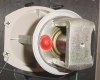
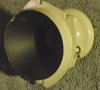
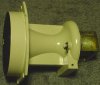
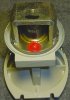
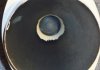
After removing all the speaker hardware for a good cleaning and re-wiring, I noticed that the phase plug (shown in the “Fukuyo_horn4” picture) in the center of the horn throat was cracked and distorted from corrosion; totally closing-off the acoustic passage from the diaphragm. They’re choked.
Unfortunately, the crumbling phase plug is integral with the entire voice coil and diaphragm. A rebuild isn’t possible.
These are original to the console and have the name “Fukuyo-Sound” and “Coral” cast into their frames. Sadly, it appears that these cool OEM horn tweeters have reached the end of their life. My goals to keep the original equipment as a complete, functioning system won’t be possible.
These horns measure about 5 ½” from front to back and 3 ½” diameter rim. They are 16 Ohm. I believe the crossover was designed to split off 3,500 Hz and higher to these.
Any suggestions on a good manufacturer that makes quality horn tweeters that may offer similar performance?
Hello again. Progress with restoration has been slow. But, I wanted to update with some recent discoveries; even if this update is a bit of a downer.
Serious problem with the original tweeters: Looking for suggestions to find replacements that may offer similar performance as these originals.
After removing all the speaker hardware for a good cleaning and re-wiring, I noticed that the phase plug (shown in the “Fukuyo_horn4” picture) in the center of the horn throat was cracked and distorted from corrosion; totally closing-off the acoustic passage from the diaphragm. They’re choked.
Unfortunately, the crumbling phase plug is integral with the entire voice coil and diaphragm. A rebuild isn’t possible.
These are original to the console and have the name “Fukuyo-Sound” and “Coral” cast into their frames. Sadly, it appears that these cool OEM horn tweeters have reached the end of their life. My goals to keep the original equipment as a complete, functioning system won’t be possible.
These horns measure about 5 ½” from front to back and 3 ½” diameter rim. They are 16 Ohm. I believe the crossover was designed to split off 3,500 Hz and higher to these.
Any suggestions on a good manufacturer that makes quality horn tweeters that may offer similar performance?
Attachments
TheRed1
Console Conservationist
I'm surprised that Fisher used a Japanese made component but I suspect it was a decent quality horn for 1961. It certainly has an interesting look to it. You might try posting in the Speaker forum to see if you get more response over there. Perhaps it could be rebuilt.

Hi Jeromee -- Welcome to the AK Fisher Forum!
Based on the description of the symptoms, your problem could very likely be more of a phonograph problem than anything else. Check that the cables from the phonograph are fully inserted and making good contact. If that doesn't resolve the issue, then remove those two cables, and reinsert them in the same jacks, but with their positions reversed. If the problem is swapped to the other channel, then the phono pickup, it's leads, or the cables connecting the phonograph to the tuner/preamp are the issue. Or, if when reversed, if the problem stays in the same channel, the the problem is in your tuner/preamp chassis.
I hope this helps! Let us know!
Dave
Based on the description of the symptoms, your problem could very likely be more of a phonograph problem than anything else. Check that the cables from the phonograph are fully inserted and making good contact. If that doesn't resolve the issue, then remove those two cables, and reinsert them in the same jacks, but with their positions reversed. If the problem is swapped to the other channel, then the phono pickup, it's leads, or the cables connecting the phonograph to the tuner/preamp are the issue. Or, if when reversed, if the problem stays in the same channel, the the problem is in your tuner/preamp chassis.
I hope this helps! Let us know!
Dave