VA1DER
Member
I am writing this mostly as a tool to eBay sellers who sell 1n4148 pairs as replacement for varactor diodes. Or for people to point eBay sellers to as a reference.
Background:
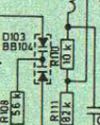
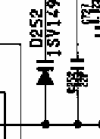
VD-1121, VD-1221, VD-1212, and MV-13 are single and dual varactor diodes. Or varicaps, if you will. A lot of people use one or two 1n4148's to replace the single and dual varactors where they have failed. As opposed to the thread title, this is actually reasonable in a number of circuits (see explanation below). The problem, is that this replacement is anything but universal, and the problem is if you do this in the wrong circuit the temperature compensation won't work, or the circuit will simply not work.
Explanation:
VD-1121/1221 et al are single and dual varactor diodes wrapped in ceramic beads. They were intended as temperature compensation components. As such, they work one of two ways:
1) As a normal diode, often for temperature sensing where their voltage drop changes with temperature. The voltage drop, of course, decreasing with increasing temperature. But since they are normal diodes.
2) As a temperature sensing varactor/varicap, where their capacitance changes with reverse bias voltage and temperature. A varactor is appealing to use for temperature compensation because its capacitance is inversely proportional to temperature. So as temp increases, capacitance decreases.
They are also used a third way simply by virtue of being a varactor:
3) As a normal varactor/varicap, where their capacitance change is used for voltage-controlled capacitance like any varicap, most often for voltage-controlled tuned circuits.
Now, a 1n4148 has a tiny junction and essentially no capacitance to speak of. In case #1, their voltage drop will map about the same as a varactor diode, so they are a reasonable choice. However for case #2 and #3, a 1n4148 switching diode never has any capacitance to speak of at any time.
Practical upshot: In case #1 a 1n4148 will work as intended. In case #2, though it is completely useless. It's probably not dangerous, but the circuit will act as if it's at max temperature even when it's cold. In case #3, a 1n4148 will cause the circuit to cease to function - there will be no tuning at all.
I have seen circuits that use them in temperature compensation both ways, forward biased as diodes and reverse biased with capacitance-based bias adjusting. These diodes were used that way a lot because they came in ceramic beads that conducted heat effectively. But they were also used in other places that had nothing to do with temperature compensation - for example in early voltage based tuned circuits, where voltage is used to change a tuning like the rare Realistic QTA-790 which used them for programming tuning presets.
Better Replacements than 1n4148:
A better replacement of a varactor diode that will work in almost all cases depends on whether you are replacing a single or dual varactor:
Single: A reasonable replacement is a 2n2222 with the collector lead cut off. The larger junction area of a transistor makes for similar varicap functionality as a true varactor. And they come in TO-18 metal cans that conduct heat very well. If you need a non-conducting case to link to a heat sink, then you can use a TO-92 though it won't conduct heat as well, or put a thin layer of 3M TC2810 thermal-conductive epoxy over a TO-18.
Double: Two of the above, soldered similarly to the double 1n4148s, emitter of #1 to base of #2, both collectors removed. This gives a large package, so another option is a BC846S dual NPN transistor in a single SOT363 package.
For eBay sellers, you can even value-add by adding leads to a BC846S, wiring the two transistors in series, and then putting the whole thing in a bead of the above-mentioned 3M TC2810 thermal conductive epoxy. This epoxy has boron nitride ceramic particles which have no dielectric to speak of, and the epoxy itself won't add more than 1pf of fixed capacitance - not enough to skew the output. And it will be in a nice epoxy/ceramic "bead" similar to the original and useful everywhere the original dual varactors were, not just one of three circumstances.
Background:
VD-1121, VD-1221, VD-1212, and MV-13 are single and dual varactor diodes. Or varicaps, if you will. A lot of people use one or two 1n4148's to replace the single and dual varactors where they have failed. As opposed to the thread title, this is actually reasonable in a number of circuits (see explanation below). The problem, is that this replacement is anything but universal, and the problem is if you do this in the wrong circuit the temperature compensation won't work, or the circuit will simply not work.
Explanation:
VD-1121/1221 et al are single and dual varactor diodes wrapped in ceramic beads. They were intended as temperature compensation components. As such, they work one of two ways:
1) As a normal diode, often for temperature sensing where their voltage drop changes with temperature. The voltage drop, of course, decreasing with increasing temperature. But since they are normal diodes.
2) As a temperature sensing varactor/varicap, where their capacitance changes with reverse bias voltage and temperature. A varactor is appealing to use for temperature compensation because its capacitance is inversely proportional to temperature. So as temp increases, capacitance decreases.
They are also used a third way simply by virtue of being a varactor:
3) As a normal varactor/varicap, where their capacitance change is used for voltage-controlled capacitance like any varicap, most often for voltage-controlled tuned circuits.
Now, a 1n4148 has a tiny junction and essentially no capacitance to speak of. In case #1, their voltage drop will map about the same as a varactor diode, so they are a reasonable choice. However for case #2 and #3, a 1n4148 switching diode never has any capacitance to speak of at any time.
Practical upshot: In case #1 a 1n4148 will work as intended. In case #2, though it is completely useless. It's probably not dangerous, but the circuit will act as if it's at max temperature even when it's cold. In case #3, a 1n4148 will cause the circuit to cease to function - there will be no tuning at all.
I have seen circuits that use them in temperature compensation both ways, forward biased as diodes and reverse biased with capacitance-based bias adjusting. These diodes were used that way a lot because they came in ceramic beads that conducted heat effectively. But they were also used in other places that had nothing to do with temperature compensation - for example in early voltage based tuned circuits, where voltage is used to change a tuning like the rare Realistic QTA-790 which used them for programming tuning presets.
Better Replacements than 1n4148:
A better replacement of a varactor diode that will work in almost all cases depends on whether you are replacing a single or dual varactor:
Single: A reasonable replacement is a 2n2222 with the collector lead cut off. The larger junction area of a transistor makes for similar varicap functionality as a true varactor. And they come in TO-18 metal cans that conduct heat very well. If you need a non-conducting case to link to a heat sink, then you can use a TO-92 though it won't conduct heat as well, or put a thin layer of 3M TC2810 thermal-conductive epoxy over a TO-18.
Double: Two of the above, soldered similarly to the double 1n4148s, emitter of #1 to base of #2, both collectors removed. This gives a large package, so another option is a BC846S dual NPN transistor in a single SOT363 package.
For eBay sellers, you can even value-add by adding leads to a BC846S, wiring the two transistors in series, and then putting the whole thing in a bead of the above-mentioned 3M TC2810 thermal conductive epoxy. This epoxy has boron nitride ceramic particles which have no dielectric to speak of, and the epoxy itself won't add more than 1pf of fixed capacitance - not enough to skew the output. And it will be in a nice epoxy/ceramic "bead" similar to the original and useful everywhere the original dual varactors were, not just one of three circumstances.