Hi! New here and thanks for all the info here on my 2220b. I have had this about 10yrs and over the holidays I noticed things didn't sound right and sure enough all my internal voltages were off a little from spec. So got out the meter and spent some time on the bench getting everything back to normal. But I got to thinking would there be any advantage to adding a real chassis ground and polarized power cable instead of the 2wire power cable? Just curious..Thanks!


You are using an out of date browser. It may not display this or other websites correctly.
You should upgrade or use an alternative browser.
You should upgrade or use an alternative browser.
2220B adding actual Ground to Power cable
Register to hide this ad

No advantage to adding a polarized cable. Sounds like your 2220B could use a restoration if bias and DC offset are drifting.
Welcome to AudioKarma, BTW!
Thanks! What about a ground any advantage there? The bias and DC were only off by a couple mV so not too concern seeing how its been 10yrs since the last time I checked them and adjusted.

Steven Tate
CEO Flat Forehead Soc.
I am not a tech, and couldn't tell you the rationale, but I have seen this question several times before and every time, the Marantz gurus say it is a bad idea to add a grounded plug to a 70's era Marantz receiver. I'm sure one of them will chime in and explain why it's a bad idea.

whoaru99
Epic Member
Mainly because when you add equipment/safety grounding you increase the odds of creating a ground loop. Ground loops may result in hum in the system.
If one is concerned about safety/shock hazard implement a GFCI. GFCI does not rely on equipment/safety grounding for function.
If one is concerned about safety/shock hazard implement a GFCI. GFCI does not rely on equipment/safety grounding for function.

im not as concerned about ground loops as I am about killing other people in the house...
the ground and neutral MUST not join forces until the main house panel (NEC code, enforced with rocket launchers). if ALL the gizmos inside left the chassis alone, completely, it could be done, but alas, the chassis is a common tie for about everything. Best bet is to polarize the unit with a new plug end and careful tracing. that eliminates problems when connected to other equipment also non polarized and plugged in 'backwards'
the ground and neutral MUST not join forces until the main house panel (NEC code, enforced with rocket launchers). if ALL the gizmos inside left the chassis alone, completely, it could be done, but alas, the chassis is a common tie for about everything. Best bet is to polarize the unit with a new plug end and careful tracing. that eliminates problems when connected to other equipment also non polarized and plugged in 'backwards'

The chassis is a DC common zero. Commonly called ground.
The power source is an AC line. One side is commonly considered "hot" and the other is neutral, commonly called ground. The third wire on an AC cord is just another line to the same point in the power panel.
They are not really the same thing.
Adding a connection from the AC line to the DC system is tricky.
Some units do have sort of a bleeder in the form of a resistor and/or capacitor connection.
In a well working system, the power line AC is only there up to the power supply.
The power supply converts it to DC.
All the AC inside the system, from power supply to speakers, is audio.
Mixing audio with AC power is not good.
I see people trying this ground line trick and preach against it.
It's a hack for no reason.
There is no audio improvement reason.
There is no safety reason.
It is not a fix for broken stereo.
The power source is an AC line. One side is commonly considered "hot" and the other is neutral, commonly called ground. The third wire on an AC cord is just another line to the same point in the power panel.
They are not really the same thing.
Adding a connection from the AC line to the DC system is tricky.
Some units do have sort of a bleeder in the form of a resistor and/or capacitor connection.
In a well working system, the power line AC is only there up to the power supply.
The power supply converts it to DC.
All the AC inside the system, from power supply to speakers, is audio.
Mixing audio with AC power is not good.
I see people trying this ground line trick and preach against it.
It's a hack for no reason.
There is no audio improvement reason.
There is no safety reason.
It is not a fix for broken stereo.
whoaru99
Epic Member
FYI/FWIW for your next round of NEC Trivial Pursuit...
There is a technical naming convention for these two wires.
The "neutral" wire (which is anything but neutral in a 120V circuit derived from 120/240 split phase service) is technically called the grounded wire.
The safety/equipment "ground" wire attached to the round ground prong is technically called the grounding wire.
So, now you know the rest of the story.
There is a technical naming convention for these two wires.
The "neutral" wire (which is anything but neutral in a 120V circuit derived from 120/240 split phase service) is technically called the grounded wire.
The safety/equipment "ground" wire attached to the round ground prong is technically called the grounding wire.
So, now you know the rest of the story.
FYI/FWIW for your next round of NEC Trivial Pursuit...
There is a technical naming convention for these two wires.
The "neutral" wire (which is anything but neutral in a 120V circuit derived from 120/240 split phase service) is technically called the grounded wire.
The safety/equipment "ground" wire attached to the round ground prong is technically called the grounding wire.
So, now you know the rest of the story.
oh yeah, I explain at each installation that the neutral wire wire is the current return and on an open circuit its potential is never zero simply because wire has resistance. furthermore, I preach serious grounding, not just a rod and a pipe, but rather a trench that is kept moist. the poco goes to all the trouble to ground the neutral at every pole and every junction because of one simple misunderstood rule: current does not flow the path of least resistance. it flows *all* paths, some more than others, but all nonetheless.
I also find that today LED bulbs for house sockets have threshold circuitry in them cuz....they are so efficient that the voltage present on a 3 way switch setup just from inductive coupling will light them a very small glow at all times. nothing scares a homeowner more than lights that apparently dont turn off

catrafter
Marantz Specialist
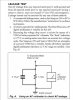
The chassis should be isolated from the AC line by a 2.2MegOhm resistor.
I always perform a leakage test before I touch anything plugged into a wall outlet.
When I am done working on 'whatever', I do the test again, just to be sure.
Tom
I always perform a leakage test before I touch anything plugged into a wall outlet.
When I am done working on 'whatever', I do the test again, just to be sure.
Tom
catrafter
Marantz Specialist
The chassis should be isolated from the AC line by a 2.2MegOhm resistor.
I always perform a leakage test before I touch anything plugged into a wall outlet.
When I am done working on 'whatever', I do the test again, just to be sure.
Tom
Oops, that link may be dead, this is the jist of it.
 .
.
its easier just to hold a house ground and lick the chassis....

jstang
Honey,I can't hear you...
Grounding done right can help.... But you have to be very careful with adding it to a system that did not include it.
Some 70s units included the ground..
Some actually needed it and benefited from it.
If you are not well versed in the requirements... Don't mess around.
You Can create a shock hazard....
Some 70s units included the ground..
Some actually needed it and benefited from it.
If you are not well versed in the requirements... Don't mess around.
You Can create a shock hazard....
jstang
Honey,I can't hear you...
hmmm. I prefer not to use any electrical advice from anything european.
If at any time you think you have a 3 wire cord wired correctly, plug it into a known good GFCI. If the GFCI pops at any time, the device in question is *not properly grounded or isolated*. even a 2Mohm rf ground type setup we use on tube stuff will pop a good gfci. As I said before, it is critical that the AC 'neutral' and AC 'ground' not come in contact with each other until the service entrance, or the power pole depending if the house is separately derived or not...
its a rookie mistake the 'home depot electricians' make all the time on subs and 4 wire feeds and people have gotten a tickle or two. the writeup, not seeing the SCM worries me because of the terminology used interchangeably when they are not. IF the differential inputs are tied to the chassis - and nothing wrong with that - then this chassis must never come in contact with the AC equipment grounding wire, as it now enables it to carry current. that conductor, aint, it is to never see current ever ever except in an actual emergency when it presents a path hopefully more palatable than you.
If at any time you think you have a 3 wire cord wired correctly, plug it into a known good GFCI. If the GFCI pops at any time, the device in question is *not properly grounded or isolated*. even a 2Mohm rf ground type setup we use on tube stuff will pop a good gfci. As I said before, it is critical that the AC 'neutral' and AC 'ground' not come in contact with each other until the service entrance, or the power pole depending if the house is separately derived or not...
its a rookie mistake the 'home depot electricians' make all the time on subs and 4 wire feeds and people have gotten a tickle or two. the writeup, not seeing the SCM worries me because of the terminology used interchangeably when they are not. IF the differential inputs are tied to the chassis - and nothing wrong with that - then this chassis must never come in contact with the AC equipment grounding wire, as it now enables it to carry current. that conductor, aint, it is to never see current ever ever except in an actual emergency when it presents a path hopefully more palatable than you.
jstang
Honey,I can't hear you...
Are you saying Europeans don't typically have good ground......? if so, I agree...
The 500's differential amplification pairS are used for signal gain and are grounded to the chassis. And the chassis is grounded to earth... All by Marantz design...
Also is what gives the amp its edge over other designs from its time.
It was a design feature....you should review the schematic. It's very different than what many people would consider to be normal design practice.
And the grounding is called out in the owners manual.
But only ground the unit if part of the manufacturer's design....
if so, I agree...The 500's differential amplification pairS are used for signal gain and are grounded to the chassis. And the chassis is grounded to earth... All by Marantz design...
Also is what gives the amp its edge over other designs from its time.
It was a design feature....you should review the schematic. It's very different than what many people would consider to be normal design practice.
And the grounding is called out in the owners manual.
But only ground the unit if part of the manufacturer's design....
hmmm. I prefer not to use any electrical advice from anything european.
If at any time you think you have a 3 wire cord wired correctly, plug it into a known good GFCI. If the GFCI pops at any time, the device in question is *not properly grounded or isolated*. even a 2Mohm rf ground type setup we use on tube stuff will pop a good gfci. As I said before, it is critical that the AC 'neutral' and AC 'ground' not come in contact with each other until the service entrance, or the power pole depending if the house is separately derived or not...
its a rookie mistake the 'home depot electricians' make all the time on subs and 4 wire feeds and people have gotten a tickle or two. the writeup, not seeing the SCM worries me because of the terminology used interchangeably when they are not. IF the differential inputs are tied to the chassis - and nothing wrong with that - then this chassis must never come in contact with the AC equipment grounding wire, as it now enables it to carry current. that conductor, aint, it is to never see current ever ever except in an actual emergency when it presents a path hopefully more palatable than you.
its easier just to hold a house ground and lick the chassis....
You Light Up My Life.
Steven Tate
CEO Flat Forehead Soc.
For a millisecond or two...You Light Up My Life.
