• The move to the new server is done. There are some software and database maintenance updates in process. This has us passing the hat around to help out. We appreciate any donations. Seriously, even a dollar helps. The payment page may be found here - https://www.audiokarma.org/support.html

2230 buzz after recapping P150

bibota

New Member
Hello everyone,

I've no electronics background whatsoever other than the high school theory from 30-odd years ago. Many thanks to you all because literally all I know now I learned from you during the last 4 months, spending evenings on the forum.
So yes, got my 2230 and started reading. Of course, at first it felt like nauseating mumbo-jumbo but it slowly started to make sense. Limited sense, obviously.

At some point I felt confident enough for recapping. It started reasonably well with chassis, then P750 (even managed to do those without cutting any wires), P700, P400 and P800. I stopped for a good few hours of power and sound check after finishing each board and thought I was doing well. That is, until hitting P150 (found it very difficult on more than one account, but I'll skip that bit of the story to get to the point).

After having P150 done, there is a strong, low buzzing when inserting the first RCA into either Phono or Aux socket. The noise gets more or less cancelled when inserting the second RCA and there's reasonable signal for the speakers but the quality of the sound playing doesn't seem to be quite right even after that.
I went back and forth several times trying to find the problem but it seems I'm getting nowhere and have to admit defeat. I've also reached the stage when I'm not sure if a record sounds good or bad therefore don't trust my ears anymore.

So here I am, could someone help with some suggestions please.
 
Register to hide this ad
Welcome to AK!

That's good to hear you are testing after each board. I'm not immediately seeing a connection between the buzzing and the P150 board. But it's a good time to check that the capacitors at C183 and C181 are in correctly? The silkscreen on the board is backwards for C183. And C181 has no polarity marking. The + side of the cap goes to chassis ground.
 
The silkscreen on the board is backwards for C183. And C181 has no polarity marking. The + side of the cap goes to chassis ground.
Welcome to AK and the world of vintage restoration. Always good to check the Marantz error log at the beginning of the the Marantz forum. Good luck Rich
 
Those caps sound like likely suspects. I have also read where you can have a hum as long as the metal bottom is off of the chassis, but goes away once the bottom is screwed back on. It would be worth a try, putting the bottom back on for a few minutes just to rule that out. Good luck! Also, try reversing the plug where it is plugged into the wall. These two prong plugs can insert hum that will sometimes go away on reversing it.
 
Hello again,
many thanks for your suggestions and most importantly for making me welcomed. Feels good to be part of Audiokarma.

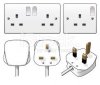
No luck so far on the practical side of things. Think I've tried all your advice, starting with the bottom back on. Reversing the plug cannot be done, since I'm in the UK and things are pretty much set over here.
plug.jpg
It may be worth mentioning my unit is a European model, originally sold in Germany.
The Marantz error log should make fascinating reading, I'll certainly allow plenty of time for it. Could the errors be deliberate I wonder, just to keep us entertained and create a sense of community in the process? Anyway, the people putting out the silkscreens seem to have had a robust sense of humour.
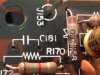
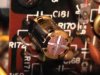
Did replace the two suspects, like thisplug.jpg
C181.jpg

C181_m.jpg

C183_.jpg

C183_m.jpg :

Also used fresh caps just in case (are they killed if briefly used with the wrong polarity, btw?) but noise remains the same.
 
There is another issue I'm not at all sure about: the 100uF 10v cap mounted on the reverse of the board.
I initially mistook it (and replaced as such) for a 10uF 100V. To make it worse, I may (or may not, but I lost count and I have no way of checking now) have soldered the initial replacement with the wrong polarity. After realising that things went wrong (noise) I went back and put in a new one with the right value. But again, at that stage I lost count and had little clue if it was the right polarity.
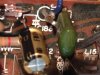
At the moment, mainly for testing purposes and trying to limit variables I have soldered on the old, original one (photo). Could it be well placed, though? No idea myself.

100uF 10V.jpg

I know, it is a bit of a dog's dinner of a joint but I'm reluctant to keep going over it before my new desoldering pump arrives. One very annoying thing about P150 is that there are so many tight and awkwardly placed joints. Although not pretty, this particular one isn't bridged and I'd rather leave it as it is for the moment.
http://www.ebay.co.uk/itm/162235207269?_trksid=p2060353.m1438.l2649&ssPageName=STRK:MEBIDX:IT
 
Sounds like a bad ground- check for broken wires or traces connecting to the RCA. Check continuity with your DVM from the RCA shells to the chassis and to power supply ground. Whenever you doubt the polarity of an installed cap, just check it. Carefully measure the voltage with the unit powered up and be sure the positive voltage is on the positive side of the cap.
 
Sounds like a bad ground- check for broken wires or traces connecting to the RCA. Check continuity with your DVM from the RCA shells to the chassis and to power supply ground. Whenever you doubt the polarity of an installed cap, just check it. Carefully measure the voltage with the unit powered up and be sure the positive voltage is on the positive side of the cap.
Conrad, I'm a noob looking for the basics here. To do the measurement across the cap the way you describe, would you put the red/black probes on the two pads and see if you got a positive reading and if not, reverse them and once you get a positive reading, the red is on positive? Also, do you do this with the cap in place? Thanks! - Steve
 
Yes, cap in place- you're doing an operating measurement, so all safety precautions about not touching any circuits and not shorting anything out apply! Red lead on plus, black lead on negative should give you a positive reading on DC volts scale. If in doubt about the meter or connections, measure a battery to be sure everything makes sense.
 
Yes, cap in place- you're doing an operating measurement, so all safety precautions about not touching any circuits and not shorting anything out apply! Red lead on plus, black lead on negative should give you a positive reading on DC volts scale. If in doubt about the meter or connections, measure a battery to be sure everything makes sense.
Great! That's helpful. Thanks!
 
In this picture, C181 is backwards.

Tom

index.php
 
Thanks Tom, had it reversed. The buzz stays the same, but if this is the right position for it then I guess something else should improve.

Also thanks for your question Steve, myself I'm a few knowledge steps behind you and realise I don't quite know enough yet to even ask the right questions. I did some research following your intervention so now I know (sort of) how to check for continuity.

As about Conrad's words, embarrassingly enough, they could be a bit beyond me. Only did the continuity checks from RCA to chassis and power supply ground and they seemed to be consistent around 00.5 on all points, but didn't venture to the cap side of business.
Now, the really embarrassing bit: the test was done with no power on, was I doing it right I wonder?

RCA.jpg

Multi.jpg

power.jpg

On the buzz thing: it comes up every time a male RCA (red or white no matter) gets inserted first into the Left female of the amp. The noise gets cancelled when inserting the Right.
The thing seems to be preempted when the insertion is done in the reversed order, first Right and then Left.
It happens with any lead from any source so the cause shouldn't be a particular faulty RCA cable.
It happens on Phono, Aux and also Tape.
Does it make any sense?
 
Sorry, I'm a complete idiot.
Correction: the noise happens when the RCA insertion is done either way and gets cancelled when its pair gets plugged.
The Right speaker wasn't on, since the wrong conclusion. I know, I know...
 
Buzz first, are you plugging in with the thing on and the volume up a bit? It would be normal to get a buzz when the center pin of the cable hits the connector, before the ground connects. With either cable you have ground, so the next one you plug in won't buzz. Do you have buzz with both cables plugged in? That would be abnormal. In general, don't plug in with power on and/or volume off zero.

If that cap is supposed to be non-polar, you have to order the right type of cap and replace it, lest it explode or other bad things happen.
 
after looking at pics on the net it appears the schematic is in error ....
from catrafters thread on tapeheads ..
JM2230AM2_zps31da6500.jpg
 
Back
Top Bottom