• The move to the new server is done. There are some software and database maintenance updates in process. This has us passing the hat around to help out. We appreciate any donations. Seriously, even a dollar helps. The payment page may be found here - https://www.audiokarma.org/support.html

2385 low hum

sendust

Music feeds the soul
Subscriber
Hi guys i have a 2385 that just started to hum, the sound comes out of both speakers, the hum changes tone a bit when speakers are connected to the second output and volume increased but the hum gets loader when speakers connected to 1rst output and volume increased ,doesn't mater what setting on (phono, aux, fm etc) i have the unit connected directly to the ground on my electrical panel , pete
 
Register to hide this ad
While waiting for the marantz gurus...

Has the 2385 been refurbished to any extent (power supply recapped??)
Try running the 2385 as a preamp using PRE_OUT RCA's to another power amp.
Likewise run the 2385 as a power amp, connecting another pre to the MAIN_IN
RCAs. If no pre available use an ipod or similiar at minimal volume.
Hum present/same level for both configs?

To keep things simple, test cases should be using AUX, prefer with a well
grounded CDP...
I will give that a try, i am out of the country for a few days but will post findings .
 
Certainly tired main filters can result in increased hum however there are other causes
- bad ground connections, wires/solder
- failed/tired parts in regulated power supply
- incorrectly grounded source
- environmental (lightin/other appliances...)
:
The Preamp/main amp test should help narrow down what stage is at fault.
People tell me there is a smart phone app that can measure the frequency of the hum
typically mains (60Hz) or rectified mains (120Hz). If you get bored you can check for
dry solder joints (google for pix), really need a magnifying lamp or similiar to pick them up.
 
While waiting for the marantz gurus...

Has the 2385 been refurbished to any extent (power supply recapped??)
Try running the 2385 as a preamp using PRE_OUT RCA's to another power amp.
Likewise run the 2385 as a power amp, connecting another pre to the MAIN_IN
RCAs. If no pre available use an ipod or similiar at minimal volume.
Hum present/same level for both configs?

To keep things simple, test cases should be using AUX, prefer with a well
grounded CDP...
When i use another amp for a pre amp i use the pre out with rca cable , where does it go in to to the other amp? just making sure
 
If the other amp has a "main in" use it, if it is a integrated or a receiver that doesn't have a main in, you can use aux or tape or tuner, (not phono) turn volume on second integrated or receiver up at least half way, then control the volume with the 2385.
 
If the other amp has a "main in" use it, if it is a integrated or a receiver that doesn't have a main in, you can use aux or tape or tuner, (not phono) turn volume on second integrated or receiver up at least half way, then control the volume with the 2385.
thanks pete
 
The 2385's pre has a lot of gain so the throttle may be a little touchy if the other amp's input is more sensitive than the 2385's.
 
<They were replaced a few years ago....>

With what? Can you post some photos? Many pull the originals, throw them on a cap tester and if the test indicates <OK> then they put them back in spite of the fact that they're over 40-years old.
 
Last edited:
<They were replaced a few years ago....>

With what? Can you post some photos? Many pull the originals, throw them on a cap tester and if the test indicates <OK> then they put them back in spite of the fact that their over 40-years old.
I will post some photos asap
 
Certainly tired main filters can result in increased hum however there are other causes
- bad ground connections, wires/solder
- failed/tired parts in regulated power supply
- incorrectly grounded source
- environmental (lightin/other appliances...)
:
The Preamp/main amp test should help narrow down what stage is at fault.
People tell me there is a smart phone app that can measure the frequency of the hum
typically mains (60Hz) or rectified mains (120Hz). If you get bored you can check for
dry solder joints (google for pix), really need a magnifying lamp or similiar to pick them up.
I connected my 2275 to the main amp, i used the pre amp rca to connect to my 2385 main in and the hum is identical, it is definitely not a buzz, i disconnect everything from amp but speakers still there, decreases a bit when volume increased from zero, any thoughts. I tried my pioneer same location, same power source, same speakers no hum. thanks pete
 
<They were replaced a few years ago....>

With what? Can you post some photos? Many pull the originals, throw them on a cap tester and if the test indicates <OK> then they put them back in spite of the fact that they're over 40-years old.
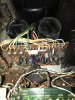
. Please note the large 6800 caps look old but the new ones where installed in the old casing to keep look
IMG_0311.JPG IMG_0310.JPG IMG_0309.JPG
 
Appears the 2385 has separate power supply for L&R channels. So hum in
both channels would mean both main filter caps are tired. Certainly possible
but more likely to be one problem.

Also you mention that the hum gets louder when volume is increased. This usually
means that the source of the hum is before the vol pot. However the pre-out/main-in
test confirms hum present in power amp.

If you plan to refurb the amp then certainly replace the main filters, note
these are 2 caps in one, however there is a significant chance that it wont
solve the problem.

I would go back and check the GND connections at these 2 caps and to the power
amp stages. The schematic is a logical representation, you were right, the pixs
don't help much. Ideally the grounding should be star based, where multiple GND
connection are made to a single point on the chassis. In older design the
grounding was to a single point between the filter caps then a single wire to
the chassis (this is "bad")

Start at white and grey wires on transformer secondary, they should go directly
to star centre/chassis. Likewise the GND wire from the filter caps/R006,7 to
chassis. Then check the GND connections to the power amps (J062,3/J737,8 pin 2)
You can try measuring resistance from the chassis GND connection to the power amp
connections and also to the black speaker post however this is normally inconclusive.
2385_GND1.JPG
2385_GND2.JPG
 
Appears the 2385 has separate power supply for L&R channels. So hum in
both channels would mean both main filter caps are tired. Certainly possible
but more likely to be one problem.

Also you mention that the hum gets louder when volume is increased. This usually
means that the source of the hum is before the vol pot. However the pre-out/main-in
test confirms hum present in power amp.

If you plan to refurb the amp then certainly replace the main filters, note
these are 2 caps in one, however there is a significant chance that it wont
solve the problem.

I would go back and check the GND connections at these 2 caps and to the power
amp stages. The schematic is a logical representation, you were right, the pixs
don't help much. Ideally the grounding should be star based, where multiple GND
connection are made to a single point on the chassis. In older design the
grounding was to a single point between the filter caps then a single wire to
the chassis (this is "bad")

Start at white and grey wires on transformer secondary, they should go directly
to star centre/chassis. Likewise the GND wire from the filter caps/R006,7 to
chassis. Then check the GND connections to the power amps (J062,3/J737,8 pin 2)
You can try measuring resistance from the chassis GND connection to the power amp
connections and also to the black speaker post however this is normally inconclusive.
View attachment 1181011
View attachment 1181013

The main filters were replace 2 years ago it is just the casing that is original, also i stated the hum decreases by 50 % when volume is increased with no inputs engaged. does this help with possible issue. pete
 
also i stated the hum decreases by 50 % when volume is increased with no inputs engaged. does this help with possible issue. pete
Apology, problem with google translator.
Good to know main filters replaced, points further to a GND connection. Such recommendations are usually frowned upon, no part replacement, no quick fix.
just hard yards... Check the GND connections as mentioned. Also try and identify grounding technique, ie multiple connections to single chassis connection or not?
Will try thanks . pete
 
Apology, problem with google translator.
Good to know main filters replaced, points further to a GND connection. Such recommendations are usually frowned upon, no part replacement, no quick fix.
just hard yards... Check the GND connections as mentioned. Also try and identify grounding technique, ie multiple connections to single chassis connection or not?
I opened the bottom of the unit to check the ground connection for the new main power caps , low and behold i noticed the metal plate the connects wires from cap to cap had a broken solder connection. The amp had travelled from Ontario to Montreal and i guess the vibration broke the solder, i checked the other side and it was solid, i re soldered the wires to the plate and made sure it was secure, fired it up and hum is gone. I thank everyone for helping me on this. I guess i have learned chat moving the receiver is taking a chance . thanks again pete .
 
Back
Top Bottom