• The move to the new server is done. There are some software and database maintenance updates in process. This has us passing the hat around to help out. We appreciate any donations. Seriously, even a dollar helps. The payment page may be found here - https://www.audiokarma.org/support.html

3 way speaker systems

I have one system that could probably benefit from a sub. A Technics SU-V707 paired to some Scott S166 speakers that utilize the Philips tweeters. Very nice sounding but the 6.5" woofers aren't going to rock the house. Of course that is OK since I live in an apartment and don't feel like bothering the neighbors. I give them a bit of bass boost from a Technics 7 band EQ. And I also don't run them that hard either (once again the apartment).

My main system consists of an MCS 3842 integrated amplifier running two sets of two way speakers, each with 8" woofers and 1" dome tweeters. Plenty of bass with that system and a Fisher 10 band EQ also fills in that bottom end nicely. Four 8" woofers running in tandem gives plenty of good bass.

So yeah, you can go either way depending on how things get implemented. I am not against EQs at all and I do use them in a prudent manner to enhance the lower end of speakers. You just don't want to overdo it. But a properly set up subwoofer can really get some of that low end to the listener and can dig a bit lower as well. I have just never felt the need for one, especially since I live in that apartment setting.
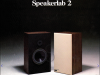
 
A proper two way speaker can sound every bit as good as a three way speaker. It's just all about what the listener is looking for. Three ways are more common in speakers with larger woofers, since the larger woofer can not cross over at a very high frequency. There were a few good speakers that used a 10" woofer in a two way. Like the Avid 102's. Also I am pretty sure that Speakerlab made one as well. I just don't know how good those speakers actually sounded since I have never heard either one.

Yup, the Speakerlab 2 came with a 10" woofer...
Screenshot at 2021-12-06 09-47-09.png
The Speakerlab 2 was also a 4 ohm speaker...
 
That is what seems to work for me with 2 channel. With my HTR, I have a 12 inch Klipsch powered sub. It may be that the HTR EQ program fixed things for me, where as I didn't have access to something like that when integrating a sub with my 2 channel stereo. But what stood out for me the most when trying to integrate a sub with my stereo, is that they have different voicing, and that was what I didn't like. I came to the conclusion that perhaps the fact that a powered sub uses its own amplifier makes this exercise futile for me. I did hear that there is someone who came up with a way of capturing the voicing of the system and integrating it with the sub. I read about it 8 years ago and don't recall the details. It might have been Vandersteen.
That being said, I WAS able to get your mentioned timbre issue dealt with on a pair of custom subs up in the kid's gaming Room by tweaking the dampening. It took awhile to suit my ear and it DID help to have the subs under the satellites. Overdamped was thumpy and annoying. Underdamped sloppy. It took a mixture of pyramid acoustical foam and some pink house insulation to match the front channel ADS L-780s. The bad part is that there's a bad ass gaming system now going on up above the home theater.
 
My "sub-woofer" complaint is just the result of low-end equipment. I knew it all along just didn't accept it.
I wish that were true in my case. I think I have some sort of hypersensitivity to placement issues. I wish I had more of that sensitivity at high frequencies so I could hear what all of this chatter about stuff up above 13khz is about.
 
My "sub-woofer" complaint is just the result of low-end equipment. I knew it all along just didn't accept it.

I bad sub is worse than no sub at all. A good sub should integrate so you absolutely can't tell it is there. Took me a while to find it and once I did there is always a little sub in the mix. Good, deep, and solid and takes those loads off the main speakers where they are liberated to do the 50hz and up stuff. I prefer servo subs but many will work when integrated well. Cheap subs are just boom boxes and never will sound transparent in my findings. Turn it up until you know it is there and then knock it back a notch or to.
 
BTW I am running my Dayton AIRs (6.5: 2 way with AMT tweeters) and a M&K servo sub and it sounds like one big coherent floors stander. You can't "hear" the sub, the satellites just seem like they go ridiculously low. Seamless integration.
 
When a good sub is properly implemented, the only way one should be aware it's there is when you turn it off. The low end just disappears.

Al of my main speakers are 2 ways, one 8" and two 6 1/2'

QFT:

Three ways or two ways it makes no difference. The smaller the woofer the more benefit a sub will have.

I've been using dual subwoofers for 20+ years. There are two things I'm sure of.

1. Just about every speaker will benefit from the addition of a subwoofer (two is better). The only exceptions are speakers like Infinity IRS's and other assaults on the state of the art. Quite often they include powered bass towers or subwoofers as part of the system.

2. 99+% of most subwoofer complaints are because the level or crossover is too high. Frequently it's both.

If you can "hear" a subwoofer in use, it's not properly dialed in. Once it is, there is no need to change the settings regardless of the source or listening level.
 
There is the notion that bass is non directional so that a single subwoofer can be placed anywhere and you can't tell. Not true.
Bass is less directional, and the lower you go, the more non directional it gets. But with small speakers, the desire for big bass comes with the urge to raise the volume or the crossover frequency, and suddenly it is boomy and imaging is all messed up since the lower bass comes from a different point than the upper bass. Two subwoofers is better, but the level and crossover frequency have to be right (and phase can be important, too) or they will always draw attention to themselves.
 
There is the notion that bass is non directional so that a single subwoofer can be placed anywhere and you can't tell. Not true.
Bass is less directional, and the lower you go, the more non directional it gets. But with small speakers, the desire for big bass comes with the urge to raise the volume or the crossover frequency, and suddenly it is boomy and imaging is all messed up since the lower bass comes from a different point than the upper bass. Two subwoofers is better, but the level and crossover frequency have to be right (and phase can be important, too) or they will always draw attention to themselves.

one reason why more expensive subs include variable phase control, a 180 degree switch is seldom a cure but can be helpful.
 
A proper two way speaker can sound every bit as good as a three way speaker. It's just all about what the listener is looking for. Three ways are more common in speakers with larger woofers, since the larger woofer can not cross over at a very high frequency. There were a few good speakers that used a 10" woofer in a two way. Like the Avid 102's. Also I am pretty sure that Speakerlab made one as well. I just don't know how good those speakers actually sounded since I have never heard either one.

Yup, the Speakerlab 2 came with a 10" woofer...
View attachment 2414094
The Speakerlab 2 was also a 4 ohm speaker...
Being a lifelong Seattle audiophile, I had a pair of Two's before I could grow a decent beard. They were great, but if I could've bucked up the extra bucks, I'd have bought a pair of 2.5's, which were three way. I thought they had an edge on the Two's.
I have a pair of ESS Rock Monitors. The ESS two ways were reputed as notorious for the inability of their large 10" and 12" woofers reaching up to the exaggerated lower end of the AMT, so the Rock Monitor added a "transition driver" to extend the bass, essentially rendering it a three way. I'd pit it against any of the two ways that I've heard. Contrary to the reassurances of our favorite girlfriends, size does matter.
 
I assume you're not using an amp.
What is your control and media source?
(Edit... I have no idea why this font is bold)

Klipsch R-51PM Specs

  • SYSTEM DESCRIPTION
  • Powered Monitor (pair)
  • FREQUENCY RESPONSE: 68Hz – 21kHz
  • DYNAMIC BASS EXTENSION: 49Hz @ 35% Volume
  • MAX OUTPUT: 107.3 dB
  • TOTAL SYSTEM POWER: 120W Total System Power (140W Peak),60W per channel cont. @ <%1 THD
  • HIGH FREQUENCY DRIVER: 1” (2.5cm) Aluminum diaphragm compression driver mated to 90° x 90° square Tractrix horn
  • LOW FREQUENCY DRIVER: 5.25” (13.3cm) copper spun magnetically shielded IMG woofer
  • CROSSOVER FREQUENCY: 1663 Hz (Passive)
  • ENCLOSURE MATERIAL: MDF
  • ENCLOSURE TYPE: Bass-reflex via rear-firing port
  • INPUTS:Bluetooth, wireless technology, Phono/Line analog (with switch and ground screw terminal), 3.5mm analog mini jack, USB digital, Optical digital
  • OUTPUTS: Single RCA line level output for connection to subwoofer
  • HEIGHT, WIDTH, DEPTH: 13.3” (33.8 cm), 7” (17.78 cm), 9.12” (23.16 cm)
  • WEIGHT: 10.6 lbs (4.8 kg)
  • FINISH: Black
  • VOLTAGE: 100V-240V 50/60Hz internal power supply with region specific power c
I'm using J river on a dell xps 17 9700 for digital music out to a Cambridge dacmagic 100 to preamp (klipsch)
 
I don't use any subs in any of my systems. But then my main system uses a 4-way JBL with an 18-inch woofer, 10-inch mid-bass driver, compression horn HF, and a ring-radiator UHF.
:thumbsup:
 
I don't use any subs in any of my systems. But then my main system uses a 4-way JBL with an 18-inch woofer, 10-inch mid-bass driver, compression horn HF, and a ring-radiator UHF.
:thumbsup:

Where do the 18s cross to the 10s?
I assume your speakers use the 18" drivers like many others (people and companies) use subwoofers.
 
Back
Top Bottom