I have a pair of home brew cornwalls, now CornScala. Used B&C drivers, Eminence/Crites woofer. Mids are 8ohm woofer 4 ohm. I have always used the 4ohm tap on the output tap of the amps because was told what ever the woofer ohm is you match it. I just AB’d both taps and I can say the 8ohm is better than the 4ohm output tap. The mids are better with a more prominent phantom center channel.


You are using an out of date browser. It may not display this or other websites correctly.
You should upgrade or use an alternative browser.
You should upgrade or use an alternative browser.
4 and 8ohm taps what sounds best
- Thread starter Mopardave
- Start date
Register to hide this ad

Tube amplifiers with a choice, use the one you think sounds best.
Speaker impedance varies too much to go by the nominal rating.
Speaker impedance varies too much to go by the nominal rating.

I can't answer your question, but what a nice listening room. I wish I had the space for speakers like that. Our living room is not bad for listening but I don't think it could accomodate speakers that large. My old ProAcs work well enough in the space, and my wife loves them, but I've always wanted to try a high-efficiency speaker like that.
Tube amplifiers with a choice, use the one you think sounds best.
Speaker impedance varies too much to go by the nominal rating.
yes, plus 1 for comments. An average speaker impedance rating does not mean much unless you know the whole curve. Some speakers have some pretty wide swings in their impedance.

IIRC, over the years of reading Stereophile reviews, John Atkinson, the tech expert & equipment tester often recommends that amps be connected with their 4 ohm tap due to low speaker impedances in the bass or "power range." The reviewer will sometimes conclude that the 8 ohm tap sounds better inspite of that technical recommendation . I suppose it depends on the combination of amp & speaker and there may be no way to tell without testing. Unfortunately some amps, like mine, need to be opened to swap the OPT wires to the binding posts, so comparing transformer taps is a PITA.
KentTeffeteller
Gimpus Stereophilus!
Use the correct tap for your speaker's nominal impedance as a system.


DirtyErnie
Well-Known Member
Most listening is happening at such low power levels that you'll never hit the edges of the power stage's voltage or current capabilities. If you stay in the middle of that map, there's no danger to amp or speakers.
Guitar amplifier use is different, get the wrong tap, crank it too much, cook your tubes.
Guitar amplifier use is different, get the wrong tap, crank it too much, cook your tubes.

Lavane
Lunatic Member
Probably due to how low impedance wise the 6 ohm speakers can dip?I have a pair of 6 ohm Klipsch, and not a single amp with 6 ohm taps. Some amps they work better on the 4 ohm, some they want the 8 ohm. Currently they are on the Pilot SA-260 which has only 8 and 16, so its running on 8. It'll just have to live with the mismatch.
I have one pair of 6 ohm speakers that sound best on the 4 ohm taps, and another that sounds best on the 8 ohm taps using the same amp.

Also, many combo guitar amps have open backs. These setups sometimes have crazier impedance curves. Many get very close to zero, if the speaker is on too low impedance secondary (or wrong OPT).Most listening is happening at such low power levels that you'll never hit the edges of the power stage's voltage or current capabilities. If you stay in the middle of that map, there's no danger to amp or speakers.
Guitar amplifier use is different, get the wrong tap, crank it too much, cook your tubes.
DirtyErnie
Well-Known Member
Too low impedance at full power is better than too high. Load Lines exiting through the top of the curve is fairly benign, tubes run out of current capacity before they hit the voltage limits. High impedance is where the problem happens at full-tilt. Load line exits out the side of the curves, screen current goes through the roof, and your tubes die.Also, many combo guitar amps have open backs. These setups sometimes have crazier impedance curves. Many get very close to zero, if the speaker is on too low impedance secondary (or wrong OPT).
Leakage inductance is worse when using the lower impedance tap. Not a fan of leakage inductance.IIRC, over the years of reading Stereophile reviews, John Atkinson, the tech expert & equipment tester often recommends that amps be connected with their 4 ohm tap due to low speaker impedances in the bass or "power range." The reviewer will sometimes conclude that the 8 ohm tap sounds better inspite of that technical recommendation . I suppose it depends on the combination of amp & speaker and there may be no way to tell without testing. Unfortunately some amps, like mine, need to be opened to swap the OPT wires to the binding posts, so comparing transformer taps is a PITA.
That's generally good advice ... however ... occasionally the spec'd speaker impedance is estimated upwards to make them appear compatible with more amps.Use the correct tap for your speaker's nominal impedance as a system.
I suspect we've all looked at impedance and phase curves and realized it's sometimes only an opinion as to what the rating should be. Some speakers will be comfortably above 8 ohms for most of their range, but dip below 4 ohms for some narrower frequency bands. Where those low impedance frequency bands reside may determine one's choice.
Like so much in audio: the particular combination of ALL of the components, including cables, may be the final arbiter when choosing the correct tap.
I remember some manufacturers measuring the nominal impedance at 1kHz, 1-watt. Sine wave input.That's generally good advice ... however ... occasionally the spec'd speaker impedance is estimated upwards to make them appear compatible with more amps.
I suspect we've all looked at impedance and phase curves and realized it's sometimes only an opinion as to what the rating should be. Some speakers will be comfortably above 8 ohms for most of their range, but dip below 4 ohms for some narrower frequency bands. Where those low impedance frequency bands reside may determine one's choice.
Like so much in audio: the particular combination of ALL of the components, including cables, may be the final arbiter when choosing the correct tap.
Something like that.

KentTeffeteller
Gimpus Stereophilus!
Yes, Nominal Impedance is the base line, how low the impedance load dips, better be what the amplifier can handle without making it run hot, clipping, or about to cook itself. Ohm's Law applies always, plays no favorites. Avoid too much, or too little amplifier for the application, and you need headroom for whatever loud party, or keg party your audio system will ever see anytime.That's generally good advice ... however ... occasionally the spec'd speaker impedance is estimated upwards to make them appear compatible with more amps.
I suspect we've all looked at impedance and phase curves and realized it's sometimes only an opinion as to what the rating should be. Some speakers will be comfortably above 8 ohms for most of their range, but dip below 4 ohms for some narrower frequency bands. Where those low impedance frequency bands reside may determine one's choice.
Like so much in audio: the particular combination of ALL of the components, including cables, may be the final arbiter when choosing the correct tap.
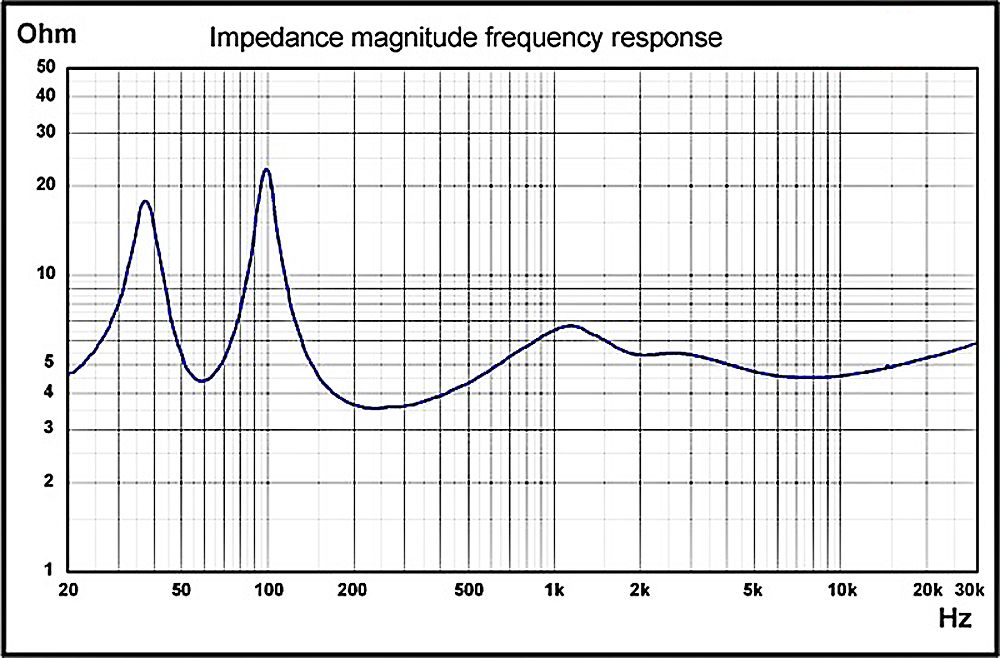
Although nominal impedance is around 8-ohms, per manufacturer's data --- the [impedance versus frequency] spectrum varies over the audio range.
A single-ported enclosure profile.
Speaker impedance curve.
Last edited:
