• The move to the new server is done. There are some software and database maintenance updates in process. This has us passing the hat around to help out. We appreciate any donations. Seriously, even a dollar helps. The payment page may be found here - https://www.audiokarma.org/support.html

4" Full Range Transmission Line - Aucharm speakers

Brussi

New Member
Hi guys!
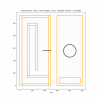
I'm totatlly new in this field, I have done some research to learn the best cabinet I would build for my pair of chinese speaker 4" Aucharm DG-403 (https://www.aliexpress.com/item/330...earchweb0_0,searchweb201602_,searchweb201603_) which doesn't have many technical information on the store . So far, I found the TL more interesting, locazating the speaker 1/3 of the legth of the tunel to avoid the dip. So I used python to calculate dimensions given a design that I liked. According to the store the Fs is 72hz, so I end up with these two cabinets, the left tunned to 72hz and the right tunned to 50hz. I got a TDA7377 amplifier and a preamp with ES9018 decoder DAC with 12AU7 tube used probably for buffering. Every sigle piece of this system I found doing researches on youtube and forums, I'm completaly new in this field, therefore, I would appreciate so much any suggestion.
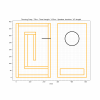
72.png, 50.png

Cheers from Brazil.
 
Register to hide this ad
Without knowing the T/S parameters of the driver, anything you 'design' is just a shot in the dark. If you can't find that data anywhere on the internet, then you can either buy test equipment (Parts Express sells https://www.parts-express.com/Dayto...ter-Based-Audio-Component-Test-System-390-807 for $129--note that it works with a PC) or take a chance and use an enclosure that is supposed to work with a variety of drivers, Like Dave Dlugos' Frugal-Horn Mk 3.
 
Without knowing the T/S parameters of the driver, anything you 'design' is just a shot in the dark. If you can't find that data anywhere on the internet, then you can either buy test equipment (Parts Express sells https://www.parts-express.com/Dayto...ter-Based-Audio-Component-Test-System-390-807 for $129--note that it works with a PC) or take a chance and use an enclosure that is supposed to work with a variety of drivers, Like Dave Dlugos' Frugal-Horn Mk 3.

Sorry, this is out of my budget.
I thought using only Sd and Fs parameters should be ok to build. After assembling, I was think about calibrate with Dacron polyester just by listening
 
They have a box design on the site you linked or a sealed box.
As already mentioned TLs need to be specifically designed for a driver using the T/S numbers, using stuffing is for fine tuning after the design is correct.
 
I already bought the parts. Thanks guys, I gonna build a model with Fs, Qt and Vas, which is given by the store
 
I have built a few pairs of transmission line loudspeakers and I would make the following points:

1. There is no known perfect calculation for TL speaker design. It will always be a bit hit and miss and will require a lot of tuning. Allow for access panels to the line for the addition or removal of stuffing during final testing.
2. The principle of an open line is for the energy exiting the line to reinforce the driver at bass frequencies. I would take your 72Hz design, turn it upside down and position the driver close to the port opening as this will help with in phase bass reinforcement. Having the driver closer to the start of the line than than 1/3rd of it's length will make little difference to the overall response. By the look of it the 50Hz design would not work too well as the tuning is too far below Fs and you would probably end up with a very uneven bass response curve.
3. You are quite correct in that the principle factors are the Fs and SD of the driver. The length of the line should be 1/4 of the wavelength of Fs, but remember that a tapered line can be slightly shorter than this. The start of the line should be about SD (a bit bigger is allowed) and the port end of the line should be 1/2 to 1/3rd of SD. Don't worry if the line length comes out a little short of the calculated values. This is actually better than having it too long.
4. Put 45 degree angled panels in the outside corners of each turn in the line. You are trying to fool the air in the line into behaving like it is in a long straight tapered tube, so make the turns as smooth as you can.
5. most of the stuffing will probably be in the first 1/3 of the line. Quite often the end of the line is empty.
6. Line the area behind the driver with 1/2" of compressed felt to help absorb reflected sound energy which would bounce back straight through the driver cone and give a muddled sound.

Good luck.
 
Hi Powertech, thank you so much for the tips. I have followed the instructions of GM from diyaudio forum, he sent to many Martin J. King article and worksheet to build a mudel using Qts, Fs, Vas and Bl.
https://web.archive.org/web/20130328134100/http://www.quarter-wave.com/TLs/Alignment_Tables.pdf
http://web.archive.org/web/20120304...om/TLs/Alignment_Tables_Calculator_3_3_09.xls
So I built this.
50.png

medidas.png


But I'm quite skeptical with these parameters from alixpress store some people claim that they are fake, to make matters worse I don't have Bl so I got from another aucharm similar model. Thefore, I'm giving up from building my own design. I'm thinking about to make a design like Pensil 7.3 and just try to adjust the length of the port.
 
This project is doomed from the start, I think, tho I sincerely wish you the best, and hope it turns out well.

I have some McIntosh XRT20's. Line array is one of my favorite designs. Best of luck.
 
Back
Top Bottom