• The move to the new server is done. There are some software and database maintenance updates in process. This has us passing the hat around to help out. We appreciate any donations. Seriously, even a dollar helps. The payment page may be found here - https://www.audiokarma.org/support.html

6-string Bass: Hard to learn?

JRhoBurton

All roads lead to music
My first guitar loooooog ago was an electric bass. I currently have an acoustic (both 4-string).

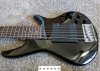
A local guy is selling this bass...

rps20190504_204532.jpg

"Custom Ibanez Gio GSR206 6-String Bass Guitar Black
EMG 45JX pickup (bridge)
EMG 45PX pickup (fingerboard)
Scale: 34" (864mm)
Maple Neck
2 Truss Bar cables
Bridge pins tuned perfectly
Plays very easily (no pain)
Custom poplar bass ramp
Aftermarket tone/volume knobs
Just a few minor scratches
Brand new D'Addario EXL170-6 6-String Nickel Wound, Light Gauge
Very clean sound, low punch, and crystal clear highs
Hear it recorded here:

https://mosstone.bandcamp.com/album/hubbub "

It looks like a good deal, but how much harder are they to learn? Four string seems difficult enough nowadays.

John
 
Register to hide this ad
Nice looking bass.

I intend to buy flatwound strings for my four string bass, and to me they are not cheap. Imagine buying flatwounds for a six stringer.

I can't offer input on whether it would be easier to play. My first bass years ago was a 5 string Samick. I never really got good with it because I didn't stick with it, but when I was playing it, my thought was I really didn't need the 5th B string. I'm just now starting over again with a four string bass, so I really don't know much.

I'm thinking with a 4 string being E-A-D-G, 5 string being B-E-A-D-G and 6 being B-E-A-D-G-C tuning's the outer strings would be useful but would it be a much greater benefit? I don't know but I'd be interested in finding out as well, and I bet someone has covered it on a Youtube upload.

Best of luck with whichever way you go JR.
 
I never got the need for more than 4 string bass other than metal bands that play in dropped D with 7 string guitars.
4 strings were good enough for the Beatles, Stones, The Who & Led Zeppelin.

Love this video ( Bass comes in @ 1:15 ) If a player cant do what John does with 4 why does anyone need more strings?
John Entwistle's isolated bass on Won't Get Fooled Again!

 
Last edited:
Nah, you aren't serious unless you go for the Chapman Stick, 2-handed player model, like Tony Levin! ;)

Watched the whole video I don't think I saw him touch the lower 6 or 5 strings once.
Very interesting instrument.
I guess technically it's a bass but I can't imagine someone playing that in a typical band.
Cheers
PQ
Ps This photo pretty much says it all for me!
Unknown.jpeg
 
Watched the whole video I don't think I saw him touch the lower 6 or 5 strings once.
Very interesting instrument.
I guess technically it's a bass but I can't imagine someone playing that in a typical band.
Cheers
PQ
Ps This photo pretty much says it all for me!
View attachment 1502473

Yeah, maybe I picked the wrong video for you - he has a lot of them on the youtube.
But he gets a LOT of session work - tours a lot, Gabriel, Seal, and others,
plus he plays with some guys named King Crimson from time to time -
I 'spose it all works for him.

the wiki says
A prolific session musician since the 1970s, Levin has played on 500 albums, including those by Cher, Asia, Alice Cooper, John Lennon, Sarah McLachlan, Paula Cole, Stevie Nicks, Pink Floyd, Paul Simon, Dire Straits, Lou Reed, David Bowie, Joan Armatrading, Tom Waits, Buddy Rich, The Roches, Todd Rundgren, Seal, Anderson Bruford Wakeman Howe, Warren Zevon, Kevin Parent, Bryan Ferry, Laurie Anderson, Yes, Kate & Anna McGarrigle, Gibonni, and Jean-Pierre Ferland. Additionally, he has toured with artists including Peter Gabriel, Paul Simon (with whom Levin appeared in Simon's 1980 film One-Trick Pony), Gary Burton, James Taylor, Herbie Mann, Judy Collins, Carly Simon, Peter Frampton, Tim Finn, Richie Sambora, Ivano Fossati and Claudio Baglioni.
 
Went to church last weekend and the band had a guitar, bass guitar and keyboard. Sounded great.

I am sure it did.
The key to a good mix on stage and FOH is players keeping in their own "sonic lane" for lack of a better term.
Basically each player works hard to make room for other and try not to compete with each other sonically.

Best analogy is taking a group photo .Everyone makes room for the others.
So they don't stand in front of one another and block somebody out of the photo.

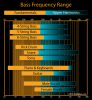
When each player carves out their own sonic space it reduces muddiness by reducing competing freq and build up of standing waves and phase issues. The Bass guitar, kick drum and lower register on keyboards and organs all operate in the same freq range.
So if the KB player leaves the very lowest notes to bass player and bass player lets the keys cover mid bass and mid freq it simply sounds better. (see the chart below please)
In my band we have 2 guitarist I play rhythm mostly open chords and seldom venture past the 5th or 7th frets..frets 1-7 They are "my sonic space"
The lead player generally sticks to frets 5 thru 24
He seldom if ever plays open chords and plays mostly fills, counter melodies and solos.
When he does play chords he plays a different voicing of the chord I am playing. Example if I am playing an open G chord in the 1st position he will play a G bar chord on the 3rd or 10th fret

The goal is to compliment not compete with each other.
French composer Claude Debussy said,
“Music is the space between the notes.”
I love this quote: it reminds us that beauty needs a certain amount of emptiness to be appreciated. The space between notes allows them to resonate, reverberate, and reach their full measure of expression. Without this space, noise and cacophony (i.e...muddiness) result.


Cheers
PQ
BassFreqRange.png
 
Last edited:
I am sure it did.
The key to a good mix on stage and FOH is players keeping in their own "sonic lane" for lack of a better term.
Basically each player works hard to make room for other and try not to compeate with the other.

Best analogy is taking a group photo everyone makes room for the other so we don't stand in front of one another blocking somebody out of the photo.

When each player carves out their own sonic space it reduces muddiness by reducing compeating freq and build up of standing waves and phase issues. The Bass guitar, kick drum and lower register on keyboards and organs all operate in the same freq range.
So if the KB player leaves the very lowest notes to bass player and bass player lets the keys cover mid bass and mid freq it simply sounds better. (see the chart below please)
In my band we have 2 guitarist I play rhythm and seldom venture past the 5th or 7th frets..frets 1-7 They are "my sonic space" I play mostly open chords, The lead player generaly sticks to frets 5 thru 24 he plays mostly fills, counter melodies and solos.

Cheers
PQ
View attachment 1504606
Maybe i wasn't paying close enough attention, but it seemed as if the pastor was playing mostly lead and solos on the guitar (Strat and Byrdland) and the keyboard was playing rhythm.
 
When each player carves out their own sonic space it reduces muddiness by reducing competing freq and build up of standing waves and phase issues. The Bass guitar, kick drum and lower register on keyboards and organs all operate in the same freq range.
So if the KB player leaves the very lowest notes to bass player and bass player lets the keys cover mid bass and mid freq it simply sounds better.

I find this interesting and I'm thinking it would sound great when done with original material.

I'm a very harsh critic of cover bands because I feel if you're going to cover someone's original material, there should be effort made to play it note for note and make it sound as close as possible. I'm not a big fan of remakes either (even though I know they are good musicians) due to most doing things much different than the original. But at the same time, I do realize that many songs by the best bands out there are remakes. I guess it's all in the way it's recomposed.

For example: No Doubt's cover of Talk Talk's "It's My Life" comes to mind. Great musicians, but I really dislike the cover.

Sorry for taking the thread off course.
 
Last edited:
I find this interesting and I'm thinking it would sound great when done with original material.

I'm a very harsh critic of cover bands because I feel if you're going to cover someone's original material, there should be effort made to play it note for note and make it sound as close as possible. I'm not a big fan of remakes either (even though I know they are good musicians) due to most doing things much different than the original. But at the same time, I do realize that many songs by the best bands out there are remakes. I guess it's all in the way it's recomposed.

For example: No Doubt's cover of Talk Talk's "It's My Life" comes to mind. Great musicians, but I really dislike the cover.

Sorry for taking the thread off course.

Original or cover it really doesn't mater. Any good recording (tracking) engineer or producer will EQ each individual track and arrange the song so the instruments don't cancel each other out.
The 1st thing most mixing engineers do with the final recored tracks is generally put a "High Pass" filter on everything but the kick drum and bass.
Then they EQ the bass and kick drum so they each "sit in the mix" & have their own sonic space.
The principles of good musical arraignments are the same for all songs, original & covers.
As a side note many songs you think are original songs by the artist are often songs written by songwriters under contract to record labels.

I'm a very harsh critic of cover bands because I feel if you're going to cover someone's original material, there should be effort made to play it note for note and make it sound as close as possible.

Sorry I am not trying to be argumentative you are certainly entitled to your opinion.
I am just posting a different view to what you posted.

As a musician for me It doesn't' take any creativity to simply copy someone else's song note for note.
I consider it the musical equal of painting by numbers.
To me it's not much different than copying a famous painting whats the point?
Sure It takes highly skilled technical ability.... but no creativity.

On the other hand to hear a song and reimagine it in a completely different & new way takes vision & talent.
I can name dozens of songs that artist have covered and I think are better than the original version.
Here is a few off the top of my head....

Hendrix's cover of Bob Dylan's All Along the Watchtower.
Santana's version of Fleetwood Macs Black Magic woman.
Janis Joplin's version of Kris Kristofferson's Me and Booby MCGee
Whitney Houston's version of Dolly Parton's I will always love you
Johnny Cash's cover of 9 Inch Nails "Hurt"
Linda Ronstadt covering damn near anybody's song from Hank Sr. to Neil Young and Warren Zevon
CSN&Y version of Joni Mitchell's "Woodstock'
Eric Clapton covering any blues or Robert Johnson song.
Joe Cocker covering the Beatles With a Little Help From My Friends and Bathroom Window
Eva Cassidy covering just about any song from Strange Fruit to Somewhere Over The Rainbow to What A Wonderful World.
Pick any just about any Frank Sinatra song...Chances are Sinatra did it better.
Ditto... Elvis Presley...
I could sit and type this list all night..

What maters is that the folks creating and listening to music enjoy it!

And to get back to the intention of OP's thread....Yes I believe it is harder to play a 6 string bass because one must learn all the additional 40-48 notes on the fret board created by the additional 2 strings.
Cheers
PQ

 
If you do a lot of soloing then get a six string. I’ve never wished I had more than four.
However, I know a guy who plays an eleven string bass and is an absolute lunatic on the thing.

Bass solo....Every time I hear that term, it reminds me of all the times I have heard audience shouting in unison "We want a Bass Solo!"
More Bass Solos!.... :rockon:Oh yea I forgot... I have never been to a concert or played a show where that happened.LOL.

Just kidding bass players! Sorry I couldn't help myself. :rflmao:

I actually I have been to some jazz & prog rock shows where the audience digs extended bass and drum solos.
Stanley Clarke, Primus, Rush and Yes come to mind.
So all you bad ass bass players solo away! I need to pee and grab a beer anyway.

Cheers
PQ
 
Back
Top Bottom