• The move to the new server is done. There are some software and database maintenance updates in process. This has us passing the hat around to help out. We appreciate any donations. Seriously, even a dollar helps. The payment page may be found here - https://www.audiokarma.org/support.html

7868 SEP transplant and mod

not sure if thata a 6.8K or 68K feedback resistor. 6.8K would be DC resistance about 4K, but a smaller feedback resistor than the resistor to ground seems wrong. 68K into 10K looks like a reasonable ratio, that comes out to 8.7K which seems too large.

I suspect its that second one, and the cathode voltage is just wrong. Based on plate voltage its running at a half milliamp which seems reasonable for a 12ax7, but that wouldn't come out to 13 or 1.3 volts with either resistor value.
6.8 they forgot the decimal point.
 
These are 3k transformers. And did the orientation method with loading down the pt secondary and placing the opt primary on the scope. I have them correct. I am planning on an Alps dual ganged 100k pot on the front. But I most always use a tube preamp because I can add a little bass or treble. I realize turning the control wide open bypasses it. Would you still recommend the higher gain 6sl7?

 
I would make plans to replace R24 (56 ohm 3W) first dropping resistor in the power supply with a choke- like the Hammond 156R for better power supply filtering. SE amps are very prone to hum from ripple on the B+ supply. The output stage operating point can be tweaked some for higher power, like the screen voltage could be increased (reduce R25), but since this transformer will be operating without the tuner load, you might want to see where the voltages actually land and then walk it in from there.

The coupling caps are surprisingly small- only 0.0047, you could take those up to more like .1uF.

If you make a decision for certain on what driver tube we can start knocking out it's biasing.
I have some Stancor C-1003 or a C-1002 without spending anything.
 
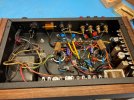
Single ended 7868 amps are not very common. Here are a couple of pics of one I put together using the power and output transformers from an old Capehart Console. The tuner/preamp/power amp were all on the same chassis, so I just used the transformers to put together this little amp. Just copied the amplifier section of the Capehart. It is really a sweet sounding amp.
 

Attachments

  • 7868 SET amp a.JPG
    7868 SET amp a.JPG
    225.6 KB · Views: 7
  • 7868 SET amp c.JPG
    7868 SET amp c.JPG
    264.3 KB · Views: 7
I am planning on an Alps dual ganged 100k pot on the front.
Having a pot on the power amp is problematic if you sometimes use a tube pre-amp, depending upon what the output impedance of the pre-amp is.
There are competing problems here. The tube pre-amp may not be able to drive the input of this amp with a 100K pot- even when it is turned to wide open, it still places a 100K resistor from input to ground, loading the pre-amp, possibly increasing distortion and bringing down the output level. The other problem is the Miller capacitance looking into the predriver triode- in a 12AX7 this is on the order of 170pF, and in the 6SL7 it can be as high as 200pF. When the volume knob is turned down as it often will, it places a large resistance (>50K) in series with the source, and this forms a low-pass filter going into the input and it will roll off your high frequencies.

I love to have a volume control on my power amps so I can listen to source direct, and I avoid these problem by only using solid state sources or pre-amps that naturally have a really low output impedance (< 1K). Then, I can use a 10K volume that is low enough resistance it does not really cut any audible frequencies given the Miller cap.

On other tube designs, I have seen a cathode follower stage used at the input of the power amp to enable using even the very high resistance attenuators needed for use with vacuum tube pre-amps.
 
I do still recommend using either the 6SL7 if you want to stay octal, or a 12AX7 if you want to go 9-pin mini if you want to retain the high level of negative feedback that this original chassis employed, to preserve the accuracy, low distortion, and high bandwidth. But, if you would prefer to go with low feedback or alternate form of feedback (Schade, etc) to get that thick "tubey" 2nd harmonic distortion that is often enjoyed with single ended amps, we may need to consider a tube that has a lower plate resistance (and will have lower gain, requiring a hotter input signal for the same volume).
 
Back
Top Bottom