Plimpington2
Super Member
My friends, a few weeks ago one of our members posted a sad and sorted thread regarding the transoceanic peril a recently acquired Sansui C-2301 suffered at the hands of one of our international carriers. The main glass had shattered, rendering the unit nearly useless. To add insult to injury, the glass emulsion had also ground the paint off at least two of the knobs (including the main volume knob). This penultimate preamp looked to be in sad shape. Another member spotted a replacement glass on ebay, and this was quickly acquired. However, this did not represent the totality of this preamp's woes. Our member hooked up the pre-amp to his system (sans glass and front panel) and found that it lit up and passed signal, but the phone stage was out. You can review that thread here: A sad example of the real risks of ordering from Japan (if someone knows better how to link a thread here, let me know).
In any event, I have since acquired this unit (and the replacement glass) and begun the process of bringing this unit back to life. Aside from the obvious issues with the glass, at first I had trouble even diagnosing the main electrical issue. In fact, in my system, this thing also lit up and passed line-level signal. BUT the main volume control (and many of the other controls) did not seem to work at all. It was only after reviewing the picture of this unit working in the original owner's system AND another unit fired up in another member's system did I realize that the main lamp should be green when operational rather than red. This unit was in protection!! But HOW was it passing signal?
The answer came only after reviewing the schematic (i was surprised to find one in the AK archives, but there it was) - this unit has a "source direct" function, which passes a line-level signal from inputs to outputs entirely unmolested, save a passive multi-step attenuator. Accordingly, even in protection this unit can give the impression that it is operational (somewhat) even when it is not. So, our electrical problem was at least somewhat conventional - I just need to clear the protection and we should be good to go.
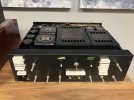
Before I get into it, a few words about the topology of this (seemingly) sophisticated preamp. This is a dual mono design all the way back to the power switch - two transformers, two PSU's, two phone stages (with two MC step-up transformers, each with two secondaries, I believe to accommodate a higher gain and lower gain option) and FOUR amplifier stages - each channel getting both a "hot" and a "cold" rail. The "hot" stage feeds the conventional RCA "unbalanced" outputs directly. However, when accessing the "balanced" outputs, both the "hot" and "cold" amplifiers are used. This absolutely beautiful pre-amp has very substantial shrouds/boxes over each stage. And in one oddity, the two channels are not situated on the left and right sides of the preamp, but rather one channel is housed in the top of the preamp and the other in the bottom. I will be using this device with my Sansui B-2301L amplifier, which has both conventional and balances inputs. This is the first time in my 52 years that I have ever owned balanced devices. So that will be fun.


In any event, I have since acquired this unit (and the replacement glass) and begun the process of bringing this unit back to life. Aside from the obvious issues with the glass, at first I had trouble even diagnosing the main electrical issue. In fact, in my system, this thing also lit up and passed line-level signal. BUT the main volume control (and many of the other controls) did not seem to work at all. It was only after reviewing the picture of this unit working in the original owner's system AND another unit fired up in another member's system did I realize that the main lamp should be green when operational rather than red. This unit was in protection!! But HOW was it passing signal?
The answer came only after reviewing the schematic (i was surprised to find one in the AK archives, but there it was) - this unit has a "source direct" function, which passes a line-level signal from inputs to outputs entirely unmolested, save a passive multi-step attenuator. Accordingly, even in protection this unit can give the impression that it is operational (somewhat) even when it is not. So, our electrical problem was at least somewhat conventional - I just need to clear the protection and we should be good to go.
Before I get into it, a few words about the topology of this (seemingly) sophisticated preamp. This is a dual mono design all the way back to the power switch - two transformers, two PSU's, two phone stages (with two MC step-up transformers, each with two secondaries, I believe to accommodate a higher gain and lower gain option) and FOUR amplifier stages - each channel getting both a "hot" and a "cold" rail. The "hot" stage feeds the conventional RCA "unbalanced" outputs directly. However, when accessing the "balanced" outputs, both the "hot" and "cold" amplifiers are used. This absolutely beautiful pre-amp has very substantial shrouds/boxes over each stage. And in one oddity, the two channels are not situated on the left and right sides of the preamp, but rather one channel is housed in the top of the preamp and the other in the bottom. I will be using this device with my Sansui B-2301L amplifier, which has both conventional and balances inputs. This is the first time in my 52 years that I have ever owned balanced devices. So that will be fun.