• The move to the new server is done. There are some software and database maintenance updates in process. This has us passing the hat around to help out. We appreciate any donations. Seriously, even a dollar helps. The payment page may be found here - https://www.audiokarma.org/support.html

About to Replace the Capacitors on a Technics SA-202 Receiver, Questions About the Tuner Stage

EndlessMike

New Member
So, after catching the re-cap bug from doing my Onkyo A-7070 (holy crap, what an improvement!), next on the surgery table is my Technics SA-202. The Technics, though, has a tuner section, and that is where my trepidation begins.

I have heard conflicting reports that replacing caps in tuner sections can lead to mis-alignment. Thoughts?

Also, perhaps the more pressing issue is this: several of the actual caps in the unit (mainly in the tuner section) are running different voltages than are specified in the service manual. The capacitance values are the same, but there are a lot of "50V specified - 16V found" instances, etc.

Now, in the power and other sections, I plan on always defaulting to the higher voltage value, just on general principal. However, would the chance of misalignment be greater if I follow the same strategy for the tuner stage? Would it be better to ABSOLUTELY stick to the capacitor voltage ratings found in the unit for the tuner stage? (...even against my Tim Taylor "more power!!" tendencies)

These questions are meant to be more about general practice with tuner stage re-capping than about my particular model, but any specifics are certainly appreciated.

Thanks in advance, you all are awesome. (my apologies if this should've been posted in the Solid State forum)


A few notes
  • Naturally, I'm only replacing electrolytics (and some of them look really bad). I generally stick with Nichicon audio caps UFW and above.
  • I've sent the service manual to the database, and to hifiengine.com, so it should be freely available soon.
  • I can also scan my notes marking which caps deviate from the service manual, if necessary.
  • I can take pictures, if necessary.
  • This is the first time I'll be replacing the lower capacitance components with foil caps. Any recommendations for brand/series on foil capacitors?
  • There are no notes about Low Leakage caps in the service manual, but I've read that old orange colored electrolytics were LL, so I'm planning on replacing these with foils, or Nichicon UKL series. Anything wrong with that?
  • I'm not interested in having the "if it ain't broke, don't fix it" argument. Thanks, but no thanks. I'm here to tinker and putz around, and any sunk costs into this project will be considered educational tuition.

Thanks again!!
 
Register to hide this ad
You can look up the reliability handbook here:

http://www.sre.org/pubs/Mil-Hdbk-217F.pdf

This is the product of many hundreds of thousands of hours of test and measurement and is regarded as the holy scripture of reliability engineering.

Check out page 10.14 for electrolytic capacitors and you will find that the failure rate (given in failures per million hours) is proportional to the stress level for operating voltage over rated voltage is cubed so if you are operating at rated voltage, the factor is 1. If you are operating at half the rated voltage, the factor is 0.125. The failure rate is defined by the product of base failure rate, factors related to capacitance, temperature stress, quality level and voltage stress.

If you can afford a higher voltage rating and it fits, use it. If you can replace an electrolytic capacitor with a film capacitor, do it. Aluminum electrolytic capacitors are self-healing to an extent meaning small sections will blow out if overstressed or the dielectric contains inclusions, so the tendency is for electrolytics to decline in value over time. The best electrolytics are worse then the worst film caps.
 
Thanks so much for your response!

So, considering that I'm essentially a Neanderthal with a soldering iron, I'm getting that:
  • Going up in voltage can basically only be a good thing (within reason, I'm assuming)
  • I shouldn't sweat over choosing which film cap to use, as long as it's at or above the specs of the electrolytic it's replacing (and fits).
I guess the crux of my question was whether changing the cap voltages would throw the tuner out of alignment, and it seems like it won't. (Or at least not any more than putting in caps of equal voltage would). Phew.

That's super interesting about why electrolytics gradually go out of spec. I knew that they did, but now I know why. Neat.

Thanks!
 
I would say that it needs an alignment whether you recap it or not. So you might as well recap. If you use the same values it should not affect it to bad and it should be now worse than it is now. Values I mean capacitance, I always step up the voltage rating myself.
 
If you are replacing capacitors in the audio section, there should be no effect on alignment and if you have suspicious capacitors as you state, recapping may help bring things back into tune by allowing power supply voltages to return to the designed values. After an amount of time that varies with the design, the tuner may not remain in alignment.so try it out after recapping and see if you have any tuning issues. Some people go to higher values when they recap to get extended low frequency response or a better "soundstage" but you should calculate what you need if you change things.
 
Ah, ok, I think I’m finally getting that the rated voltage of a capacitor only describes what that particular cap can handle, and isn’t describing the capacitor’s effect on the voltage of the circuit. Does that sound about right? Am I totally off base? (Amptramp, are you talking about people using higher capacitance or voltage values at the end of your last comment? I’m assuming the former)

Like I said, this is my second re-cap and, without any background in electrical engineering, I generally default to “whoever designed this thing knows better than I do.” The only times I’ve deviated from the rated capacitance or voltage values have been with the two big power caps on my Onkyo (increase in both values), mainly due to availability (but a little due to internet recommendations), and one other spot in that amp, also due to availability. Then came the Technics with its mis-labeled voltages and this thread…

Anyway, I made my Mouser order last night and I stuck to all the rated capacitances, while choosing the higher of two voltages when I had a choice. But based on this thread, maybe I’ll try going up one or two standard steps in voltage for all the caps on my next re-cap (assuming everything physically fits).

Thanks for all your help, and sorry to drag everyone back to EE-101. I really appreciate it.
 
To address your tuner question:
I personally have had good luck recapping tuners.
My Pioneer SX-950, SX-1000, and Sansui 771 improved markedly after swapping in new transistors and caps.
My Realistic STA-90, whose tuner was not right by any means, was not helped. It's still a mess. Something else is probably wrong.

If your tuner is performing acceptably, I would not touch it.
It it is not, then rolling the dice is justified.

For 6 months or so I had a Technics SA-5170, a few years older than the 202, but near the same point in the model line.
It was a very nice receiver. I really enjoyed it.
I bet your 202 will be terrific once you have it in good shape.
 
I’ve recapped a lot of tuners.
Never had any problem as far as tuning.
Since I don’t have alignment tools or experience, I have no idea how well it was aligned before or after recapping.

Every tuner I recapped worked well and seemed to sound better after.

FWIW, mass production will use the least expensive parts possible to protect profit margin. Of course they want a reliable product but they won’t put in the best parts available. They use just enough to do the job.

For tuners, the used voltage value should be fine. Stepping up a voltage level or two is not going to hurt but we do that mostly in high surge areas like amps and power supplies to try and improve life.

Most tuner caps are very low rating to where you can use stacked film if you like. I think I’ve gotten stacked film up to 10uf and that should cover the signal path anyway.
 
I've recapped three tuners now, so not a lot of experience, but one was my son-in-law's Technics SA-200. Overall, I didn't notice anything better in sound quality, and there is no signal strength meter, so it was purely subjective if it was worth it. Also, all of the caps in the unit (tuner and amp) were still within spec. I replaced 'em anyway since I was in there and had pulled them.

However, the Luxman R-1050 gained a bit of signal strength after recapping, particularly in the low reception stations (prior signal strength 2 stations went to 3 on the meter, etc - and they cleaned up quite a bit in noise), so I considered the exercise very worth while. I do realize that this could be that the re-cap just cleaned up the signal strength meter's electrical path to make it more accurate...so it could be a placebo effect. But I also tested all the caps I removed, and some were definitely on their way out - (way out of spec).
 
Thanks for all the help and assuaging my anxieties, everybody.

I’ve got some stuff going on, but I should get a’solderin’ sometime next week.

I’ll give an update once I get everything done and maybe do a whole photo write up, if I’m able to walk and chew gum at the same time.
 
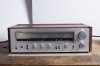
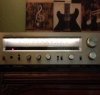
Hey everyone. Just wanted to let you know that I got all my soldering done, everything went well, and the Technics has been rockin for a few weeks now. I took some photos and video, but I 1: was paying more attention to the electronics than the documentation and 2: have been insanely busy and haven't had a chance to go through all of said media to see if I can make a cohesive presentation out of it.

Technics-001.jpg

Thank you thank you thank you!

(Post script: Don't let the signal meter in the picture fool you. When it's upstairs, it pulls in WFMU like a champ and that's all that matters)
 
Hey everyone. Just wanted to let you know that I got all my soldering done, everything went well, and the Technics has been rockin for a few weeks now. I took some photos and video, but I 1: was paying more attention to the electronics than the documentation and 2: have been insanely busy and haven't had a chance to go through all of said media to see if I can make a cohesive presentation out of it.

View attachment 1150699

Thank you thank you thank you!

(Post script: Don't let the signal meter in the picture fool you. When it's upstairs, it pulls in WFMU like a champ and that's all that matters)
Lookin' great! Always liked the look of the Technics receivers.
 
Back
Top Bottom