
• The move to the new server is done. There are some software and database maintenance updates in process. This has us passing the hat around to help out. We appreciate any donations. Seriously, even a dollar helps. The payment page may be found here - https://www.audiokarma.org/support.html

Acculab 480 Speakers

dbuz

AK Subscriber
Subscriber
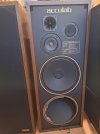
Here we have a pair Acculab model 480 tower speakers. They look to be a 4 way design with a 12in woofer and a 12in passive radiator. The cabinets are very heavy particle board, vinyl wrapped, and filled with pink panther insulation.

Unfortunately, the passive radiators are trashed, so I'm wondering if these are worth spending any money on? They seem to be rare, but I get the feeling they might be good party/garage speakers if fixed up.
1000003463.jpg
1000003464.jpg
 
Register to hide this ad
had a pair in the 90s. everything points to cheap speakers but they sounded pretty badass

a single cap on the mid and both tweeters and the woofers run wide open

unless you can find foam for those radiators and repair them, don't bother. you will not find anything modern to replicate that PR
 
had a pair in the 90s. everything points to cheap speakers but they sounded pretty badass

a single cap on the mid and both tweeters and the woofers run wide open

unless you can find foam for those radiators and repair them, don't bother. you will not find anything modern to replicate that PR
I might get a cheapie refoam kit. Or maybe just seal up the hole. I'm just curious what they would sound like. They were basically free, so if they're ruined it's no big deal.
 
Sealing up the hole is unlikely to work well, because you'd be changing the box design. Just get some generic foams on ebay. The total mass probably won't match the original exactly, but my hunch is that not a lot of engineering went into these originally.
 
As long as you have both passive radiators, refoaming with generics is the best option. It may not be perfect, but they might be a lot of fun. Given audiophile norms, it can be startling how great any speaker with deep bass sounds - this is an area where the general public knows best. You have to learn to appreciate detail, imaging, air, depth, palpability (whatever that might be), but everyone likes bass. Preferably pant flapping, as they used to say in the 50s and 60s.
 
Sealing up the hole is unlikely to work well, because you'd be changing the box design. Just get some generic foams on ebay. The total mass probably won't match the original exactly, but my hunch is that not a lot of engineering went into these originally.
You're not kidding. The passive radiator is literally a round piece of corrugated cardboard with a cheap vinyl cover. RtR was really trying to keep costs down with these, since I know their other speakers from the same era had a proper 12 inch passive.

I'm ordering the cheapest refoam kit I can find and we'll see what happens. If they're halfway decent they can do garage/backyard duty.
 
I think it is a reasonable choice. Passive radiators are driven by air pressure, which is quite uniform, so a simple flat surface will behave fairly pistonically (if that is a word). So a cone is uneccesary. Standard drivers need a cone since they are driven from a central voice coil - a flat surface will not behave as a piston at all unless the surface is supported by a cone of styrofoam, or is made of something very rigid and light (and expensive, like areolam), or unless driven by multiple voice coils.)
If the passive needs mass loading, that might complicate things, but that doesn't seem to be the case here. So the money spent on anything fancier has to come out of some other component, which likely would have more affect on performance.
 
I'm curious if they crossed over the piezo (super)tweeter properly. @painttoad indicated that each tweeter had a single capacitor, but since a piezo is a capacitive (rather than resistive) load, another capacitor in series with it won't do it. You need to put a resistor in parallel with the piezo so the crossover cap "sees" a proper resistive load, and of course that cap needs to be the appropriate value to work with that resistor. This might be a good cheap mod if these sound otherwise decent.

This is why piezo tweeters have a reputation for sounding harsh. Unlike dynamic drivers, they don't need the crossover for protection, so manufacturers of cheap speakers skip it entirely.

ETA: rtr made speakers under their own brand name with piezo tweeters as well. If these were indeed made by rtr, it's possible the supertweeters were already crossed over appropriately.
 
Last edited:
I'm curious if they crossed over the piezo (super)tweeter properly. @painttoad indicated that each tweeter had a single capacitor, but since a piezo is a capacitive (rather than resistive) load, another capacitor in series with it won't do it. You need to put a resistor in parallel with the piezo so the crossover cap "sees" a proper resistive load, and of course that cap needs to be the appropriate value to work with that resistor. This might be a good cheap mod if these sound otherwise decent.

This is why piezo tweeters have a reputation for sounding harsh. Unlike dynamic drivers, they don't need the crossover for protection, so manufacturers of cheap speakers skip it entirely.

ETA: rtr made speakers under their own brand name with piezo tweeters as well. If these were indeed made by rtr, it's possible the supertweeters were already crossed over appropriately.
i only remember seeing 1 cap on each except the woofer but it was almost 30 years ago. there is a chance that there was a resistor at the piezo that i didn't see.

i remember the inside of my cabinets were stamped rtr.

when i was looking them up again years back having flashback, i read that they were rtr's budget line.

i'd love to hear a pair today to see if they still sound as good as i remember.

edit: it's actually been 33 years since i left them behind in n.c.
 
Last edited:
Back
Top Bottom