• The move to the new server is done. There are some software and database maintenance updates in process. This has us passing the hat around to help out. We appreciate any donations. Seriously, even a dollar helps. The payment page may be found here - https://www.audiokarma.org/support.html

Acoustic Treatment Failure

FauxHall

Super Member
I've had good to great success with acoustic treatment for my living room (good) and music room (great.)

My dining room had poor acoustics too, making conversation difficult, even after I added a rug.

So I used the big corner bass traps made of acoustic foam that had worked so well in the other rooms.

However, this initial treatment made little difference. I think the reason is that the room has a large soffit that houses HVAC ducts. The better location would have been against the wall but two side lack corners due to corridors and a third due to an access panel on the bottom of the soffit. Bass reverb is a bit better but no affect on conversational frequencies.

The next step is fabric-wrapped acoustic tiles to mount on walls about ear level - maybe next payday.
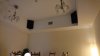
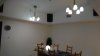
Dining room treatment 1.jpg Dining room treatment 2.jpg
 
Register to hide this ad
That's a lot of reflective surface area you have in that space. As was mentioned above, you're using the wrong acoustic treatment devices for the issue you're trying to remedy. Absorption panels on the walls is the more appropriate solution. And I suggest you move away from foam construction and look for panels that use compressed fiberglass or rockwool as the absorption medium as they'll be effective over a wider spectral range.
 
My first thought at seeing the title was "I hope no one was injured". :biggrin:

Incidentally basotect/melamine foam is also supposed to be good for controlling mid-range frequencies (I have not tried it yet). Some of the GIK dispersion/absorption panels could make that room look like fine dining.
 
The "bass traps" are big prisms of acoustic foam designed for two plane and three plane surface interfaces. They still have a substantial surface area for absorbing frequencies of all energies, not just bass - about three square feet each. Each flat tile is about one square foot so I've got the equivalent of a dozen flat tiles already. They are "bass traps" because they are deep foam and they fit in the wall/wall/ceiling corners where they catch bass nodes most effectively.

Note that I"m located on the desert coast of the Arabian Sea (aka Persian Gulf) and there are no vendors in this country where I can get a single package of OC 704. Worst, my company town is in lockdown with the army guarding the roads in and out so I ain't driving no where. Nor am I willing to pay for shipping from Europe - that would cost more than the OC 704. That's the case for manufactured sound panels in the quantities I can use - I've checked.

What I can buy here with delivery are some acoustic foam products like the bass traps. The second treatment planned is some flat foam pieces covered in a cream fabric to blend with the wall paint I'll probably order 8 of those to mount in two panels of four with a half an inch air gap behind using a thin wood framework. I'll put on on the wall opposite the short hall to the kitchen and another opposite the long hall to the bedrooms. They will face opposite sides so I'll catch reflections off each plane.

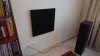
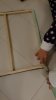
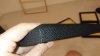
I started a long thread in this forum on treating my listening room. Attached are a couple of photos showing the panels I built for the first reflection points.
Absorber first reflection pont.jpg Absorber frame.jpg Absorber edge.jpg
 
Then use what you can for absorption on the walls as I maintain that the bass traps will not fix your coherency issue regardless of how thick they are or what they’re constructed from. Foam on the walls is certainly better than nothing, and your intention to target those areas is a worthwhile strategy as compared to relying upon or expecting bass traps to remedy your issue. They simply can’t fix a problem that’s originating from the walls when mounted in the corners.

I wouldn’t call your acoustic treatment effort a fail...just incomplete. Carry on as planned and you’ll be rewarded appropriately.
 
Last edited:
I also encourage you to mount a few panels on one (or both) of the opposing front and rear walls as the two, left untreated, will play ping pong with sonic energy and continue their contribution to the coherency issue.

Michael
 
Last edited:
GIK Acoustics is a good site to look at--some of the sample images they provide show their sound absorption panels used in public spaces that aren't exactly music rooms or studios (I've attached a couple here). A noisy restaurant full of hard surfaces can benefit from some absorption here and there. Some strategic panels place on the walls will do a lot to help with that, even by starting with one surface.

GIK-Acoustics-back-wall-panels-1024x683.jpg GIK-Acoustics-custom-panels-2-at-ESS.jpg
(Click to enlarge)

See more examples further down on this page: https://www.gikacoustics.com/acoustic-panels-calculator/ .

Bass traps won't help unless there is a lot of bass content--corner traps help keep the bass from collecting in the corners of a room.

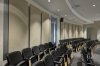
One interesting example is this conference room:

upload_2020-5-19_10-10-0.png

There are four absorption panels, and four diffusion/absorption panels, which simultaneously absorb some of the sound yet also scatter it. A room can be too dead if too many panels are used.
 
Last edited:
Even some soft wall hangings would help. It's such a nice room visually that some decor that doubled as sound absorption or diffusion would do wonders for the acoustics.
 
I made my own absorbers. This is a large room with a full wall of windows on one side and very high ceilings. The fabrics is a linen type speaker cloth. Behind is 4” thick fiber glass insulation. It really helped in this room.


B06315C8-19CA-4B59-AFFB-7011DB7AD7E2.jpeg
 
Your dining table may be adding to reflecting issues. Without pictures of whole room, difficult to assess.
Could you put a couple layers of moving blankets hidden under tablecloth, until table is used for serving.
Mine has them for cat claw protection.

An audio shop I've been to has tall ceilings. They suspend an open wood diffusion panel from ceiling in middle of room. In yours, maybe a fiberglass/ wood, absorption/diffusion panel suspended between your two chandeliers. With your high ceiling it might not be intrusive. More than one panel on ceiling?
 
Last edited:
Your dining table may be adding to reflecting issues.
At a seminar I attended at an audio show, an acoustician mentioned that audiophiles will treat a room nicely, but have a reflective coffee table in the middle of the room that bounces the sound all over. He said that if it is cluttered with things (books, magazines, coasters, knick-knacks, etc.), that acts like diffusion and is usually not a big problem. But otherwise he says that putting some sort of blanket on the table during listening sessions will make a big difference. A large table certainly will be a reflective surface!
 
Back
Top Bottom