Hello guys,
I did some work on the only Acrosound pre-amplifier ever produced, with the idea of making it work together with it's mate, the UL120. Thanks to Diamondsouled for finding me this one.
First I thought it would be an easy caps swap and go. As usual, it did not happen this way.
First I started to notice some oddities with the boards versus the schematic. After some time, I realized that the model I had did not follow the schematic as it has 2x7199 per board and not a 7199 in low input followed with a 7247.
This is odd but reality: the version I have is not the "regular" model, but maybe an early version.
After a change of all electrolytic caps (1 HV cap was shorted), and set the correct tubes, it came to life.
But It had a high level of hiss that I tried to chase.
Long story short, I ended up changing all the caps and CC resistor with new CC resistor and orange drop mylar caps, tube sockets, added some shielded cable in strategic places. And also the tone control old resistor/caps which did help a lot. And I went DC on all tubes heaters.
I still have some hiss when I go very close to my speaker, but I am guessing this is the nature of this design.
I only use the medium amplification AUX, so only one tube is used. I tracked that the noise is generated by the first pentode after the tone control, and not the second stage triode. Even with the screen pin 7 to ground, the hiss is still there. I don't get it.
Anyway you have to get your hear very close to the tweeter, else you can't hear it.
I am now listening to the great Acrosound duo: the sound produced by these products is quite astonishing for such old equipment. And I like the look and the preamp controls are funny to use.
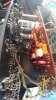
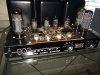
Here is pictures of the set, and the schematic of the second amplification stage on my model.
Thanks for reading,
Brice.


I did some work on the only Acrosound pre-amplifier ever produced, with the idea of making it work together with it's mate, the UL120. Thanks to Diamondsouled for finding me this one.
First I thought it would be an easy caps swap and go. As usual, it did not happen this way.
First I started to notice some oddities with the boards versus the schematic. After some time, I realized that the model I had did not follow the schematic as it has 2x7199 per board and not a 7199 in low input followed with a 7247.
This is odd but reality: the version I have is not the "regular" model, but maybe an early version.
After a change of all electrolytic caps (1 HV cap was shorted), and set the correct tubes, it came to life.
But It had a high level of hiss that I tried to chase.
Long story short, I ended up changing all the caps and CC resistor with new CC resistor and orange drop mylar caps, tube sockets, added some shielded cable in strategic places. And also the tone control old resistor/caps which did help a lot. And I went DC on all tubes heaters.
I still have some hiss when I go very close to my speaker, but I am guessing this is the nature of this design.
I only use the medium amplification AUX, so only one tube is used. I tracked that the noise is generated by the first pentode after the tone control, and not the second stage triode. Even with the screen pin 7 to ground, the hiss is still there. I don't get it.
Anyway you have to get your hear very close to the tweeter, else you can't hear it.
I am now listening to the great Acrosound duo: the sound produced by these products is quite astonishing for such old equipment. And I like the look
and the preamp controls are funny to use.Here is pictures of the set, and the schematic of the second amplification stage on my model.
Thanks for reading,
Brice.