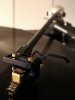
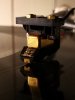
>>> Just to clarify .. should I be getting a genuine NOS ADC RZL stylus or JICO RZL?
I'd get the genuine original article.
However, its price has skyrocketed, as they say in the papers; there are other cartridges and styli in that price range, and I have not heard the J-RZL myself. I would expect it to be very good, and competitive, having heard their other attempts. Turntableneedles.com's shipping is free. Adding the ~$15 shipping charge to the Jico price, the difference is still ~$22. That would make this a painful choice for a cheapskate like me.
I also don't know whether the two Shibatas are different in any way. The RZL is a nude mount, but I believe the J-RZL's is a bushed or bonded mount. J-RZL owners, please correct me if I'm wrong. More significant would be if one had a taller vertical contact line than the other. Shibatas are not all the same; there are tall ones and short ones.
Gretsch: The XT-III, like the XLM Mk III, is indeed a great stylus in the ADC realm, and an excellent alternative in this case, but it lacks something the RZL unusually has: an underdamped, possibly undamped, high-treble resonant peak that's more like a spike, just beyond 20kHz. You can do things with this spike. Put the RZL in a low-inductance body like the one it came in, and it tends toward an uncomfortably etched or too-analytical subjective impression. What it really is, I'm convinced, is the steep rise in the uppermost octave (8 kHz to 16kHz, give or take), which was originally an attempt to keep the response going strong all the way out to the 30kHz CD-4 (discrete quad) carrier's center frequency.
However, put the RZL in a body with three times the inductance (an XLM Mk III body, for example), and what you get is a cartridge that
sparkles very effectively in most systems. That spike never goes away, but it can be tamed, and though the resulting sound isn't, strictly speaking, faithful to the original, it's a sound that's very convincing. The highest highs are boosted, but they're utterly clean, and the effect can be subjectively refreshing. The effect can be turned up and down by a phono stage that has variable resistive loading.
He's more than a footnote, but a note of thanks to AKer David Laloum of Australia, who showed us the frequency response of the Super way back when.