• The move to the new server is done. There are some software and database maintenance updates in process. This has us passing the hat around to help out. We appreciate any donations. Seriously, even a dollar helps. The payment page may be found here - https://www.audiokarma.org/support.html

Adcom GFA-585

Immersion

Active Member
I've been a longtime lurker, but I've finally got some questions.

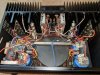
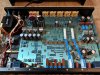
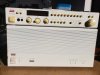
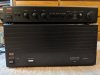
I picked up an Adcom GFA-585, that is in good physical condition. I tested the voltage across the speaker terminals during start up, and warm up, and had it stabilize well under the 30mV suggested by EBC Electronics. I have no audible pop on startup, and the amp seemed to be providing good power. However, when I turn the amp off, the bass drivers on my speakers pulse, or thump, a bit. I immediately pulled the speaker wires.

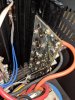
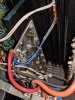
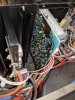
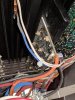
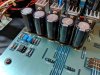
My first thought was that it was an issue with the capacitors. When I pulled the lid on the amp, I noticed that the capacitors looked ok visually (to my novice eye) but I noticed some corrosion on a couple of the boards. (Edit: I looked at the capacitors on the Pre-amp, and noticed a little seeping. I was looking for popped capacitors on the amp boards, so I probably missed some seepage. I will take more pictures showing the cap side of the board, and not just the corrosion to the circuitry below.)

So I guess my questions are: Do you think this can be cleaned/serviced? What's the success rate with cleaning the board, vs replacing? Cost benefit analysis here? Should I consider contacting anyone other than EBC Electronics? (I'm located 2 hours from Denver, if anyone has a good Colorado repair suggestion.) I've done some basic soldering, and am detail oriented, so I'm considering taking on the repair myself as well.
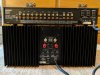
IMG_20191228_180755.jpg
IMG_20191228_180831.jpg
IMG_20191228_182435.jpg
IMG_20191228_182455.jpg
IMG_20191228_182504.jpg
IMG_20191228_182516.jpg
IMG_20191228_182528.jpg
IMG_20191228_182546.jpg
IMG_20191228_182554.jpg
IMG_20191228_182607.jpg
 
Last edited:
Register to hide this ad
That thump is just the capacitors discharging. Perfectly normal. Can't see the one's you say are leaky but 9 times out of 10 it is just glue.

If its working fine, there's really nothing wrong with it unless its giving you hum, distortion, smoke, intermittent issues, etc.
 
To prevent the popping thru the speakers from the filter caps discharging in a GFA-555 Mk.II it was necessary to replace the discharge resistors with larger values. In the 555 MkII these are resistors R801, 802, 803 & 804. The stock value for these metal oxide resistors is 3.9K/3W. Swapping them out for wire wound 4.7K/5W resistors completely eliminated the popping in a pair of Mk.II's I used to own. Maybe you can use a similar resistor swap for your 585?
 
adcom_gfs-3_speaker_selector.jpg
 
Unpopulated PCBs for $80 a pop? Dang! That seems kinda steep. You would think at that price shipping would be free.
 
That thump is just the capacitors discharging. Perfectly normal. Can't see the one's you say are leaky but 9 times out of 10 it is just glue.

If its working fine, there's really nothing wrong with it unless its giving you hum, distortion, smoke, intermittent issues, etc.

So when you're saying perfectly normal, you mean during "like new" operation? The amp is definitely silent on startup (other than the physical switch noise) and during operation. I haven't heard any hum, or distortion, or had any smell/smoke. The only concern I had was the "whump... Whump... Whump" roughly every 2/3 of a second. Definitely getting weaker with each cycle. I was sure it was capacitors bleeding off, but I guess I haven't ever seen/heard it happen, so I assumed it was not normal.

I looked closely at the boards again (as closely as I can without removing them) and the material that is built up on the base is gold, almost crystalline, and scrapes off fairly easily. Glue? (I'm not familiar with the assembly process.) The boards themselves seem to be in good shape, and I can't see anything on the top side that looks concerning.

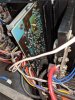
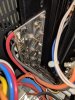
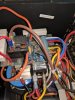
Here is a picture from the GFP-565 preamp, that is supposedly affected by the same bleeding cap issue. Is the bit of brown around the base of the capacitors of concern? Or is that from assembly? I have only tested the preamp with my Technics SL-1100A, and the GFA-585, through a pair of Infinity RS4 towers. The soundstage seemed accurate, but lacking in the low range. Bass and treble controls had little to no effect on output. I'm going to try a few more sources to test it a little more thoroughly.

IMG_20191229_103833.jpg

IMG_20191229_103850.jpg
 
Also, thanks for the welcome. So often I join communities of interest, only to have new questions buried or ignored. I'm excited to expand the auditory experience of those around me, while I get to learn a new skill set. Cheers.
 
Funny enough, I still have my 565; been packed away the past 15 years.
If i had to guess, the brown stuff is transport glue for the caps.

IIRC, there are two versions of the blue circuit board, one tint more desirable than the other.
There is a post on that somewhere here on the AK.

Nice gear, and welcome!
 
Thank you for putting my mind at ease!

Any thoughts on the bit of brown below the capacitors on the preamp?

Glue!

The boards run along on an assembly type of belt that runs them through a bath of molten solder which solders anything that is not covered by that green (or sometimes other colors) film. Bigger parts like the bigger capacitors might shake loose as the board is running along its path so they used glue to keep 'em steady before the solder bath is complete. There's also a youtube video somewhere. I have seen it years back but I am sure you can find it with a simple search. It's cool to watch the process.
 
I have had a GFA5500 for 25 years now . I got the Adcom speaker sector and never heard a pop again . But yes , every time I turn it off . it popped . Brand new .
 
I have had a GFA5500 for 25 years now . I got the Adcom speaker sector and never heard a pop again . But yes , every time I turn it off . it popped . Brand new .

Good to know! I've had it hooked up to some Infinity RS4's, and have been running it at low power for a few hours now. Everything is warm and clean, with no weird smells. Seems to be a solid pickup. It should be able to drive almost any pair of speakers I bring through the collection for now.
 
Good to know! I've had it hooked up to some Infinity RS4's, and have been running it at low power for a few hours now. Everything is warm and clean, with no weird smells. Seems to be a solid pickup. It should be able to drive almost any pair of speakers I bring through the collection for now.
I think you are right . That's a beast .
 
That's a big beautiful Adcom! I've been jonesin' for Adcom's current model 565 or 575. Unfortunately that'll be a while down the road. I had a GFA 5300 and 5400, they both thumped the speakers too.
 
I hope this thread is still watched by you ADCOM GFA 585s. I just bought one from a buddy for a good deal (IMO). He stored it >6 years, so cautiously I picked up a speaker set I don't care about. Scared but excited I hooked them there's a big pop and loud hum on the left channel only. I'm not surprised. So not I'm studying xraytonyb's youtube videos and thinking about picking up hobbe's circuit boards to repair. I still haven't opened up the top lid yet, but I bet I got the typical capacitor issues. I hope to hear any feedback or hints you all might have. Also gonna ping OP.
 
Bass and treble controls had little to no effect on output.
Three sets of output connections--"Bypass", "Lab" and "Normal". The "Bypass" set eliminates the tone controls, filters, and the coupling caps for "purest" sound. "Lab" removes the coupling capacitors, but leaves the tone controls active when the "Tone In" button is pushed in (engaged.) "Normal" includes the coupling caps, and the tone controls when the "Tone In" button is pushed in.

If the bass and treble don't work right, look for the position of the "Tone In" button (engaged/disengaged) and verify your output connection to the power amp--The "Bypass" outputs will kill the tone controls no matter which way the Tone In button is pushed.
 
Back
Top Bottom