• The move to the new server is done. There are some software and database maintenance updates in process. This has us passing the hat around to help out. We appreciate any donations. Seriously, even a dollar helps. The payment page may be found here - https://www.audiokarma.org/support.html

Adding a switch and fuse

Pondoro

Active Member
I have an old tube amp from a console. It has a two wire power cord. I want to ground the chassis, add a power switch and add a fuse. I have already taken the preliminary step of measuring voltage from the chassis to a good ground, it is zero. I then ran a jumper from the chassis to ground and nothing bad happened. So I feel confident I can run a three wire cord and ground the chassis. So where do I add the fuse and power switch - hot lead or cold lead or one each?

Thanks
 
Register to hide this ad
Exactly what @Tom Bavis said.
And for the love of god measure before you drill anything! Do a neat job it only takes a few seconds longer...
Dont take it personally, I've seen too many gorgeous tube amplifiers wrecked cosmetically because someone with a drill started hogging out holes at random places...
Put the holes in a straight line and centered between things so they look good.
Visualize it in your mind before you make chips. Draw it out, make it symmetrical, and try and fool the next guy Into thinking it came that way from the factory.
 
There are two existing holes in good locations near the power transformer and the electrical cord. One hole needs to be smaller, I made a custom plate out of galvanized 0.030 sheet steel. The electrical cord hole needs to be enlarged. I’ll be careful. Pictures when I’m finished.
 
What tom said is good. Here's the why: you want the fuse protecting everything, so it goes before the switch on the hot wire. Then you wire to the switch, because you want everything inside definitely to turn off when the switch is off. Neutral is return wire for that circuit, so shouldn't have anything to switch when the hot wire feeding the circuit is switched off.

If you ground the chassis, which I always think you should if it is ever exposed where it can be touched, make sure that the amp itself isn't using the chassis anywhere as a ground. Sometimes the input and output jacks have connections to the chassis hidden where you can't see them. You may need to add a ground bus in the amp to fix this. Try to ground everything to a single point, preferably the same place as the negative side of the B+ lead coming from the transformer. Use big wire if you can't ground to a single point, so that there is as little resistance as possible along the ground... otherwise good luck finding where the hum is coming from!
 
Last edited:
What tom said is good. Here's the why: you want the fuse protecting everything, so it goes before the switch on the hot wire. Then you wire to the switch, because you want everything inside definitely to turn off when the switch is off. Neutral is return wire for that circuit, so shouldn't have anything to switch when the hot wire feeding the circuit is switched off.

If you ground the chassis, which I always think you should if it is ever exposed where it can be touched, make sure that the amp itself isn't using the chassis anywhere as a ground. Sometimes the input and output jacks have connections to the chassis hidden where you can't see them. You may need to add a ground bus in the amp to fix this. Try to ground everything to a single point, preferably the same place as the negative side of the B+ lead coming from the transformer. Use big wire if you can't ground to a single point, so that there is as little resistance as possible along the ground... otherwise good luck finding where the hum is coming from!

The amp does ground to the chassis, in several locations. Floating a ground buss off of the chassis would be a lot of modifications.
 
What tom said is good. Here's the why: you want the fuse protecting everything, so it goes before the switch on the hot wire. Then you wire to the switch, because you want everything inside definitely to turn off when the switch is off. Neutral is return wire for that circuit, so shouldn't have anything to switch when the hot wire feeding the circuit is switched off.

If you ground the chassis, which I always think you should if it is ever exposed where it can be touched, make sure that the amp itself isn't using the chassis anywhere as a ground. Sometimes the input and output jacks have connections to the chassis hidden where you can't see them. You may need to add a ground bus in the amp to fix this. Try to ground everything to a single point, preferably the same place as the negative side of the B+ lead coming from the transformer. Use big wire if you can't ground to a single point, so that there is as little resistance as possible along the ground... otherwise good luck finding where the hum is coming from!

I really want to discuss this advice. I am not arguing but it is the first time I have heard it. The amp most definitely uses the chassis as a ground. It would be a major modification to change that. I ran the amp and measured voltage from the chassis to ground, using a reasonably expensive digital volt meter. Nada. Zip. So I connected a temporary ground from the chassis to a piece of conduit that I know is grounded. The amp did not explode or make bad noises. This led me to believe adding a three wire cord and grounding the chassis was a safe option. I have a different amp that was rebuilt by a pro and that is what was done to it. But I do not want to endanger life or limb, nor destroy a working old amp. So I want to continue this discussion. I am open to learning.
 
Most all old console amps (metal or steel) use the chassis as a common ground. Honestly, I would not add a 3 prong plug to the engineers standard 2 prong plug as you may (or may not) experience ground loop issues.

Before pics, what brand amplifier are we talking about here?
 
I agree, if this chassis is going to be used outside of a console, where you can touch it, ground the chassis. It's all speculation that is will create ground loops and in my experience, if you plug everything into the same power strip, it probably will be fine.
 
I agree, if this chassis is going to be used outside of a console, where you can touch it, ground the chassis. It's all speculation that is will create ground loops and in my experience, if you plug everything into the same power strip, it probably will be fine.
@StepheK - You seem to have a) Touched a lot of amplifier chassis', and b) Remained alive. Good credentials.
 
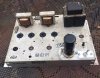
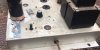
Pictures and model numbers have been requested. This is a Magnavox 8802, my second old Magnavox. The current amp was bought off the internet from a fellow who replaced all the capacitors but did not add a fuse, power switch or three wire cord. He was up front about this and I was happy with the price. The amp sounds very good, not as loud as my other old Magnavox amp, but quieter. Really quiet. In the pictures you can see a fuse holder and an On-Off switch that I have added, in existing holes. I would have preferred that the holes were closer but they existed. The switch and fuse are not yet wired into the circuit. This thread was started for advice about that. You can also see the original two-wire power cord, it will be replaced. An empty hole on the other side of the chassis, near the input jacks, will hold a pilot light. Thus no extra holes need to be drilled, but the power cord hole will need to be enlarged. Once modified and working (it already works, my goal is to not change that!) I will sheath it in pretty hardwood.
 

Attachments

  • Small 2.jpg
    Small 2.jpg
    106.7 KB · Views: 22
  • Small 3.jpg
    Small 3.jpg
    79.4 KB · Views: 22
More info on grounding. I have a different old Magnavox, it was completely rebuilt by a pro. He added a three wire cord and grounded the chassis. It has only the slightest noise when plugged in and on. With no source, if you put your ear up to the speaker, you can barely hear some noise. I actually ran a separate ground wire from the bare chassis to a piece of conduit and reduced the slight noise, a noticeable amount. I realize that I was possibly creating a ground loop but I also know that ground circuits are fraught with uncertainty. I won't do anything unsafe, if I can help it. But as far a sound goes ground loops seem to be more village knowledge than settled science. So amp one is quiet enough, I do not hear the noise when music plays. I know that the very existence of the noise would bother many, like a scar that is not visible to the public, but it does not bother me. That amp is a similar but more powerful amp, a Magnavox 185.

This new amp is absolutely dead quiet, I was shocked at how quiet it is. As I said I ran a temporary ground wire from the chassis to a conduit, no noise or hum appeared. So I feel good about adding a ground wire to the chassis via a three wire cord, unless some safety reason exists against that plan. I cannot think of a safety concern, I believe grounding the chassis only increases safety. But I am open to all comments.

I counted chassis grounds, there are seven (7!) separate chassis grounds, the amp sounds great, I will not undo all of the chassis grounds, it would be a major rebuild.
 
Modern safety standards call for a grounded chassis or double insulation (which would be tested for breakdown at 3000VAC). If you built an amp like this for sale today, it would require a 3-wire cord to be safety certified (UL or CE). It would also require top and bottom covers to keep fingers away from hot tubes and dangerous voltages.

As far as hum and noise, I am sure that the engineers who designed '60's equipment understood grounding and how to avoid hum better than most audio hobbyists today. Power amps with ~1V input aren't very fussy anyway - connect the rectifier return to the first filter cap minus and there will be no hum caused by grounding anything anywhere else. Actually easier to do multi-point grounding properly than star or bus ground - '60s integrated amps had quiet phono preamps (gain of ~500 ahead of power amp) due to careful layout.

Ground loops can sometimes occur with external connections to AC powered components - for example, a TV connected to cable may be hopeless without audio isolation transformers. But lifting the ground on one or more components sometimes helps.
 
Last edited:
A lot of people didn’t have three wire plugs in their houses when these amps were made. Engineers designed stuff to be sold at an affordable price point. You’re not likely to hurt the amp by grounding it, but the ground loop problem, if there is one, can be a giant pain to track down the cause. Ymmv. My only real problem with them so far in life has been hooking my TV up to my stereo. Lifting the ground on the TV power supply solved the problem temporarily.
 
I haven’t looked in my amps/preamps currently in use to see what is tied to the chassis, but the power amps are definitely grounded with three wire plug, and plugging the TV in made an awful hum to the point where I was worried for a minute that the power supply capacitors where starting to fail. Looked again at all the cords, unplugged the TV, and the hum went away. Big sigh of relief. I’ve always assumed, maybe wrongly so, that if the circuit is not using the chassis as a ground point, there should be fewer issues with ground loop hum. The amp I’m currently working on has ground wires everywhere in it, but the input jacks are not isolated from the chassis, and end up making it tied to ground also. Thought about what to do about that, but will cross that bridge when I get to it if it manifests itself as a problem.
 
Back
Top Bottom