• The move to the new server is done. There are some software and database maintenance updates in process. This has us passing the hat around to help out. We appreciate any donations. Seriously, even a dollar helps. The payment page may be found here - https://www.audiokarma.org/support.html

Adding multi-channel, Bluetooth and wireless to an old-school setup.

Raphaz

AK Subscriber
Subscriber
I was wondering if I could get some advice here. I’m looking to improve my system and add the following capabilities (without sacrificing sound quality):

  • 2 separate stereo channels (pairs) I can control the volume (and ideally eq) independently, but also one master volume
  • Option to add 2 pairs of wireless stereo speakers
  • Direct streaming/bluetooth
  • Less foot print (specially for the speakers)

Current set up:
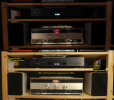
  • Yamaha R-2000 - powers 2 KEF Q500 and a Klipsch 120SW (mains). The R-200 is connected to a
  • Nikko NR-1219 which powers 6 Minimus 7 (secondary) for one of the lofts and the kitchen nook.

I live in an open warehouse loft space with two open upstairs/mezzanine/loft spaces - approx 1200 sqft, 7 ft ceiling, wooden floor, brick walls, 4 large cathedral windows.

Unlike most audiophile setups I don’t target a particular listening spot - I’d like to have room-filling sound that reaches most areas of the large space (and harder to reach areas are covered by secondary speakers).

I play mainly vinyl records and Spotify, sometimes CD, and on occasion tape, MiniDisc and other “exotic” sources.

I’m happy with my setup and the clear transparent sound of the R-2000. Although lower volumes could be more pronounced, and the mains could be more room-filling.

I like the old school silverface look of my receivers - I’m actually lusting for a good deal on a CR-1020 or 2040 or one of the monster Sansui and I’d also be happy with nice Revox or McIntosh gear (but I can’t spend a fortune). But I’m open to add newer gear with streaming, wireless and multi-channel control capabilities.

I was looking into newer Yamaha receivers (like the R-N1000A), Rotel, Luxman, but also
Bluesound Nods, Peachtree, Cambridge, Naim, Outlaw, WiiM, Linn, Niles, Schiit and such but I’m a bit lost. Also, I don’t want to over-spend when I just want to add to my current setup. I wonder if I can get away with used gear.


Thank you for sharing your experience and for your advice.
 
Last edited:
Register to hide this ad
Sorry, I only added bluetooth and wireless capabilities to my BELL 2420 from 1964... That's all... :confused: But it works fine with my laptop as an audio source ! :cool:;)

1703694989392.png

T
 
My approach to the question is different than most. I started with a (IMO) very good sounding two channel system to which I added surround/HT.

For two channel stereo I have a system composed of separates with a mix of tube and SS gear set up in a dedicated and treated room. For HT/surround I place my preamp in bypass mode. Then my HT processor controls everything (5.2 speakers) including my bi-amplified w/dual subwoofers front speakers.

When playing two channel sources the surround gear is not turned on. I feel that this arrangement gives me the best of both stereo and surround sound. My processor has an available Bluetooth dongle, but I have no need for it. I use a Bluetooth equipped laptop as a music server feeding an external USB DAC. The output from the DAC is connected to my two-channel preamp.
 
Sonos Ports or Bluesound Nodes if you want to add to what you have. If you want to move away from the Minimus 7 wired zone-setup, I'd look into sprinkling a few Sonos Era 100's or Bluesound Pulse Flex 2i's around the place which would trounce the existing speaker setup in performance, ease-of-use, flexibility, etc.
 
My approach to the question is different than most. I started with a (IMO) very good sounding two channel system to which I added surround/HT.

For two channel stereo I have a system composed of separates with a mix of tube and SS gear set up in a dedicated and treated room. For HT/surround I place my preamp in bypass mode. Then my HT processor controls everything (5.2 speakers) including my bi-amplified w/dual subwoofers front speakers.

When playing two channel sources the surround gear is not turned on. I feel that this arrangement gives me the best of both stereo and surround sound. My processor has an available Bluetooth dongle, but I have no need for it. I use a Bluetooth equipped laptop as a music server feeding an external USB DAC. The output from the DAC is connected to my two-channel preamp.
What HT processor/bluetooth dongle do you use, and what kind of a DAC?
 
Sonos Ports or Bluesound Nodes if you want to add to what you have. If you want to move away from the Minimus 7 wired zone-setup, I'd look into sprinkling a few Sonos Era 100's or Bluesound Pulse Flex 2i's around the place which would trounce the existing speaker setup in performance, ease-of-use, flexibility, etc.
So far I have shied away from Sonos - from what I understand their proprietary cosmos doesn’t allow for true stereo (as in left/right channel speaker pairs). Would Bluesound Flex allow for that? Also, I’m not sure if I want to commit to one brand and it’s proprietary wireless tech and to be stuck with using their speakers only. Do I have to?
 
I should probably add that, so far, I haven’t considered surround sound or playing TV through the same system. I could be convinced ,if it gets me to where I want to be (as in above).
 
So far I have shied away from Sonos - from what I understand their proprietary cosmos doesn’t allow for true stereo (as in left/right channel speaker pairs). Would Bluesound Flex allow for that? Also, I’m not sure if I want to commit to one brand and it’s proprietary wireless tech and to be stuck with using their speakers only. Do I have to?
Sonos plays in stereo, with the exception if you have a single speaker, like a Play1 or a Era100, for example. Since they are just single speakers, they get a mixed mono signal playing through them. However, you can easily pair 2 of them together for stereo sound in the app.

I imagine you could cobble some sort of solution together using Bluetooth dongles, separate apps, etc., but the user experience would be crappy, at best, since you have separate zones and multiple speakers. With single solution like Sonos or Bluesound, you can create party modes, to join all the speakers and zones together playing one source while having volume control for each zone, plus an overall volume control for everything. You can also use their alarm clock features, which is great, rather than an old-fashioned alarm clock or that annoying thing on your phone, so you can wake up to the music stream of your choice and have multiple different alarms set for the week. All the streaming apps such as Tidal, Spotify, Amazon, etc. are all controlled in the app so it's as smooth and cohesive as possible. The entire experience is on another level from individual dongles/ receivers, app, etc.

You should see if you have any Sonos or Bluesound dealers in your area and set up a demo appointment to check it out so you can experience it first-hand.
 
I should probably add that, so far, I haven’t considered surround sound or playing TV through the same system. I could be convinced ,if it gets me to where I want to be (as in above).
Sonos plays in stereo, with the exception if you have a single speaker, like a Play1 or a Era100, for example. Since they are just single speakers, they get a mixed mono signal playing through them. However, you can easily pair 2 of them together for stereo sound in the app.

I imagine you could cobble some sort of solution together using Bluetooth dongles, separate apps, etc., but the user experience would be crappy, at best, since you have separate zones and multiple speakers. With single solution like Sonos or Bluesound, you can create party modes, to join all the speakers and zones together playing one source while having volume control for each zone, plus an overall volume control for everything. You can also use their alarm clock features, which is great, rather than an old-fashioned alarm clock or that annoying thing on your phone, so you can wake up to the music stream of your choice and have multiple different alarms set for the week. All the streaming apps such as Tidal, Spotify, Amazon, etc. are all controlled in the app so it's as smooth and cohesive as possible. The entire experience is on another level from individual dongles/ receivers, app, etc.

You should see if you have any Sonos or Bluesound dealers in your area and set up a demo appointment to check it out so you can experience it first-hand.
Sonos plays in stereo, with the exception if you have a single speaker, like a Play1 or a Era100, for example. Since they are just single speakers, they get a mixed mono signal playing through them. However, you can easily pair 2 of them together for stereo sound in the app.

I imagine you could cobble some sort of solution together using Bluetooth dongles, separate apps, etc., but the user experience would be crappy, at best, since you have separate zones and multiple speakers. With single solution like Sonos or Bluesound, you can create party modes, to join all the speakers and zones together playing one source while having volume control for each zone, plus an overall volume control for everything. You can also use their alarm clock features, which is great, rather than an old-fashioned alarm clock or that annoying thing on your phone, so you can wake up to the music stream of your choice and have multiple different alarms set for the week. All the streaming apps such as Tidal, Spotify, Amazon, etc. are all controlled in the app so it's as smooth and cohesive as possible. The entire experience is on another level from individual dongles/ receivers, app, etc.

You should see if you have any Sonos or Bluesound dealers in your area and set up a demo appointment to check it out so you can experience it first-hand.
Very helpful, thank you!
Can you confirm:
With the exception of mentioned Play1 and Era100, Sonos and Bluesound both do true old school stereo, with separated, dedicated right/left channels, just like a classic receiver - as opposed to the mono signal being split and two speakers each playing the same mono signal?
And do both, Sonos and Bluesound require proprietary speakers and amp/receivers?
Is Yamaha MusiCast any different?
 
In the setup, the app asks if you would like to connect 2 speakers in a room/ zone as a stereo pair. If you don't, then each speaker is just mono because they're small and can't provide stereo sound without being coupled up with a second.

None of the brands listed below require any proprietary speakers/ amps since you can interface their systems and the app experience with passive devices such as the Bluesound Node, Sonos Port, Yamaha MusicCast WXC-50 or the Denon Heos Link which would just plug in with RCA cables.

Yamaha MusiCast, Denon Heos, Bluesound and Sonos all compete in the same market space with competing/ comparable products.
 
In the setup, the app asks if you would like to connect 2 speakers in a room/ zone as a stereo pair. If you don't, then each speaker is just mono because they're small and can't provide stereo sound without being coupled up with a second.

None of the brands listed below require any proprietary speakers/ amps since you can interface their systems and the app experience with passive devices such as the Bluesound Node, Sonos Port, Yamaha MusicCast WXC-50 or the Denon Heos Link which would just plug in with RCA cables.

Yamaha MusiCast, Denon Heos, Bluesound and Sonos all compete in the same market space with competing/ comparable products.
I probably need to pick speakers with wireless capability - I can’t just make my current speakers wireless, correct?

I’m still slightly confused when you say none of mentioned brands require proprietary speakers. I though that you can’t just (as an example) use wireless KEF LS50 speakers with Sonos or Q Acoustic M20 HD speakers with MusiCast? Was I wrong?
 
Last edited:
Thank you all for sharing your experience and advice. I am starting to get a better idea of the options on hand.

Not sure yet what will give me the best sound quality/convenience improvements without adding too much footprint, and if a satisfying solution is available for me without breaking the bank.

As someone mentioned I should go to some dealers and have them demoing some options.

I guess it will come down to decide between adding a simple bluetooth “dongle” like BluDento, vs adding a Sonos amp or Bluesound Node, vs adding a “modern” audiophile receiver with Bluetooth capabilities.
 
Each of the manufacturers listed have 2 types of solutions in their ecosystems. One is a free-standing, self-powered speaker the plugs into a power outlet. The other type of device allows users to bring an existing system to their ecosystem, such as the Sonos Port which would connect to an existing amplifier/ preamp with RCA cables become a source:

https://www.sonos.com/en-us/shop/po...YHfF41PmgpMBklV0LP7lDVgQtv7cO40xoC_08QAvD_BwE

In addition to that, the Port has a set of inputs where you could pipe audio from your main system from say, a turntable, to the rest of the house.

I'd suggest visiting a dealer or two in your area as well as review the manufacturers websites to get a better feel of how they all work:

https://www.sonos.com/en-us/how-sonos-works

https://usa.yamaha.com/products/audio_visual/musiccast/index.html

https://www.bluesound.com/music/
 
What HT processor/bluetooth dongle do you use, and what kind of a DAC?
My HT processor is an Emotiva UMC-200. There is a Bluetooth dongle available for it. Not being a Bluetooth fan, I never bought the dongle. My main DAC is an Emotiva XDA-2.

I prefer my audio not going through a Bluetooth conversion. OTOH, the laptop I use as a music server has Bluetooth. It pulls files from an NAS. The NAS and laptop are hard wired to my router. My DAC has a USB connection to the laptop. I use my phone or tablet to control the music server.
 
Last edited:
My HT processor is an Emotiva UMC-200. There is a Bluetooth dongle available for it. Not being a Bluetooth fan, I never bought the dongle. My main DAC is an Emotiva XDA-2.

I prefer my audio not going through a Bluetooth conversion. OTOH, the laptop I use as a music server has Bluetooth. It pulls files from an NAS. The NAS and laptop are hard wired to my router. My DAC has a USB connection to the laptop. I use my phone or tablet to control the music server.
NAS as in cloud storage?
 
I start to wonder if a DAC can improve the source, for example when adding a good DAC btw. a MacBook and a vintage receiver. When plugged in to the outs of the Mac (USB or mini RCA) wouldn’t the signals (coming from the Mac) have to bypass the internal Mac DAC in order to pick up as much of the original source as possible? Isn’t the goal to preserve as much as possible the original data and amplify it from there?
I probably got that all wrong…
 
NAS as in cloud storage?
Absolutely not! I have a local NAS with a couple of 2TB HDD's. Although I have been using the internet continuously since Compuserve offered the service via a 2400 baud modem I don't like having to go to the internet to listen to music, to access my files or to run an application that I own. Windows 11 and Office 365 have been somewhat of a problem for me. The default for everything Microsoft is currently publishing is to use cloud services. I had to jump through some hoops with Office 365 and Windows 11 to store my files locally.

I start to wonder if a DAC can improve the source, for example when adding a good DAC btw. a MacBook and a vintage receiver. When plugged in to the outs of the Mac (USB or mini RCA) wouldn’t the signals (coming from the Mac) have to bypass the internal Mac DAC in order to pick up as much of the original source as possible? Isn’t the goal to preserve as much as possible the original data and amplify it from there?
I probably got that all wrong…
If you use a USB port or the optical port Apple hides in the headphone jack to attach a DAC you automatically bypass the PC's internal DAC. It was an easy decision for me. I asked myself one question. "If music is important to me, would I prefer using a $2 DAC buried on the motherboard or a decent external DAC?". I pondered the same sort of issue between MP3 (lossy compression) or FLAC (lossless compression). Suffice it to say, none of my music files are MP3.

I have compared the sound of various external DAC's with the onboard ones on the PC's I have access to. In every instance the external DAC sounded better. That includes some very inexpensive (<$40) DAC's. It was no contest. Desktop or laptop the external DAC always sounded better.
 
Back
Top Bottom