stevland
New Member
Note: *indicates that a photo is attached
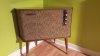
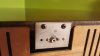
I have an old Philips satellite speaker with an integrated tube amplifier* from the late '50s in excellent condition. (It has been discussed previously on this forum).
To keep things simple I will refer to it as "the Philips cabinet" going forward.
It has a single RCA input.
It uses high impedance 800 ohm drivers which I understand were rare in the tube days, and became completely obsolete in the era of solid state.
Long story short, it was originally meant to connect directly to one channel of a stereo turntable without a preamp.
As you might expect, when I plug in a typical audio source (let's say, an MP3 player) I have to keep the volume between 0% to 20% or else distortion will quickly ensue.
In other words, it would be extremely easy to blow the drivers and practically impossible to replace them. More on this later.
Like a crazy person, I want to join the Philips cabinet to my multi-zone home audio empire for occasional use.
I'm seeking suggestions or advice on my plan, which at the moment looks something like this:
1. Turntable > preamp
2. PC > DAC
3. Bluetooth > DAC
↓
Behringer 5-channel mixer > Main Out
↓
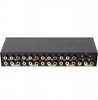
Powered 1 in to 8 out AV splitter*
↓
1. Mini class D amp > zone 1 speakers
2. Mini class D amp > zone 2 speakers
3. Mini class D amp > zone 3 speakers
4. Mini class D amp > zone 4 speakers
5. Mini class D amp > zone 5 speakers
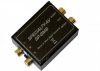
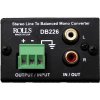
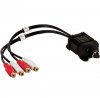
6. RCA stereo potentiometer* >
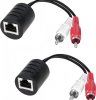
RCA to Cat5e balun* (send) >
50' Cat5e cable >
Cat5e to RCA balun (receive) >
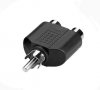
RCA splitter* (used in reverse) >
single RCA cable >
Philips cabinet
7. unused
8. unused
Questions
Looking at #6 above, is there a more elegant way of achieving this? (I'm open to all suggestions, but fairly committed to using Cat5e cable as it is already in place and very difficult to replace. And a weak signal is not a concern in this application. Quite the opposite, actually.)
I have read conflicting reports on whether or not it is advisable to use a simple RCA splitter to combine stereo signals and feed the resulting signal into one mono device. Obviously my top concern is to avoid damaging any of the Philips cabinet components!
If using such a splitter is a bad idea, what is the best way to mix an analog stereo signal down to mono?
In case it isn't self evident, the potentiometer is intended to lower the signal strength and minimize the chances of damaging the Philips cabinet.
One might ask, why not put the potentiometer on the other end? I'm hoping to set it and forget it. I'm also concerned that, if it is in zone 6, someone might come across it and — not knowing what it's for — play with it.
But it also occurs to me that I might get better quality sound if I send the full signal and then use the potentiometer to reduce the signal right before it enters the Philips cabinet. I lack the knowledge to determine whether it would make a difference or not. I'd love some feedback.
Another question might be: why not combine the signals into mono before sending the signal over the Cat5e cable? A: I may as well have stereo on the other end for unforeseen future use.
Thanks for reading.
I have an old Philips satellite speaker with an integrated tube amplifier* from the late '50s in excellent condition. (It has been discussed previously on this forum).
To keep things simple I will refer to it as "the Philips cabinet" going forward.
It has a single RCA input.
It uses high impedance 800 ohm drivers which I understand were rare in the tube days, and became completely obsolete in the era of solid state.
Long story short, it was originally meant to connect directly to one channel of a stereo turntable without a preamp.
As you might expect, when I plug in a typical audio source (let's say, an MP3 player) I have to keep the volume between 0% to 20% or else distortion will quickly ensue.
In other words, it would be extremely easy to blow the drivers and practically impossible to replace them. More on this later.
Like a crazy person, I want to join the Philips cabinet to my multi-zone home audio empire for occasional use.
I'm seeking suggestions or advice on my plan, which at the moment looks something like this:
1. Turntable > preamp
2. PC > DAC
3. Bluetooth > DAC
↓
Behringer 5-channel mixer > Main Out
↓
Powered 1 in to 8 out AV splitter*
↓
1. Mini class D amp > zone 1 speakers
2. Mini class D amp > zone 2 speakers
3. Mini class D amp > zone 3 speakers
4. Mini class D amp > zone 4 speakers
5. Mini class D amp > zone 5 speakers
6. RCA stereo potentiometer* >
RCA to Cat5e balun* (send) >
50' Cat5e cable >
Cat5e to RCA balun (receive) >
RCA splitter* (used in reverse) >
single RCA cable >
Philips cabinet
7. unused
8. unused
Questions
Looking at #6 above, is there a more elegant way of achieving this? (I'm open to all suggestions, but fairly committed to using Cat5e cable as it is already in place and very difficult to replace. And a weak signal is not a concern in this application. Quite the opposite, actually.)
I have read conflicting reports on whether or not it is advisable to use a simple RCA splitter to combine stereo signals and feed the resulting signal into one mono device. Obviously my top concern is to avoid damaging any of the Philips cabinet components!
If using such a splitter is a bad idea, what is the best way to mix an analog stereo signal down to mono?
In case it isn't self evident, the potentiometer is intended to lower the signal strength and minimize the chances of damaging the Philips cabinet.
One might ask, why not put the potentiometer on the other end? I'm hoping to set it and forget it. I'm also concerned that, if it is in zone 6, someone might come across it and — not knowing what it's for — play with it.
But it also occurs to me that I might get better quality sound if I send the full signal and then use the potentiometer to reduce the signal right before it enters the Philips cabinet. I lack the knowledge to determine whether it would make a difference or not. I'd love some feedback.
Another question might be: why not combine the signals into mono before sending the signal over the Cat5e cable? A: I may as well have stereo on the other end for unforeseen future use.
Thanks for reading.