


Sci525
Member
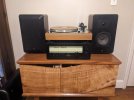
Below are some measurements I took of my ADS L470. My pair is in all original condition. The crossovers caps have not been replaced. I have only measured one of my pair, it takes a fair bit of time, and I have no idea if my speakers are representative of the line. All measurements below are with the grills on, but I did measure with them off and the difference was only a couple db in the upper treble. All measurements are done at 85db@1m. I use this method to measure speakers which uses impulse response windowing to generate quasi-anechoic speaker measurements.
I keep to bookshelf speakers, and while I've only owned a dozen(ish) vintage speakers, these are my favorite. I wanted to figure out why.
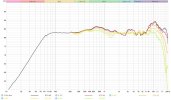
First, the on-axis and horizontal frequency response. Bright on-axis, but great at around 30*. This suggests these speakers were meant to be set up pointing straight into the room and positioned in an equilateral triangle with the listener. The dispersion is wide till about 12kHz but drops off quickly past that. Maybe not a young person's speaker. The bass is shelved so this speaker will probably sound most balanced near the wall. Bass extension is very good. Placed near the wall this speaker frequency response has a slight U-shaped profile.
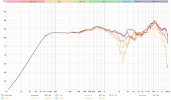
Next, the vertical response. Best to keep ears at the tweeter line or slightly above.
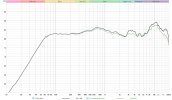
Now the listening window. This is the average of the on-axis, +/- 10* vertical, and 10, 20, 30 and 40* horizontal.
Finally, distortion. Take these measurements with a grain of salt because I live in an urban area, although I have tried to capture and account for the noise floor. Good at 85db@1m but maybe not keeping up with the modern standard. The speakers are struggling at 95db@1m. ADS made lots of big speakers and if you want to get loud while keeping clarity you may need one of them.
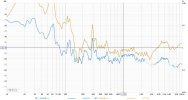
I live with these speakers, and I really like them. I have them positioned against the wall and I sit about 20* off-axis. I find that they do have a U shaped sound, but they are not dark or bright to my ears. They are also easy to supplement with a small sub. I have certainly noticed that they don't play very loud well, and the fuses don't let you get much past 100db on the tweeter anyway. I use them in an office, and I don't need any more volume than they can comfortably provide. I don't feel that they reproduce female vocals quite as enjoyably to me as some other speakers. I wonder if this is the roughness in the lower treble, the slight U-shaped frequency response, the good, but not great distortion, or maybe I need to get in there and replace the caps. In 2024 these sell for <$200 in my area and I can't think of many better things to do with $200.
Cheers,
Joe
I keep to bookshelf speakers, and while I've only owned a dozen(ish) vintage speakers, these are my favorite. I wanted to figure out why.
First, the on-axis and horizontal frequency response. Bright on-axis, but great at around 30*. This suggests these speakers were meant to be set up pointing straight into the room and positioned in an equilateral triangle with the listener. The dispersion is wide till about 12kHz but drops off quickly past that. Maybe not a young person's speaker. The bass is shelved so this speaker will probably sound most balanced near the wall. Bass extension is very good. Placed near the wall this speaker frequency response has a slight U-shaped profile.
Next, the vertical response. Best to keep ears at the tweeter line or slightly above.
Now the listening window. This is the average of the on-axis, +/- 10* vertical, and 10, 20, 30 and 40* horizontal.
Finally, distortion. Take these measurements with a grain of salt because I live in an urban area, although I have tried to capture and account for the noise floor. Good at 85db@1m but maybe not keeping up with the modern standard. The speakers are struggling at 95db@1m. ADS made lots of big speakers and if you want to get loud while keeping clarity you may need one of them.
I live with these speakers, and I really like them. I have them positioned against the wall and I sit about 20* off-axis. I find that they do have a U shaped sound, but they are not dark or bright to my ears. They are also easy to supplement with a small sub. I have certainly noticed that they don't play very loud well, and the fuses don't let you get much past 100db on the tweeter anyway. I use them in an office, and I don't need any more volume than they can comfortably provide. I don't feel that they reproduce female vocals quite as enjoyably to me as some other speakers. I wonder if this is the roughness in the lower treble, the slight U-shaped frequency response, the good, but not great distortion, or maybe I need to get in there and replace the caps. In 2024 these sell for <$200 in my area and I can't think of many better things to do with $200.
Cheers,
Joe
Last edited:


