• The move to the new server is done. There are some software and database maintenance updates in process. This has us passing the hat around to help out. We appreciate any donations. Seriously, even a dollar helps. The payment page may be found here - https://www.audiokarma.org/support.html

Advice for buying long term Reel to Reel

SpeakerdeJon

New Member
Hi everyone,

I'm looking to buy a new Reel to Reel. I have a few criteria for what I'm looking for:
  • Easy or at least cheaper to service/buy parts for,
  • Longevity - something with least amount of belts, rubber to wear down and is mostly direct drive with dedicated motors,
  • Sounds pretty good (doesn't need to be professional sounding as for home use),
  • Auto-reverse/playable without switching over the reels,
  • Looking at around $200 USD
What do you guys think, any recommendations?

Regards,
John
 
Register to hide this ad
Hi John,
I've been using several Sony TC-730's ( I have 4) for a few years and have had no issues besides general maintenance.
Very robust and direct drive and sound great on any decent amp. Auto reverse too.
I also like the sound quality of my Sony TC 366 too, although not direct drive as such. It uses idler wheels to engage the mech but isn't auto reverse. That doesn't bother me too much.
The only belts are counter belts, so no big deal there.
As for parts, if ever you needed them, good parts machines are a plenty and you can usually find bits online.
If you are desperate, you can try asking here on AK.
There is always a solution to every problem.
 
We have four of them here at the house from back in the day when dad was into them and they all work good, for now.
I changed a few belts, tubes and what not here and there.
My take on them is get an A #1 unit from the start because they are complicated and it may cost more to have them repaired than it does to buy them.
I did like "servicing" them but a true repair would have been a different thing for me.
If I were to buy one I would expect to pay north of $200 for a prime just gone thought ready to go unit and hope for the best. And I wouldn't buy one that was not.
Good luck, reels are a lot of fun.
 
I re-entered reel to reels several years ago and started a thread on TH - "What reel to reel decks are easiest to restore?" which steered me into a Teac.

What I wound up with was a bit of an oldie, a first generation A3300. Knowing then what I know now, I would have looked for one a bit newer. Not because I am dissatisfied, just that the "toggle switch" used in those early versions are subject to failure from misuse - or so I've read. My switch is in good condition and operating it kind of reminds me of driving an old British sports car - drives well but antiquated. It needed some work which I was able to do (internet forums are a wonderful thing) and one or two bits & bobs I found online but I expect it will outlast me even though it was very well used when I got it. You should have seen the layer of dust caked on the motor fan.

I still use that A3300 but since getting it, I obtained an Akai GX4000 then a Pioneer RT707.

The Akai had a problem and in correcting it, I learned of the reported "bad Akai transistor" - Hitachi 2SC458. I discovered there were 14 of them in the GX4000 I had, replaced them all which solved the problem then sold it to someone wanting a black face reel to reel. I had no qualms about passing it on to her as it functioned well and sounded very good.

I acquired the Pioneer because it was an opportunity buy and I liked it's configuration (small face-on dimensions) plus its auto reverse feature. It's still here and gets used along with the A3300. The only thing I had to do to it so far was replace the belt for the tape counter and one of the caps (not capacitor) on a function button.

If I were to embark in purchasing another R2R, another Teac would probably be at the top of the list but I must admit, that auto-reverse feature is nice to have. Some Teac's are auto-reverse but it would add to the initial cost.

Too bad that function ceased working in my Pioneer. I must investigate that one day.

EDIT: Worth mentioning probably, is that Teac and Pioneer parts don't seem too hard to come to by - maybe easier than other brands.
 
Last edited:
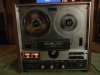
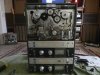
One of the ones here is a Teak A-4070G. From 1972. It's a three motor auto reverse job. Works good ,nice and smooth every time .The $15 belt and lube job was simple.
It acts like it's going to go and go....
The single motor Roberts 770-X from 1964 is a bit testy and to me more complicated with all the mechanicals needed for just one motor. But, it's all tube and has two fine separate amps (6 watts)& preamps.
It sounds mighty good when plugged in to the house speaker banks. And it has straight though to speaker inputs for phono, tune, cd........................
A true tube integrated?
 

Attachments

  • P3240001 (2).JPG
    P3240001 (2).JPG
    68.6 KB · Views: 31
  • P3200003.JPG
    P3200003.JPG
    95.5 KB · Views: 31
Thanks for the advice. I have been looking into TEAC A-2300SR. It seems that the A-2300 series comes highly recommended with this iteration having reverse playback. I'm sure they are hard to come by.
 
Hi everyone,

I'm looking to buy a new Reel to Reel. I have a few criteria for what I'm looking for:
  • Easy or at least cheaper to service/buy parts for,
  • Longevity - something with least amount of belts, rubber to wear down and is mostly direct drive with dedicated motors,
  • Sounds pretty good (doesn't need to be professional sounding as for home use),
  • Auto-reverse/playable without switching over the reels,
  • Looking at around $200 USD
What do you guys think, any recommendations?

Regards,
John

$200 won't buy you such a thing. Not in today's market. The best you can do given this criteria will compromise in one or more ways. Teac A series like the A 2300 SR is as good as you get (and it has a capstan belt) for your budget.
 
$200 won't buy you such a thing. Not in today's market. The best you can do given this criteria will compromise in one or more ways. Teac A series like the A 2300 SR is as good as you get (and it has a capstan belt) for your budget.
I suggest he spend more $ and go for the gold to get one he can actually use from the start.
In general regardless of what brand it is
 
Last edited:
I had a Pioneer RT-701 that I simply loved. It was very easy on the eyes and not bad to service if you have some minor skills. The most common problems they have are counter belt failure and the pads that stop the hubs from spinning when you press stop being worn. Those are fairly easy to replace but hard to find. I never replaced the counter belt. A good demag pen is needed for it to sound at its best.

They can be had for close to what you are willing to invest. I ended up selling mine for about $250 with 30-40 reels of tape.

461174_10151669544847941_1484869930_o.jpg
 
I learned theory, operation, and maintenance, on a beast made up of 16 Ampex 440’s stringed together on a VTR deck. That aside, 2 channel 1/4 decks go for very reasonable prices. I fell into it pretty hard, took me years to really get it: i understand such madness is not for everyone. but Ampex’s are great sounding, made to be serviced machines. A little overkill for home use perhaps.
 
Thanks for the advice. I have been looking into TEAC A-2300SR. It seems that the A-2300 series comes highly recommended with this iteration having reverse playback. I'm sure they are hard to come by.

The thing I don't like about the A-2300SR is the fact that it uses a single four track playback head (same as the one in the A-2340 multitrack deck) for forward and reverse play instead of using a separate 1/4 track head for each direction. Another thing is it doesn't have the mechanism that drops down and stops during the reverse cycle, it's like they just stuck a four track head and a relay into an A2300, wired the motor for reverse and called it a day. I had one and I didn't really care for it (mostly due to all the crosstalk from the four track head).

A better choice for a long term auto reverse tape deck would be a TEAC A-4300SX or a 4010GSL. There are a lot of older versions of the 4010 machines out there but the 4010GSL is the last and best version, and the A-4300SX is the machine that replaced it. These machines were designed to have auto-reverse from the beginning and they do it very well IMO.
 
Hi everyone,

I'm looking to buy a new Reel to Reel. I have a few criteria for what I'm looking for:
  • Easy or at least cheaper to service/buy parts for,
  • Longevity - something with least amount of belts, rubber to wear down and is mostly direct drive with dedicated motors,
  • Sounds pretty good (doesn't need to be professional sounding as for home use),
  • Auto-reverse/playable without switching over the reels,
  • Looking at around $200 USD
What do you guys think, any recommendations?

Regards,
John
You are entering a minefield with R2R. Unless you are willing to spend thousands to get a reconditioned unit.

The decks are complicated and can have all sorts of issues, some of which require some tech skills in tracking down problems and, hopefully, remedying the problem.

First thoughts, your expectations for a working deck for $200 is a challenge. A deck that works and is being sold by someone knowledgeable of its condition will command a higher price. There are plenty of decks out there where the seller claims "good working condition" but without any real knowledge of how this equipment works or how to test its condition.

There are more 7.5 inch reel decks in your price range than 10 inch. The latter will always command a higher price.

What are you intending to do with the deck? For playback on pre-recorded tapes a 7.5 inch unit is what you need with speeds of 3 3/4 and 7.5 inch per second. If you want to record your own material this gets more complicated as to what speeds you need.

The sources for fresh blank tape are very limited and expensive. There is a lot of old Ampex (perhaps others) tape that is to be avoided due to failure of the binding material that will gum up your drive elements.

TEAC may be the better choice in terms of finding someone to work on it and finding replacement parts and fitting your price range.

I don't find auto-reverse a big advantage but that is entirely my own preference. It adds a level of complexity that brings added concerns.

Also, be well aware of the head condition. These components do wear to the point of making the whole deck useless at worst and limited in use in many cases. Go on line and look at pictures of head wear to get familiar with what to look for.

 
Good morning. I have reels but don't know much about them, so. I will say that I can't get anything in my town that works good for that money.
 
In reply to DavidF, I'm looking for a simple good sounding R2R as I have a fair few classical commercial tapes around. It seems that from all the advice thus far it would be best to consider any working machine (that I think sounds good) that has dedicated motors and least belts to go wrong.
 
Personally, I'd take a pass on it. That model is getting on in years, even for me and it looks like it has an internal amplifier to drive speakers directly. I am a bit prejudiced against decks with internal amplifiers as it adds more circuitry to the mix. It can be connected to an amplifier by regular means and I myself would never use the built in amps. But then I'm a bit anal about such things and it would bother me no end to own such a deck and not have the internal amps working properly.

Another thing about Akai's with mechanical, lever actuated transports, is that the cam the lever attaches to which runs the show, is made of a metal (I've seen described as pot metal) which can disintegrate due to time/use - or so I've read. But Akai did make countless thousands of decks over the years featuring such a transport control mechanism. It could be that problem is confined to a very few or, perhaps the metal allow was improved upon in more recent versions.
 
You would be very lucky to get a good deck for $200. The Pioneer 707 and 701 are typically about the best value out there.
 
Hey Lads,
I have found a Akai M10 for $130, the seller says it works alright. What do you think? Buy / Pass.

Pass. 1 motor transport, aging idlers to rebuild, pinch rollers to rebuild, and the weak pot metal cams. Wow/flutter not quite up to what you want. And not suited to be biased for modern tapes if you record. Hold out for a better machine with 3 motors/3 heads, and direct drive (capstan belt OK) Make sure those motors are also AC motors. Teac A series classics still good options and doable for around or slightly over your budget.
 
The one motor Roberts is proving to be a challenge for me with no rhyme or reason. The three motor TEAK was a breeze for this rookie. Yes like Kent said go for one motor.
 
Back
Top Bottom